en English
Untitled English subtitles
Report a problem
Advertisement
English transcript
Voiceover: Let's take a quick look
at the demographic of age.
Sociology often looks at different age cohorts.
A cohort is simply a group of people,
but here we're looking specifically at different
age groups or generations, because these people
all lived through the same certain events
through a certain time that affected their lives similarly.
The generation known as the Baby Boomers
make up a large portion of the population
in the United States and are now getting up into their 60s.
This cohort all shared similar experiences
growing up through the post-World War II period.
These people are all gradually leaving the work force,
opening up jobs for younger people,
but this also means they may become reliant
on their families or society for support,
depending on their financial status.
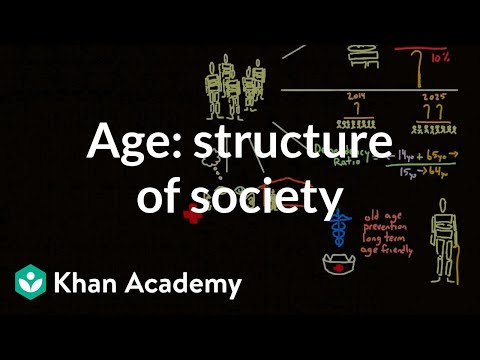
In fact, about 10 percent of the elderly
in the United States currently live below the poverty line.
The generation just older than the Baby Boomers
is the Silent Generation, who were born
during The Great Depression and World War II.
The oldest people alive today were born
during the first quarter of the 20th century
and are known as the GI Generation.
Because of the new advancements in medical technology,
people are living longer and in better health.
It is estimated that by 2025, about a quarter
of the population of North America will be
65 years old or older.
Right now, only about 13 and a 1/2 percent
of the population is over 64 years old.
Look at that, it's going to almost
double in less than two decades.
And remember, these are percentages,
not the actual numbers of people.
The reason we look at the age 65 is because
that is when many people retire
and no longer contribute to the workforce.
You can look a the dependency ratio
to see how many people are dependent
on others for their living.
The dependency ratio is a solely age-based
measurement that takes the number of people
aged 14 and under and the number of people
aged 65 and up, who are typically not in the labor force,
and compares that to the number of people
aged 15 to 64, who typically are part
of the productive labor force.
The higher the ratio, the more dependent
people there are in a population.
But, living longer enables older residents
to contribute to the workforce for many more years,
and perhaps can slow down the inflow
of the elderly into institutions, like nursing homes.
This is a good thing, but the big problem
is that as we get older, our bodies begin to break down.
Chronic illnesses and health problems like
arthritis, dementia, and visual or hearing impairments
affect the quality of life for millions of people.
Because of the slowly deteriorating state
of the human body, older people are five times
more likely to use health services than younger people.
But many times a person's age can affect
what kinds of medical insurance they can get.
And this creates an inequality in heath care,
a discrimination based on age.
But hey, getting old is good, it means
that our global health is improving.
But with the improved health comes a
social responsibility to the older generations.
They worked and volunteered for their society
for many years and as they age there will be
a need for healthcare professionals
who specialize in old-age care and prevention
of age-related diseases, as well as a social side
of providing long-term care and age-friendly
services so people can live fuller lives.
Also important, is the need for society
to readjust its expectations of old age.
Elderly people are just as essential
to a community as the working age people.
With the right encouragement and resources,
they can continue to contribute
to the cultural, social, and economic well-being
of the society, even after they leave the workforce.
As people age, they are affected by their environments,
but their environment is also affected by them.
There are many theories about this aging process
and how it is seen by society.
If you look at the life course theory,
aging is a social, psychological, and biological process
that begins from the time you're born
and continues until you die.
The biological processes change as people live longer,
which has affected the social process.
Age-based expectations no longer apply as they once used to,
when you see an 80 year old
tearing up the ski slopes or getting a master's degree.
You can't tell someone's age simply by a number anymore.
Age stratification theory suggests that you can
look at age as a way of regulating the behavior
of a generation, while activity theory looks
at how the older generations view themselves.
According to this theory, certain activities
and roles, like jobs, are lost due to old age.
Those social interactions need to be replaced
so older adults can maintain morale and well-being.
Disengagement theory suggests that older adults
and society separate, like when someone retires
from work, it assumes that they become more
self-absorbed as they age,
so the separation allows for self-reflection.
But, that considers elderly people who remain
involved in society as not adjusting to old age well,
which is rather debatable.
Continuity theory suggests that people try to maintain
a same basic structure for their lives over time.
As people age, they make decisions that preserve
that basic structure and use it to adapt
to the external changes of society
and the internal changes of aging.
Our older generations continue to age
and adapt and society has had to adapt with them.
More elderly people means the need
for old-age health professionals and long-term care's
on the rise, but it also means
that a great cultural, social, and economic
resource will be available to society
for many years to come.