en-GB English (United Kingdom)
Untitled English (United Kingdom) subtitles
Report a problem
Advertisement
English (United Kingdom) transcript
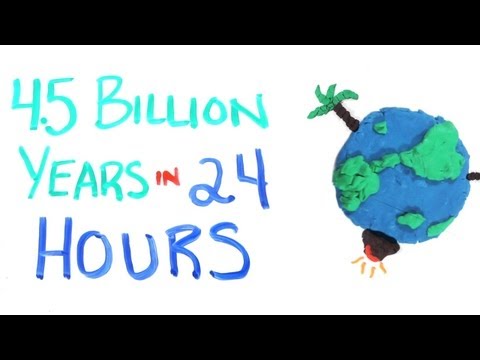
Life: with an estimated 3.8 billion years of existence in evolution on Earth, it's an
odd thing indeed. So, how did we get here? And what would the Earth's 4.5 billion year
timeline look like, compressed into a normal day of 24 hours? The story begins early in
the morning, around 4am, with the rise of the first simple, single-cell organisms. However,
these organisms are destined to spend quite some time alone. At 1pm, a simple cell engulfs
another, creating a symbiotic relationship and the first eukaryotic cells, or cells with
internal organs. At 6:30pm, these cells begin to form colonies, and thus, the first multi-cellular
life develops. But it isn't until 8:30pm that sea plants appear and 20 minutes later, we
suddenly see animal life erupt in an explosion of inventiveness. Jellyfish, the first invertebrates,
trilobytes, incredible diversification begins to take place. And just before 10pm, plants
begin to sppear on land, followed by land mammals. By 10:24, the Earth is covered in
carniforous forests, and the first winged insects appear. Many reptiles dominate the
land with less than an hour left, but a mass extinction event allows dinosaurs to storm
the scene and remain until 11:41pm, when they too suddenly vanish. And so begins the Age
of Mammals. In the last few minutes, apes split from the old world monkeys. And with
only 1 minute and 17 seconds left before midnight, humans emerge. All of the recorded human history
fits within a few seconds, an individual life lasting barely an instant, all a combination
of 3.8 billion years of life. This AsapSCIENCEvideo was made possible by the support of audible.com.
With their help, we're able to continue making fun science videos. And they want to give
you a free audiobook. Audible is the internet's leading provider of audiobooks with more than
100,000 downloadable titles across all different types of literature including fiction, non-fiction
and periodicals. Just go to audible.com/asap to get a free audiobook of your choice. Today's
episode was inspired by the book 'A Short History of Nearly Everything', in which Bill
Bryson explores the neatest bits of science, my personal recommendation. Again, just head
over to audible.com/asap to download it for free, or another audiobook of your choice.
And subscribe for more weekly science videos!