en English
Untitled English subtitles
Report a problem
Advertisement
English transcript
Hi. It's Mr. Andersen and this is AP Physics essentials video 5. It is on objects. And
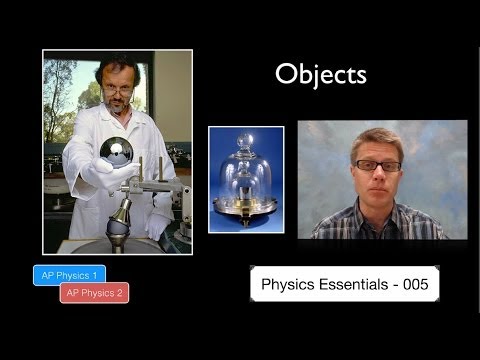
here is an object right here. It is the kilogram. And this really is the kilogram. It is stored
in Paris. The kilogram is the only unit that is based on the mass of an artifact, an actual
object which is somewhat problematic. And so Avogadro Project is working to define this
based on Avogadro's Number. And so they have created the most spherical object that humanity
has ever made. And this is it right here. If you were to blow it up to the size the
earth there would be no more variation than 2.5 meters around the whole thing. And so
this a real spherical object. But they are using that object to define a unit. And so
what is an object? And how is it different from a system? Well if we look at a system
and we look at it microscopically it is important to understand all of the interactions and
the properties of the atoms and molecules that make it up. If we really want to understand
that perfectly spherical object we have to understand what is going on at the atomic
level. But let's say we are just studying the kilogram as a macroscopic unit. It is
okay to treat that whole thing as a single object. And so if we define system and object
again, a system is a collection of objects that are connected together in some way. And
so we would call this whole Atwood machine a system. Where would you point to as far
as objects go? Here would be one object. Here is another object. And here is another object.
But if we were to zoom into one of those weights we would say that this actually could be viewed
as an object if what it is made of is important. But if we were to study it at the microscopic
level it would be important that we understand it is made of atoms. Those atoms are made
up of other particles and particles upon particles. And so depending on our scale we should really
treat things either as an object or a system. It depends on what question we are trying
to answer. So let's say we want to figure out how long it takes for a planet to go around
the sun. We can treat the planets as discrete objects because their make-up does not tell
us a lot about how they are orbiting around the sun, even though they are made up of all
these molecules. We can make these really detailed charts on where they are going to
be at any time if we treat it all as an object. It would make our problem much more complex
if we treated each of those as a system. But let's say I were to give you a smaller question,
could you tell me the difference between salt and sugar? Well you could taste it and tell
the difference. But let's say we wanted to study it in the science lab. Let's say I want
to, and this is a phet simulation, if I add salt to water, check out what is going to
happen to the concentration. You can see as I add more salt the concentration is going
up. Let's add some water. The concentration goes down. Let's evaporate some of the water.
The concentration goes up. Let's dump some of this out and the concentration stays the
same. So that is interesting. Let's put a battery in there and we can see that it lights
up. And so let's see how that would be different than sugar. Now I am adding sugar to the water.
Remove the salt. You can see that there is an increase in concentration. It does not
seem like it is going up as much. We could then pull some of the water away. Concentration
goes up. That seems similar. Add some water, concentration goes down. Dump it out, it stays
the same. Let's test its conductivity. Oh, that is weird. It is not glowing. Okay so
there are clearly difference between sugar and salt. But studying it like this macroscopically
does not allow me to see those differences. And so if I really wanted to understand how
sodium chloride and sucrose are different, I would have to treat it as a system and start
to understand what is going on in those constituent parts. And so did you learn to model the properties
of a system based on its substructure? Again, it depends on the question that we are trying
to answer. And then did you figure out how the properties of a system are determined
by the interaction of all their constituent parts? Again, figure out what is the problem
you are trying to answer and that will tell you how deep you have to go. And I hope that
was helpful.