en English
Untitled English subtitles
Report a problem
Advertisement
English transcript
COAGULASE TEST
Coagulases are enzymes that clot blood plasma by a mechanism that is similar to normal clotting.
The coagulase test identifies whether an organism produces this exoenzyme. The coagulase test
is used to differentiate Staphylococcus aureus from coagulase-negative staphylococci. Staphylococcus
aureus produces two forms of coagulase (i.e., bound coagulase and free coagulase). Bound
coagulase otherwise known as "Clumping factor" can be detected by carrying out a slide coagulase
test and free coagulase can be detected by doing a tube coagulase test. Coagulase can
tightly bound to the surface of the Staphylococcus aureus and coat its surface with fibrin upon
contact with blood. It is also proposed fibrin-coated staphylococci resist phagocytosis thereby
increasing the virulence capabilty of the bacteria.
Procedure: The Slide coagulase test
This method measures bound coagulase. The bound coagulase is also known as clumping
factor. Materials required:
Clean glass slides ( divided into two sections as control and test)
Sterile distilled water Resuspended coagulase rabbit plasma
Culture of the test organism Sterile needles
Procedure: Arrange all the materials in the laminar air
flow Place a small drop of distilled water on each
side of the slide labelled as control and test .
Heat the loop and transfer one or two colonies of the test organism from the nutrient agar
plate to each drop and emulsify to make a smooth suspension.Reheat the loop.
Now transfer one drop of resuspended rabbit plasma to the test suspension and mixed well
with a sterile needle. Do not put anything in the other drop that
serves as control.
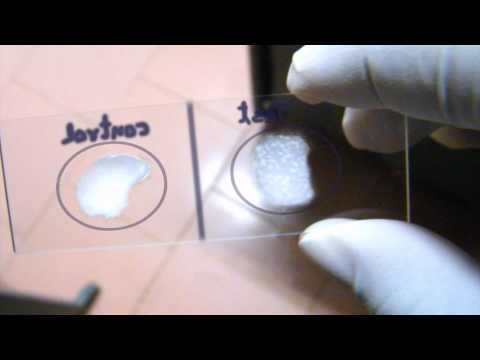
Results: Within 5-10 seconds clumping of cocci was
observed in the area marked test and the control region no visible clumps were observed which
indicates the presence of coagulase positive Staphylococcus aureus.
Some strains of Staphylococcus aureus may not produce bound coagulase, and such strains
must be identified by tube coagulase test
Tube coagulase test Materials required:
Three sterile test tubes labeled as “test”, “negative control” and “positive control”.
Resuspended coagulase rabbit plasma. Test organism.
culture of Staphylococcus aureus which serves as positive control.
Sterile nutrient broth. Procedure:
Each tube is filled with 1 ml of 1 in 10 diluted rabbit plasma.
Add 0.2 ml of overnight broth of the test organism to the tube labeled test.
And add 0.2 ml of overnight broth culture of Staphylococcus aureus to the tube labeled
positive control. Also add 0.2ml of sterile broth to the tube
labeled negative control.
All the tubes are incubated in a water bath maintained at at 37oC and suspensions were
observed at half hourly intervals for a period of four hours.
Results: Clot formation within 4 hours of incubation
was observed in the test culture and is interpreted as a positive result and is indicative of
a virulent Staphylococcus aureus strain.
All pathogenic strains of Staphylococcus aureus are coagulase positive whereas the nonpathogenic
species(Staphylococcus epidermidis) are coagulase negative. While slide coagulase test is useful
in screening, tube coagulase test is useful in confirmation of coagulase test.