en English
Untitled English subtitles
Report a problem
Advertisement
English transcript
Hey everyone. This is Jared, creator of all things Wisecrack, and we’ve got another
special episode for guys. Many people have called GTAV a satire, some have called it
social commentary, and some have called it sarcasm. Which is it?
People tend to get sarcasm, irony, and satire mixed up. Its like squares and rectangles.
You know, that thing “how all squares are rectangles but not all rectangles are squares”...
or is it vice versa? Wow, we need a math channel.
Well, no game with more than thirty minutes of end credits will ever just be one thing.
While there are plenty of arguments to be made about the classification or purpose of
Grand Theft Auto V—our concern is with a reading of the game as a very long and sustained
satire of contemporary American society. Welcome to this special episode on Social Commentary,
satire, and parody in GTA5.
It’s perhaps no coincidence that the opening scene in Grand Theft Auto 5 takes place in
a therapist’s office. The argument can be made that the main characters: Michael, Franklin,
and Trevor, are all incarnations of Freud’s model of the unconscious. If the constantly
whining Michael is the punishing superego and the cool-headed, fast driving Franklin
is the ego… then Trevor’s desire to blow shit up, hump and kill everything make him
the ideal fit for the ID… desire run amok.
Trevor Philips: the depraved psychopathic tweaker residing in sandy shores could easily
foster a discussion on mental health and the war on drugs but the more pertinent and less
mentioned element of Trevor is his relationship to violence, torture and the current state
of gaming.
Trevor has no qualms smashing a biker in the face with a bottle and then stomping on his
head till its mush, has no issues with eliminating an entire banker gang, kidnapping and seducing
someone’s wife… basically he has zero fucks to give.
Trevor is, in a sense, the personification of the average GTA player, the shit talking
crazy person people become in sandbox worlds. Trevor reflects the sociopathic behavior that
most players exhibit when they play a GTA game. In this way, the game forces the viewer
to confront the actual personification of their actions.
While most people might argue that the function of this franchise is catharsis, to act out
in the virtual world and then go back to their peaceful existence, having fulfilled their
impulse… it can be argued that the very deliberate psychotic nature of Trevor suggests
something else—when presented with the choice to indulge in debauchery—to satiate their
most violent urges—people tend to be pretty messed up. Trevor presents us with the more
radical possibility—that deep down inside we are all violent sickos.
The terror (AND macabre pleasure) we derive from Trevor’s actions force us to confront
this. Trevor essentially presents a meta-fictional element to the game. Traditionally defined
as fiction about fiction, we would have to adjust our definition and wording to says
something like Grand Theft Auto presents us with Meta-gaming, games about games.
It’s not only killing, robbing, and prostituting that this sandbox game allows you to do. It
also enables you to do inane things like yoga (which is the most boring, pointless mini-game
ever), tennis, bike riding, golf, darts, hunting, skydiving etc. But it would be a mistake to
consider the ability to have these choices as arbitrary. If doing yoga mini games is
boring, then why is massacring troves of people fun?
The game has received so much flack for supposedly “empowering” the gamer to random acts
of violence. But in GTAV, the player is presented with viable, peaceful alternatives. Playing
the yoga mini-game is just as viable as random drive-byes, yet people usually chose to bask
in destruction and chaos. In that way, the game developers make a statement about how
we project our OWN psyche and desire on to the game, and not the developers empowering
us.
Nowhere is this clearer than the most controversial scene in GTA V—where Trevor tortures an
informant for the FIB.
Not only does he Torture someone without batting an eye—he seems to take sick pleasure in
the pain he inflects.
At one point Ferdinand Kerimov, the tortured Azerbaijani, screams “sadist” at the top
of his lungs but the real question is: who is the real sadist? Trevor? Or the gamer who
enjoys acting out their psychopathic urges on fictional characters?
Far from being a passive acceptance of torture—this scene serves to over-identify with the sadistic
desire to inflict harm on the Oriental Other, or the threatening terrorist. Over identification
is a loaded term that is best described a sort of radical re-production of what is deemed
taboo—it is a tactic of performance that undermines power through mimicry.
By forcing the player to violently play out the very tactics of “advanced interrogation
techniques”, it creates the possibility of provoking a strong reaction from the gamer—whether
it be disgust, thereby subverting the ideology of the war on terror, or even sadistic enjoyment.
This is a form of satire. According to the Bedford Glossary of Critical and Literary
Terms, Satire’s “goal is not to abuse so much as to provoke a response, ideally
some kind of reform.”
It is easy to lampoon a character that wakes up in his underwear under a bridge covered
in puke and blood and has no problem murdering an entire gang to take over their turf—but
the more difficult thing to see is how Trevor’s explosion of the fourth wall creates a reflection
for the gamer—that forces a confrontation with the gamer’s true psychic self and their
actual feelings about gruesome violence.
Continuing on to part the second in which we interrogate Michael De Santos, the California
life style, Parody, and the media.
Like Mel Brooks movies—the world of Los Santos is a somewhat askew representation
of reality. In many ways Grand Theft Auto is a parody, or “a form of high burlesque…
that imitates a specific literary work or style of an author for comic effect, usually
to ridicule or criticize that work, author, or style… parody is often used to make a
satiric (and even a political) point.”
Android phones are badger phones, apple is replaced by Ifruit, Fox news is weasel news
(complete with a fictional news ticker), American Idol is Fame or Shame, the Mark Zukerberg,
Bill Gates, and Steve Jobs of the world are personified as the amalgam Jay Norris, google
maps is eyefind, and Facebook is lifeinvader.
Michael De Santos, a retired bank robber in witness protection provides a conduit to discuss
the clichéd California lifestyle—concerned with the economy, capitalism, personal fitness,
the paparazzi, celebrity, and all forms of media.
Michael is the only character that routinely watches TV and is enamored with old movies—a
parody of the stereotypical Los Ageleano.
Like Mel Brooks movies—the world of Los Santos is a somewhat askew representation
of reality. In many ways Grand Theft Auto is a parody, or “a form of high burlesque…
that imitates a specific literary work or style of an author for comic effect, usually
to ridicule or criticize that work, author, or style… parody is often used to make a
satiric (and even a political) point.”
Android phones are badger phones, apple is replaced by Ifruit, Fox news is weasel news
(complete with a fictional news ticker), American Idol is Fame or Shame, the Mark Zukerberg,
Bill Gates, and Steve Jobs of the world are personified as the amalgam Jay Norris, google
maps is eyefind, and Facebook is lifeinvader.
Michael’s wife is “enamored” with her tennis coach AND her yoga instructor, Michael
one straps his backpack, listens to horrible music, his son has identity issues, his psychologist
is utterly inept, cynical, and greedy (wait how is that different that most psychologists?),
and his daughter messes around with porno dudes. Michael, like most snowbirds that navigate
to California on permanent vacation, has Hollywood problems. Even his criticism is decidedly
Californian.
Michael rails against capitalism but doesn’t risk anything—he’s still chasing the San
Andrean dream. Much like a vegan driving a Prius—Michael is smug in his criticism of
capitalism—but he still owns a yacht, a fancy house, tricked out cars, several giant
televisions, a tennis court, pool, and a decent collection of snazzy cargo shorts with sandals
ensembles. Michael doesn’t really challenge the underlying logic of consumption—he just
sort of complains… like most people in Hollywood.
The setting of the game world itself is a tongue and cheek play on real California locations.
Vespucci beach is Venice beach, Vinewood is Hollywood, Del Perro Pier is the Santa Monica
Pier, the famous Watts towers are renamed the Jefferson towers, Compton is reimagined
as Davis, long beach is cypress flats, the pacific palisades are renamed the pacific
bluffs, Bel Air becomes Richman, or rich man and the Salton sea is renamed the Alamo sea—where
the surrounding desert in GTA is the sandy shores—in reality the area is the hipster
sands of the Coachella valley.
Grand theft Auto 5 goes to ridiculous lengths to insure verisimilitude—the amount of hours
and labor spent to create such an enormous, living breathing environment is outstanding.
The attempt to create a world that seems real to the player is commendable, but perhaps
at times it is a little too real.
To the point that Linday Lohan has sued Rockstar over the use of her likeness for the creation
of the character Lacey Jonas a former child star who has exiled her parents and is constantly
mobbed by the paparazzi.
GTA V presents an all out criticism of our media driven world—all forms Radio, TV,
and film and social media are fair game. Some of the most stinging criticisms come when
you’re driving from place to place listening to talk radio.
The gaming and tech industries aren’t exempt either. Jimmy plays a strange game where you
slaughter pigs, Michael infiltrates the lifeinvader campus to find coders unable to close copious
NSFW pop ups and run simple antivirus software, and Lester is constantly shouting while he
undoubtedly teabags the people he “domes” in his first person shooter. Lester even goes
so far as to complain that all FPS games are the same—interesting how the reboot of GTA4
allows for first person point of view—that’s irony.
If Trevor serves as a way to criticize the ever encroaching onslaught of drugs and violence
in media—Michael is perhaps the most cynical character—Michael’s storyline digs at
the ennui inherent in the shallow upper class California lifestyle—of a lifestyle built
around appearances—a world of plastic surgery, self help, leisure, and misery.
Our third section, in which we discuss Franklin, the commodification and appropriation of black
culture and white-collar crime.
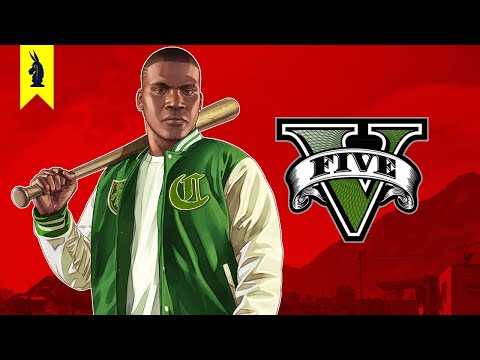
Franklin Clinton, an ambitious youth from South Los Santos serves as a sort of catalyst
for the game. Franklin’s repossession of Jimmy’s vehicle is the precipitating event
that brings Michael out of retirement.
But it is Franklin’s role in the market that serves as the critical starting point
for our discussion. When Lester asks Franklin to make ummm err… moves to insure the manipulation
of the stock market an interesting contrast is made.
No matter how many people disappear, no matter how suspicious the deaths may be, no matter
how much money is made betting on the stock market, no one is ever sent to jail. You literally
cannot get caught for insider trading in GTAV.
Which is funny given Franklin’s hatred of pyramid schemes.
If GTA is a satire of our contemporary condition is it any wonder that the people that make
millions and billions of dollars dubiously rarely ever see the inside of a jail cell?
While economic corruption may be something that goes unpunished, it doesn't mean the
police aren’t out in force. The lack of effort to capture white-collar criminals is
contrasted with the real violence that people deal with in the inner city, whether it be
criminal in nature or violence from the police—the LSPD’s motto is literally “Obey and Survive.”
The LSPD are a caricature of the LAPD whose history of race relations is well… stellar.
See what I did there? That’s sarcasm.
Complicated relations with race are explored with Franklin—each character that isn’t
a person of color adapts their own version of street vernacular when they interact with
Franklin.
Trevor, Jimmy, and Devin all change the way they speak when they interact with Franklin.
Jimmy serves as a sort of foil to Franklin—as a sort of way to prove his authentic blackness—Jimmy
merely wears blackness like a mask—while he isn’t in black face—its pretty close.
The game does it’s best to assure us that Franklin is authentic. Unlike Michael—whenever
he smokes weed from the Marijuana Lobbyist he doesn’t see aliens like Michael does—he
merely shrugs it off——we are led to believe that Franklin is authentic because the lobbyist
has weak shit compared to the chronic that Franklin smokes on the reg.
Appropriation of Black culture is an important discussion. In the end Jimmy can act black
whenever he wants but he doesn’t have to deal with any of the daily realities of being
a person of color in America—not unlike the player who gets to pick up the controller
and play an original gangsta whenever they flip over to Franklin.
This is much deeper than it seems. The player is allowed distance from the racial politics
of GTA. They believe themselves to be part of the solution and not the problem—they
aren’t acting like jizzle. They aren’t overtly racists—they aren’t a white kids
with dreadlocks.
What GTA V confronts is the desire for a guilt free solution to racism by asking the player
to laugh at white people awkwardly attempting to pass as black—while they literally control
a stereotypical shadow of a black male.
Which is pretty ironic given the number of white kids in the suburbs feeling smug because
they know they aren’t jizzle— at least, they think they aren’t. They may not have
the poser swag and stupid name, but they do get to participate in drive byes, get in gang
wars, and smoke weed—all the while believing Franklin to be an accurate depiction of an
authentic black male. Just as Jizzle lives vicariously through Franklin and the vitality
of “black culture,” GTAV self reflexively makes the audience experience the very same
gratification, it makes a more interesting statement on racial politics than just shaming
old people and pointing fingers.
To say that GTA V can just be reduced to a game about stealing cars and blowing ups stuff
is perhaps a mistake… I mean, it is about so much more—like strip clubs, drug deals,
and turf wars.
Sure it’s possible to focus on the sensational aspects of the game but to believe the game
as an unfolding series of events that un-problematically glorifies sex, violence, and drug use is to
choose be on the outside of a long string of inside jokes.
To paraphrase a popular song about missing the point—you would be the type of person
who “likes to sing along and shoot their gun, but you wouldn’t know what it means.
Michael, Trevor, and Franklin all serve to destabilize the players ability to believe
in the validity and seriousness of the world that they play in.
Grand Theft Auto is less an opportunity to indulge in debauchery and is more like a mirror
that shows America its true nature… Perhaps the writers aren’t vindictive sadists that
profit off suffering, but rather, are craftsmen that use the supposed glorification of sex,
violence, and torture to create a masterful criticism of American culture.