en English
Untitled English subtitles
Report a problem
Advertisement
English transcript
Hi, I'm Rick Steves — in what just might be the most surprising and fascinating land
I've ever visited.
We're in Iran — here to learn, to understand, and to make some friends. Thanks for joining us.
Like most Americans, I know almost nothing about Iran. For me, this is a journey of discovery.
What are my hopes? To enjoy a rich and fascinating culture,
to get to know a nation that's a leader in its corner of the world —
and has been for 2500 years, and to better understand the
70 million people who call this place home.
We'll show the splendid monuments of Iran's rich and glorious past,
discuss the 20th century story of this perplexing nation, and experience Iranian life today
in its giant metropolis,
historic capital, and a countryside village...
["Salaam"]
Most important, we'll meet and talk with the people whose government
so exasperates America.
["situation is open.."]
We'll go to Friday prayers in a leading mosque,
consider the challenges confronting Iran's youth,
enjoy the hospitality of a family dinner
and survive the crazy Tehran traffic
before experiencing the tranquility of rural life and
meeting joyful school kids on a field trip.
Iran, twice the size of France, sits in an increasingly important corner of Asia-surrounded
by
Turkey, Iraq, Pakistan and Afghanistan.
We start in the capital, Tehran, follow an ancient trade route
south to the village of Abyaneh, to Esfahan, to Shiraz,
and then finish at Persepolis.
Every country, including our own, limits access to foreign film crews.
We're here in Iran with the permission of the Iranian government.
And we're working within the limits it sets
as we explore this complex society.
Knowing we're here to explore social and cultural dimensions
rather than contentious political issues, the Iranian government is allowing our work.
It believes the Western media has given Iran an unfair image.
They gave us our visas provided we respect its limits as enforced by our guide.
His job: keep us safe, manage the complicated permissions,
and keep an eye on what we're shooting.
Tehran, a youthful, noisy capital city, is the modern heart of this country.
It's a smoggy, mile high metropolis.
With a teeming population of about ten million, its apartment blocks stretch far into the
surrounding mountains.
Traffic is notorious here. My first impression: wild drivers.
But after surviving my first day: I realized they were experts at keeping things moving.
Many major streets actually intersect without the help of traffic lights.
It's different...but it seems to work.
Two wheels are faster than four. Helmet laws are generally ignored.
As a matter of fact...sometimes the direction of traffic is ignored as well.
To cross town quickly, motorcycle taxis are a blessing. But wear that helmet.
I'd rather leave a little paint on passing buses than a piece of scalp.
Pedestrians fend for themselves.
Negotiating traffic as you cross the street is a life skill here.
Locals say it's like "going to Chechnya."
Immersed in the commotion of a busy work day —
apart from the chador-covered women and lack of Western fast food chains —
Tehran seemed much like any city in the developing world.
If you need to get somewhere in a hurry — or if your motorcycle taxi is under some big
bus —
thank goodness for the subway.
Tehran's thriving subway moves over a million people a day.
This subway system is really as good as anything I've seen in Europe.
Of Iran's 70 million people, well over half are under the age of 30.
While there are plenty of minorities, the Persian population dominates.
The local ethnicity reflects the turmoil of this country's long history.
You'll find people with Greek, Arab, Turk, Mongol, Kurdish and Azerbaijani heritage.
Iranians are not Arabs and they don't speak Arabic.
This is an important issue with the people of Iran.
They are Persians and they speak Farsi.
Faces seem to tell a story and are quick to smile...especially when they see a film crew
from the USA.
Actually, we found that the easiest way to get a smile was to tell people where we're
from.
Rick: I'm from the United States... Man 1: Oh, you're from the United States...Ok.
Man 2: America? Wow! Rick: Yeah, it's true, it's actually true.
Woman: I love you, America. Rick: Thank you, that's nice to hear.
I was impressed by how the people we met were curious and eager to talk.
Young educated people are internet savvy and well-informed about the West.
They generally spoke some English. Anywhere foreigners went, signs were bi-lingual: Farsi
for locals...and English for everyone else.
The script looks Arabic to me, but I learned — like the language — it's Farsi.
The numbers, however, are the same as those used in the Arab world.
Another communication challenge: people here have to deal with different calendars: Persian
and Muslim (for local affairs),
Western (for dealing with the outside world).
What year is it? Well it depends:
After Mohammad — about 1390 years ago,
after Christ — two thousand and some years ago.
And all this complexity is the result of a long and tumultuous history.
The National Museum of Iran helps to give an appreciation of this country's rich heritage.
At first I was disappointed by what seemed like a humble collection for such a great
culture.
Then I learned that most of its treasures were destroyed or looted by invaders and much
of what survived was taken away to the great museums in the West.
The collection starts in prehistoric times, back when nomadic hunters were becoming farmers.
This bronze plaque featuring Gilgamesh dates from about 1000 BC, a time when this region
was in the realm of Mesopotamia.
Then in about 500 BC, with the great kings Darius and Xerxes, the mighty Persian Empire
was established.
Their art glorified their kings and the notion of peace through strength.
Culture flourished and it was about this time that, with cuneiform, the Persian language
was first put into writing.
That first Persian Empire was conquered by Alexander the Great from Greece.
Later, a second Persian Empire was conquered by Arabs. Then came invasions by Turks and
Mongols.
Finally, with the establishment of a Third Persian Empire in the 16th century, this culture
enjoyed a renaissance. While it's weathered wave after wave of conquerors, the essence
of today's Iranian culture is still rooted in that first Persian Empire from 2,500 years
ago.
Newsreel: Persia; At the turn of the century, a poor agricultural country, rich only in
legend and undeveloped natural resources...
In the 20th century, with the discovery of its vast oil reserves, Iran became entwined
with the West.
Newsreel: ...oil was struck at last and drilling commenced...
During WWII, Iran was a vital oil resource for the Allies. After the war Iran's young
shah, or king, Mohammed Reza Shah Palavi became more closely involved with the West. Oil flowed
easy and he was a friend of western oil companies. Then things changed...
Oil, again poses a threat to peace and the Middle East again becomes a trouble spot as
Iran's vast petroleum reserves aroused nationalists...
In 1951 the popular Prime Minister Mossadegh nationalized Iran's foreign-owned oil industry.
With the resulting turmoil, the shah was forced into exile. This is when the troubled relationship
between Iran and the United States began.
Every Iranian school kid knows the date: 1953. That's when the CIA engineered a coup that
over threw the democratically elected prime minister Mossadegh. He had angered the West
by nationalizing Iranian oil. So they installed the pro-Western shah instead.
Newsreel: Former premier Mossadegh's ruined house is a mute testimony to three days of
bloody rioting culminating in a military coup from which the one time dictator of Iran fled
for his life. The Shah who had fled to Rome comes home backed by General Zahedi military
strong-man who engineered his return to power. Iranian oil may again flow westward.
Back on the throne, the shah allowed Western oil companies to run Iran's oil industry again.
With the profits, he modernized the country. Through the 60s there was a return to stability
and the shah was a key American ally in the Middle East.
The shah ruled in royal opulence from grand palaces. He enjoyed summers in this one until
the late 1970's. Strolling through its fine rooms visitors are reminded how the shah lived
in extreme luxury. But his materialistic decadence and pro-Western policies offended Iran's conservatives
and alienated religious and political groups. Angry people hit the streets.
The unrest led to crackdowns by the shah's forces that tortured and killed thousands.
All of this emboldened a revolutionary movement and burned into the national psyche a fear
of American meddling in internal Iranian affairs.
After 25 years of the Shah's rule, the Islamic Revolution threw him out and brought Ayatollah
Khomeini back from exile. That Revolution and the Ayatollah established the Islamic
Republic which rules to this day.
Walking the streets here, I felt a disturbing presence of government. This is not a democracy.
In 1979 the new government brought Iran not freedom, but what they call a "Revolution
of Values" - it legislated morality such as no alcohol, and no casual sex. As far as many
parents are concerned here, it's family values.
Iran is ruled by a theocracy. They may have a president, but the top religious official,
a man called "the supreme leader" has the ultimate authority. His picture-not the president's--is
everywhere....
Religious offering boxes are on every street corner.... The days when the shah's men boasted
that mini-skirts in Tehran were shorter than those in Paris are clearly long gone. Women
must dress modestly and are segregated in places like classrooms and buses.....
And yet here in the Islamic Republic of Iran, to me, the atmosphere felt surprisingly secular
compared to other Muslim countries.
Skylines are not punctuated with minarets; I barely heard a call to prayer. Except for
women's dress codes and the lack of American products and advertising, life on the streets
here seemed much the same as in secular cities elsewhere in the developing world.
While relatively uncluttered with commercial advertising, there are plenty of billboards
and murals and they pack a powerful propaganda message.... Some religious murals are uplifting-this
one is a Shiite scripture claiming; the most caring help is to give good advice.
Yet others are troubling and hateful-this one condemns what's considered American Imperialism
with skulls and dropping bombs rather than stars and stripes. And this one glorifies
Hezbollah fighters and their struggle with Israel which many here consider Americas'
51st state. This mural honors a martyr-one of hundreds of thousands who died fighting
Saddam Hussein back in the 1980s.
These murals mix religion, patriotism, and a heritage of dealing with foreign intervention.
While I find some of them offensive, I see in these murals the fear and the spine of
a people whose values are threatened.
The greatest concentration of anti-American murals surrounds the former US Embassy. In
1979, Iranian university students successfully stormed the embassy, they took 52 hostages,
and held them with the world looking on for 444 days.
Some Iranians claim the hostage crisis was a way to radicalize the Islamic revolution
and put the hard-liners in power. Others say it was a pre-emptive strike to stop the USA
from orchestrating a military coup designed to overthrow their theocracy and put the shah
back in power. They also wanted to force the extradition of the shah who was in exile in
the United States.
Today it feels like the hostage crisis is old news and younger Iranians have moved on.
The murals seemed to drone on like an unwanted call to battle-a call which people I encountered
it seems had simply stopped hearing.
Tehran is a vibrant metropolis--Iran's social, artistic and educational center. Its university
is the oldest, biggest and most prestigious in the land. It's quite selective-only about
one in ten applicants get in. Here, as in other Iranian universities, students enjoy
a higher education paid for by the government.
But wandering through campus, we learned that free tuition comes with strict guidelines
as dictated by the theocracy. While I hoped to find some non-conformity, the vibe here
made BYU seem like Berkeley. Compliance raged.
Women are perfectly welcome. In fact women outnumber Iranian men in both universities
and in many respected professions. But segregation is the rule. In classrooms, it's men on one
side and women on the other. There was no real student union center, just a small commons
in each department...with a snack bar for men and an adjacent one for women.
Despite the conservative atmosphere, we found students friendly, curious, and willing to
chat.
Rick: What do you study? Woman: Chemistry.
Rick: Chemistry? Very difficult. For me, very difficult.
Woman: Yes. Rick: What do you study?
Woman 2: Chemistry. Rick: All of you are chemistry!
Rick: So we are learning very much when we come to Iran.
Woman 3: For example? Rick: For example, the people are not angry
with America. Woman: Yes, government has a lot of war with
each other because they benefit but there's no war between people.
Rick: That's a very interesting point. So the governments have a difficult time but
the people, if we meet the people, it's like this...(links fingers).
Woman: Yes, they are like friends to each other. They should be friends.
Rick: I like that. So for Americans we are a very religious people but we make the government
and the church apart you know? Woman: It's not common to each other. But
in Iran unfortunately the religious and the politics is mixed with each other.
Rick: Yeah. Woman: And that's the main problem.
Rick: You think that's- Woman: It's the main problem and it's the
main point of that distance between people and government.
Rick: So you are a modern young woman? Woman: Yes of course.
Rick: Well educated? Woman: Yes, I like to be.
Rick: And you must cover your hair. Woman: Yes, it's a law in Iran.
Rick: It's a law. Woman: It's a law.
Rick: Now I cannot shake your hand? Woman: No because here it's a religious society.
Rick: So I can go like...Salaam? Woman: Xodâhâfez.
Rick: Ok. And I can shake his hand? Woman: Yes, Yes
Rick: I'll shake your hand for her...OK? Thank you.
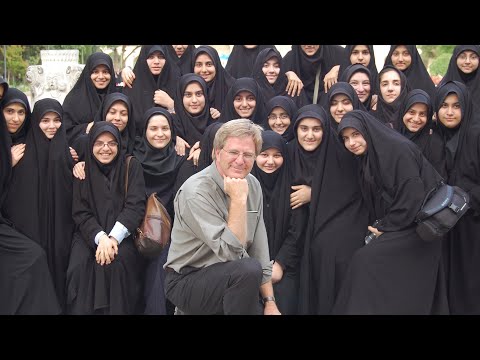
Man: Do you like to take a picture? Do you like to take a picture together?
Rick: I would like to take a picture (that's a good looking hat). I have a game I like
to play with all my new friends. I will go like this...can I take a picture with you
and me? Woman: Yes, of course.
Rick: And all of you guys together. So you can go here. OK, alright. Are we ready? So
we'll look into the camera and we'll say "salaam" and we'll say "people to people".
Iranian women live under strict Muslim laws in public. To a Western viewpoint, the dress
code imposed on women seems disrespectful. But according to an Islamic perspective, modesty
is considered respectful. In Iran, women's bodies are not vehicles for advertising. You
don't see sexy magazines. There is almost no public display of affection.
While women can dress as they like at home, in public they wear the chador and are expected
not to show their hair or showoff the shape of their body. I found their awareness of
our camera fascinating-women seemed to sense when it was near and would adjust their scarves
to make sure their hair was properly covered. Local surveys indicate that about 70% of these
women would dress more freely in public if allowed.
While modesty is enforced, vanity is not out of bounds. In fact cosmetic surgery-especially
nose jobs--is big business here among the middle class. Even though covered up, women
expertly utilize their feminine charms. Faces are beautifully made up and when so much else
is covered, particularly expressive and mysterious.
In Tehran, I found simply wandering the shopping streets endlessly entertaining. Dropping into
this book store and surveying its selection, the Persian passion for poetry became clear....
Rick: Yes, so this one opens like so.
And in Farsi, the book starts where our books end.
Rick: Is this the beginning of the book here?
Streets were lined with cheap, colorful snack bars and inviting ice cream shops. Each little
visit left me with indelible and often tasty memories.
This isn't just any ice cream sandwich-saffron, rosewater and pistachios...a Persian specialty.
But if you really want to shop with style, leave the gritty, intense central area and
head to the hilly district of North Tehran. Browsing in its malls and classy shops, you
could be in London or Paris.
Shoppers who have the money can find nearly anything they like. This high-end confectionary
shop gives a glimpse of the taste and lifestyles of North Tehran citizens.
Cafes in lush gardens like this are the playground of Iran's wealthy...where they "let their
hair down"...just a little. The young, privileged, and cosmopolitan manage to be quite fashionable.
This scene may be chic, but I heard that the real partying goes on in the privacy of people's
homes. Many of these people could afford to live abroad, but prefer to live as economic
elites here in the ritziest corner of Tehran.
On our way out of town we visit a symbol of this vibrant city, its Freedom Monument. Dating
from the 1970s, it's one of the former Shah of Iran's many extravaganzas. He built it
to celebrate the 2500th anniversary of the Persian Empire and all the mighty Persian
kings who came before him. Underlining the ancient roots of this society, its design
symbolizes a Zoroastrian fire altar and it's decorated with classic Persian motifs.
Leaving Tehran was quick and easy with its impressive system of highways. Just outside
of town, we drop by the great mosque containing the tomb of Ayatollah Khomeini. He was the
spiritual leader of the rebellion that overthrew the Shah in 1979 and Khomeini ruled the country
for the next decade.
Even though the mosque can accommodate up to a million worshippers on special days,
it's undergoing a major expansion. The work is funded by small donations mostly from the
poor as they were the people Khomeini inspired the most. This felt like a particularly easy-going
mosque-in keeping with Khomeini's image among his people. Rather than the impression I've
long held...of a menacing ideologue, here he's considered a sage--and a champion of
traditional values.
After the shah's excesses and corruption, Khomeini's simplicity and holiness had a strong
appeal to the Iranian masses. He did use oppressive tactics. But to the poor and the less educated
the charismatic Khomeini was like a messiah. As the personification of the Islamic Revolution,
he symbolized deliverance from the economic oppression and Western decadence of the Shah.
Khomeini gave millions of Iranians hope.
Continuing south on the main highway, the arid vastness of this Alaska-sized country
is clear. Venturing up a river valley, where water brings life to the landscape, we find
a timeless moment: a shepherd watching over his flock. The scene could be from five thousand
years ago when this corner of Iran was part of the Fertile Crescent. A place and time
when farming and the domestication of animals helped give rise to the first great civilizations.
You get the feeling this could be back in ancient Mesopotamia. Then we came across the
village of Abyaneh nestled in its valley. The remains of a ruined castle are a reminder
of its former importance.
Now a sleepy backwater Abyaneh is a picturesque example of Iranian village life. The reflective
roofs help residents weather blistering summers. I'm glad we're here in May.
As in small towns almost everywhere, the younger generation is pulled to the big city in search
of employment and a more exciting life. Those who remain are old and seem to have an abundance
of time on their hands.
The few tourists-mostly Iranian--wander through admiring the simple architecture and fine
old wooden balconies. For me, the village highlight was meet
…