en English
Untitled English subtitles
Report a problem
Advertisement
English transcript
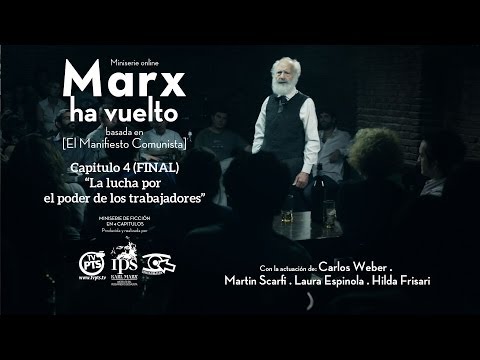
Marx is Back [based on the Communist Manifesto]
Chapter 4 (Final) -- The Struggle for Workers´Power
Produced by IPS - Instituto de Pensamiento Socialista Karl Marx -
Produced by TvPTS - www.tvpts.tv -
Produced by Contraimagen Group
I'm really happy you brought the book !
- Did you see on TV yesterday the news about Spain ? - No.
It was crazy, there were suspensions, and they are struggling.
They have the same demands we had last year.
Sure.
Workers of the world, unite !
When we struggledlast year, I was reading the Manifesto.
I remember that what affected me most is when it says that we, workers, have no country.
The proletariat's united action is one of the essential conditions of its emancipation.
With the abolition of the exploitation of one individual by another,
the exploitation of a nation by another is abolished too.
If class antagonism disappears inside Nations,
then hostility between Nations themselves disappears.
Well, have you been thinking about what we talked about on the phone ?
Yes, I have. But I'm not convinced yet.
You can't lose there, it's a sure deal.
Trust me. I never disappointed you.
I'm ok on that part.
Yes Martin,
are you coming sunday for lunch ?
No don't bring anything, its all good.
No, the boss is here with a guest.
The situation is somehow unstable.
For us, the crises are opportunities.
We keep winning money.
We keep winning money. The worst it is, the more we win.
And what I'm offering, I tell you ... it's a sure deal, with garanteed profit.
- You're staying for lunch ? - Alright.
Hilda, he's staying for lunch.
Have a drink.
Good, I hope it's not like the one from last time, is it ?
No, this one is very good.
- Sure ? - Yes. Have a sip.
Perfect. Cheers.
- It's a deal then ? - Yes.
That's how I like it !
The bourgeoisie is horrified at our program of abolishing private property.
But in today's society, proprety is abolished for 9/10th of the people.
It keeps existing precisely because it doesn't exist for the 9/10th.
You condemn us for wanting to abolish a form of property
which can exist only if the immense majority of society is deprived of property.
In a word, you accuse us of wanting to abolish your property.
Well yes, that's what we want !
3.000 or 3.500
- Hi - How are you ?
- Good. - Where are you going dressed like that ?
- To the play you recommended. - Excellent !
Yes, Laura and Carla are coming.
- Laura left the kid with his dad. - Ah, it's nice she could do that.
- Is it good ? You've seen it, right ? - Yes, it's very good.
- I should go, so I don't get there late. - Ok, see you around !
A beer, please.
What ? You've never met Marx ?
It's that you're like the Marx I dreamt of.
I'm Marx.
I'm back from the dead.
Did you notice they're talking about Marx's ideas again ?
Well, I came back because they're misrepresenting us.
No, I'm an actor who's role is Marx.
The play's about to start. Stay around.
- Alright, cheers. - Cheers.
Do you know about this magnificent episode in human history, the Paris Commune ?
It happened during 1870 and 1871, while France was governed by Napoleon III,
nephew of the Emperor Napoleon Bonaparte.
A man who had decided to associate his name with glory,
and who found no better idea than attacking the Prussian military.
He wanted to attack General Bismarck, and was naturally defeated on the spot.
And the French troops fled, leaving their weapons for the people to collect.
So the people, waving red scarves and banners throughout Paris,
gathered around the Vendôme column, the symbol of Imperial power.
There stood a bronze statue of Emperor Napoleon,
the people demolished it and climbed over the ruins, singing and dancing in joy.
They raised on the spot a gigantic red flag,
it was the red flag of the proletariat's social revolution.
It was the Paris Commune.
The Paris Commune lasted only a few months,
but it's deeds were spectacular.
It replaced the regular Army by people's militias.
It separated the Church from the State,
it gave public education a purely secular character.
It enacted the well-know decree through which all factories
and workshops, abandoned by their owners, should be handed over to workers cooperatives.
It ordered that the revenue of all civil servants would in no way exceed a common worker's pay.
It ended the nonsense of the State's hierarchy,
it layed-off the elite's bureaucrats and replaced them by revocable civil servants,
earning a qualified worker's wage.
Its parliament was comprised mainly of revolutionnary students, workers, artists and intellectuals.
The children multiplying in the street of Paris were organizing their defense,
because the old order permanently threatened to invade.
Paris was living in the street, because the people had reach the conviction that
they could build their own power, govern in everyone's favor.
So, facing the threat that the Paris Commune phenomena would spread to all Europe,
on May 21st of 1871, an army of 180.000 men,
under the command of generals that had been defeated by the Germans
but that felt courageous facing their fellow citizens,
entered the city to execute a massacre that Paris had never seen.
The defense organized with barricades.
They were defended by men, women and even children.
But the fight was completely uneven,
facing the blows of the regular army's artillery.
The Communards fought up to their last breath.
The battle lasted a week. May 28th of 1871,
the last barricade crumbled, defended by a sole fighter,
standing by the bodies of his dead companions.
The example of the Paris Commune was unacceptable;
it was terribly inspiring for the rest of the world.
They drowned it in blood.
They drove all the leaders of the Paris Commune to the Père Lachaise Cemetary.
They stood them against the wall.
They shot them.
They murdered 30.000 men, women and children.
many of them the best workers in all crafts.
But the Paris Commune left behind many lessons.
Splendid lessons.
The working class cannot limit itself in seizing
the existing State apparatus for its own goals.
Instead, it needs to establish its own State,
its own government.
There was a lot of the socialism I dreamed of in this revolution,
in the Paris Commune.
The political power, to say it properly,
is the organized power of a class for the oppression of another.
The proletariat, in its struggle against the bourgeoisie,
constitutes itself inevitably in a class, through revolution it turns itself in the ruling class,
and as such it destroys the old regime of production.
Suppressing these relations of production,
it suppresses the conditions of classes antagonism, and classes in general.
And therefore its own domination as a class.
Replacing the old bourgeois society,
its classes and class antagonisms, arises an association
in which the free development of each
is the condition for the free development of all.
Marx Is Back
This was the last chapter of the serie. If you haven't seen the others, check them out !