en English
Untitled English subtitles
Report a problem
Advertisement
English transcript
Hi. It’s Mr. Andersen and this AP Physics essentials video 73. It is on resistors and
capacitors. A resistor is drawn like this in a circuit diagram and what it does is it
restricts the flow of current in the circuit. A capacitor is drawn like this and what it
does is it stores charge in a circuit. An then it is not going to be a circuit unless
we have some kind of an energy source. So we have an emf or in this case it is going
to be a DC power source. So if we connect them like this you should know not only what
are the resistor and capacitor doing, but what makes a good resistor. What makes a good
capacitor. And so to understand that you really have to understand at the gut level how a
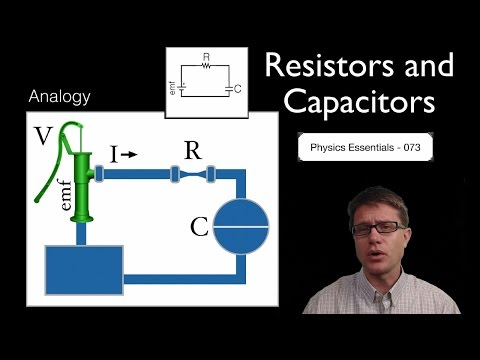
circuit works. And an analogy works best for this. And so we are going to use an analogy
of water flow to explain how a circuit works. So the first thing you need is an energy source.
Or an electromotive source. In this case I will represent that with a water pump. So
as you are pumping that water, the water, we will, say is going to flow in this direction.
It is going to go all the way around the circuit. Let’s say it is in pipe. And then it is
going to be drawn up into the pump again. And so what is the first thing we could measure?
Well we could measure the potential difference. I could put my hand here. And I could put
my hand here. And I would measure the potential difference between the two. There is going
to be way more potential energy up here. And so if it is an electric circuit we call that
the voltage or the potential difference across that emf. What is the other thing you could
measure? We could measure how much water is actually flowing. And in electricity we call
that I or current. So it is how much, we know it is electrons that are moving through the
circuit itself. So what is a resistor? A resistor is anything that we add to that circuit that’s
going to resist flow of current. We could restrict that in a water pipe by simply making
the pipe smaller. It is harder for that current to flow. We are going to have a higher resistance.
Now what is a capacitor look like using this analogy? It is almost like a dam that obstructs
the flow of that current. But imagine a dam where we have a rubber sheet that goes right
across it. So as the current flows into it it builds up a huge amount of potential energy
so there is charge there. But the current cannot continue to flow. And so in a circuit
you should understand resistors and capacitors. Not only what they do but how do you make
a good resistor, how do you make a good capacitor. And so with a resistor, we want to increase
the resistance. And so one way to do that is through the material it is made up of.
And so if we have high resistivity that is going to slow the movement of that current
and we are going to have a better resistor. But you could also build it in a different
way. It could have different geometry. And so there is a direct relationship between
the length of the resistor and the amount of resistance it offers. And then there is
an indirect relationship between the cross-sectional area. So what does that mean? If we make our
resistance longer, then we are going to have greater resistance. But if we make it wider
we are actually going to have less resistance. And so if you want a good resistor, we want
high resistivity. We want a long resistor. And then we want a really narrow cross-sectional
area. Now how does a capacitor work? A capacitor is based on the material as well but it is
between the two plates of the capacitor itself. We call that the dielectric. And so the higher
that dielectric constant is the greater the capacitance of the capacitor is. But geometry
affects it as well. And so the larger that cross-sectional area is or the area of these
two plates on either side, the greater the capacitance is. And then there is an indirect
relationship between the separation between the plates. So the more narrow we make that
gap the greater the capacitance is going to be. Now to measure the current that goes through
a resistor, we simply use Ohm’s law. So to figure out the current through a resistor
you simply divide the voltage, so the potential difference divided by the resistance. And
then on a capacitor we are going to measure the charge that actually sits on the capacitor.
And that is simply equal to the capacitance times the voltage inside the circuit itself.
So let’s start with resistors and resistance. And so I have a simple circuit here. So I
have some batteries and a light bulb. You can see that the light bulb is not lit. And
so that is because electrons are not able to flow through the circuit. So if I take
something like gold and I put it in the middle, then electrons can flow. And so gold has a
really low resistance. Let’s add glass in the middle. Glass, nothing happens to the
light bulb. And that’s because it has high resistance. But then we could take something
like carbon, put it in the middle and it is going to have a resistance somewhere in the
middle. And so a resistor is really put together to resist the flow of those electrons. And
they have little bands on the side that tell you how much resistance there is. And the
precision of that resistor. But they are really three parts to a resistor. We are going to
have the resistivity, what the material is made up of. We are also going to have the
length of the resistor. And then finally we are going to have the cross-sectional area.
So now let’s play with the resistance of a resistor. What I am going to do is I am
going to increase the resistivity, what it is made up of, increase in resistance. And
so there is a direct relationship there. Let’s look at length. Increase length, more resistance,
decrease length, then we are going to have decreased resistance. That is because it is
in the numerator. Now let’s look at the area. As I decrease the area, greater resistance.
As I increase the area there is going to be less resistance. So you could think to yourself,
how do I make the least resistant resistor? I am going to want a really large cross-sectional
area, small length and small resistivity. You can see the resistance goes to zero Ohms
at this point. What if I wanted to have the most resistance in a resistor? Then I am going
to do the opposite. High resistivity. I am going to have a really long length and I am
going to have a short cross-sectional area. So I am going to have a really large resistance.
And so you should be able to calculate the current across a resistor. And so this is
a PHET simulation. I have a battery here. You can see it is a 9-volt battery. I have
an ammeter down here which is going to measure the amps or the current or I in the circuit.
And then you can see that I have a resistor over here. In this case we have a 9 Ohm resistor.
Well you can see here right away that this is a 9 voltage, so I could 9 up here. What
is the resistance? The resistance is going to 9 Ohms and so I could put 9 right here.
What is 9 divided by 9? I have a current of 1 amp. And you can see that reads right there.
But watch what happens when I start to change the Ohms. As I increase the resistance what
is happening to my amps? It is cut in half. If I increase it again, 27 ohms, now I am
going to have way less amps. Less current is actually making it through. You can see
as I change the resistance, make it greater there is really low amps. As I decrease it
we are going to have high amps to the point where I really shorted out my battery and
we have a fire going on. Now let’s move to the capacitor. A capacitor is two plates
and a charge will start to build up on either side of it. So we get these electric field
lines. And that is where the potential energy is. To increase the amount of capacitance
we put a dielectric in the middle. And so our equation for this is the dielectric constant,
that is going to be right here. Now this is the permitivity of just free space, so that
is going to be a constant. Then we have the area on the stop. So that is the cross-sectional
area. And then we are going to have the displacement on the numerator. And so that is going to
be the distance between these two gaps. And so the three things you should understand,
number 1 is the dielectric constant. So in the simulation I am going to take that dielectric
and I am going to slide it in-between the capacitor. Now it has a dielectric constant
of 1. But see what happens as I increase the dielectric constant with teflon, paper and
glass. What is happening to the capacitance? It is increasing. So as I increase the dielectric
constant I am increasing the capacitance. What happens as I decrease the separation
between the two? I am increasing the capacitance. Then what happens as I increase the cross-sectional
area? I am increasing the capacitance. Same thing. If I pull it apart, make it smaller.
Pull out the dielectric I have gotten rid of that capacitance. Now you also should be
able to calculate the charge across a capacitor. And that charge is simply equal to the capacitance
of the capacitor times the voltage. And so now I have a capacitor I have hooked up to
a battery. As I decrease the voltage the charge goes down. As I increase the voltage the charge
goes up. Watch what happens as I change the capacitance. There is going to be a direct
relationship between the capacitance and the charge. And so all you do if you want to figure
out the charge on a capacitor is you take the capacitance of the capacitor times the
voltage and that is going to tell you how much charge, or how much Q can build up on
that capacitor. And so did you learn to make predictions about how resistors and capacitors
work in a circuit? Remember resistors resist flow. Capacitors store energy. Could you design
a capacitor and a resistor that works best? Remember it is what material it is and then
the geometry of how it is put together. Could you analyze to figure out how changing the
resistor or changing the capacitor could change the voltage in a current inside a circuit?
I hope so. And I hope that was helpful.