en English
Untitled English subtitles
Report a problem
Advertisement
English transcript
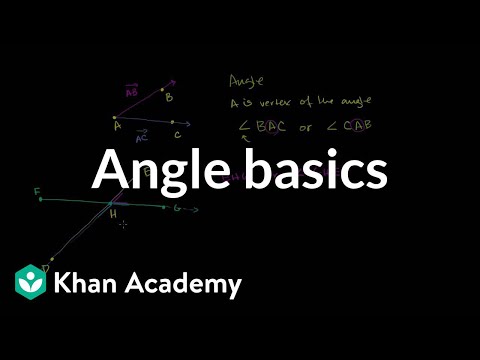
- Let's say we have one ray over here that starts at point A
and then goes through point B,
and so we could call this ray--
let me draw that a little bit straighter,
we could call this ray AB,
ray AB starts at A or has a vertex at A
and let's say that there's also a ray AC,
so let's say that C is sitting right over there
and then I can draw another ray, goes through C,
so this is ray AC.
What's interesting about these two rays
is that they have the exact same vertex,
they have the exact same vertex at A.
In general, what we have when we have two rays
that have the exact same vertex, you have an angle
and you're probably already reasonably familiar with
the concept of an angle,
which I believe comes from the Latin for "corner",
which makes sense, this looks like a little bit of a corner
right over here that we see at point A
and the geometric definition,
or the one that you're most likely to see,
is when two rays share a common vertex
and that common vertex is actually called
the vertex of the angle,
so A is vertex.
Not only is it the vertex of each of these rays,
ray AB and ray AC,
it is also the vertex of the angle.
The next thing I want to think about is how do we label?
How do we label an angle?
You might be tempted to just label it angle A
but I'll show you in a second why that's not going to be
so clear to someone based on where
our angle is actually sitting.
The way that you specify an angle,
and hopefully this will make sense in a second,
is that you say "angle",
this is the symbol for angle
and it actually looks strangely similar to this angle
right over here, but this little pointy thing
or it almost looks like a less-than sign
but it's not quite, it's flat on the bottom right over here.
This is the symbol for angle,
you'd say angle BAC
or you could say angle CAB.
In either case, they're kind of specifying
this corner, or sometimes you could view it as
this opening right over here.
The important thing to realize is that you have
the vertex in the middle of the letters.
You might be saying, "Wait, why go through the trouble
"of listing all three of these letters?
"Why can't I just call this angle A?"
To see that, let me show you another diagram.
Although the geometric definition of an angle
involves two rays that have the same vertex,
in practice, you're going to see many angles
that are made up of lines and line segments.
You could imagine that you could continue
those line segments on and on in one direction
and then they would become rays
so, in that way, they're consistent this definition.
Let's add one line segment that looks like that,
let me label some points here,
so we've already used ABC so let me call this D and E,
points D and E, so this is line segment DE.
Let's say I also have line segment FG,
FG,
and let's say this point where
these two line segments intersect,
let's called that point, point H.
How could we specify this angle right over here?
Can we just that angle H?
Well, no, because if we just said angle H,
the angle that has a vertex H,
it could be this angle right over here
or it could be this angle right over here,
let me draw it this way,
you could view it that way
or it could be that angle over there,
it could be this angle over here,
it could be this angle over here
or it could be that angle over there
and so the only way to really specify
which angle you're talking about well
is to give three letters.
If you really did want to talk about that angle
right over there, you would call that angle EHG,
so that is angle EHG
or you could actually specify that
or you could call that angle GHE.
GHE
If you wanted to specify this angle right over here,
if you wanted to specify that angle right over here,
the one made up of, if you imagine that ray
and that ray, if you were to keep on going
past those points, then you could call that angle DHG
angle DHG,
or angle GHD,
I think you get the point.
This angle up here could be FHE or EHF
and this one could be FHD or DHF
and when you do it this way, it's very clear
what angle you are referring to.
Now that we have a general idea of what an angle is
and how do we denote it with symbols,
the next thing you might be curious about is,
it doesn't look like all angles are the same,
it seems like some angles open up
or are more open than others
and some are a little bit more closed in than others
and that actually is the case.
For example, let's take two angles here,
let's say I have one angle that looks like that,
so I'll start reusing letters,
so let's say that this is A, B and C,
I can make these rays, I could keep on going
and make them rays if I like
or I could just keep them as line segments,
so right over here I have angle BAC
and let's say over here, I have angle--
so let me draw another one,
and let's say this is angle XYZ
and, once again, I could draw them as rays if I like,
to go on and on and on,
so it's angle X, Y and Z.
When you just look at these,
you just eyeball these two angles,
it looks like this one is more open,
so this one looks more open
while this one over here looks more closed,
so it looks like it's more closed,
at least relative to this one, more closed.
Maybe when we measure angles,
we should measure it based on how open or closed they are
and that actually is the case,
and so without even telling you how we measure an angle,
you could say that the measure of angle XYZ,
the measure of this angle
is greater than the measure of this angle right over here
and any convention we use for measuring angles
is essentially going to be a measure
of how open or how closed an angle actually is
and I'll take that up in the next video
where we'll see how to actually measure an angle.