en English
Untitled English subtitles
Report a problem
Advertisement
English transcript
>>
Thank you so much for coming. It's my honor and pleasure to host this morning, the venerable
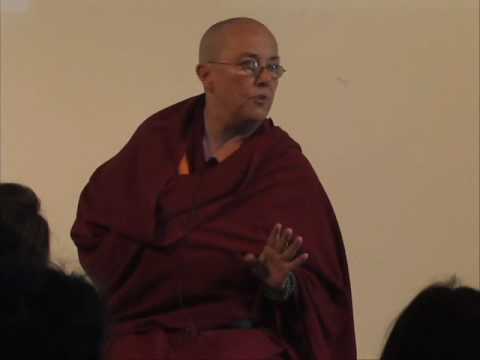
Robina Courtin. Robina has been a Tibetan Buddhist nun for over 30 years and during
that time, is well reputed for the unique and very impacting and deep style with which
she teaches. I believe that you will find this talk to be engaging and enlightening
and fun and all of the best things that you can do at work, on a Friday morning. So, Robina
is working with a group called the--was actually the executive director of the Liberation Prison--Prison
Project which has sort of provided a spiritual foundation for more than 15,000 prisoners,
world wide and this is a very big undertaking and has a staff and staff requires, you know,
funding. So to help with that and to draw funds for the Liberation Prison Project, Robina
is leading a conference in San Francisco coming up soon which our very own Chade Meng-Tan
will be speaking, our jolly good fellow. The goal of this conference is to, of course,
bring about happiness and its causes and to cut suffering and its causes and one of the
other benefits that it will have will be to support the Liberation Prison Project financially.
Robina is here to give a talk this morning about how to be your own therapist and without
any further ado, I will turn it over to her. >> COURTIN: Thank you Tom. Happy to be here
everybody. Thank you very much for having me. Well, first of all, here I am dressed
as a Buddhist nun. So we straightaway go into our religious mode, don't we? And we think
it's all about religion and therefore believing things. Well, Buddha's not like that. So for
a start, the kind of thinking cap you put on when you think science, when you think
numbers, you put that same hat on, please. Don't bring your religious hat in here. Bring
your intelligent hat because I'm not joking to say that actually Buddha is more similar,
to say, Einstein in the sense that Buddha is not a creator, he doesn't speculate, no
one revealed anything to him. He didn't have visions of things, he didn't kind of make
things up and therefore, there's nothing to believe. It's actually true to say that Buddha
you know, is a person, like a scientist as we would call it who from his own experience
has found certain things to be sowed. So what he deals with primarily is the human mind.
So from that perspective, you could say he's a psychologist. I mean, obviously he didn't
use that word then; he didn't speak Greek, did he? He spoke Hindi or Pali or whatever
it was. But actually, Buddha deals with the mind, that's his expertise and that is finally
the essence of what Buddhism is, you know. So yes indeed, I'm a Buddhist nun and if you
go to Tibetan Buddhist places, you won't get a sense of its being psychological, what you're
going go to see is religion, pictures and holy things and nuns and monks and the trappings
of religion but what's interesting about Buddhism over the centuries is that there's no contradiction,
you know, for Buddhist--for Buddhist culture. There's no contradiction between what we call
spiritual and what is called proving things and using your intelligence, you know or philosophy,
these things. And frankly, that's what actually appealed to me enormously, I was more of a
Catholic and I think in my own life the thing that really drove me was my wish. I mean it
sounds awfully noble but I'm saying it, my wish for truth. So that drove me to sort of
philosophical approach. It always ends the big view, always wondering why and what, you
know. So you know, first being a bit of an old hippie and then kind of a revolutionary
leftie and then feminist politics and whatever, always looking for why things were and I found
that enormously appealing. That's Buddha's idea; first that you know Buddha didn't--nobody
created you, including your mother and the father. But the crucial thing about Buddhism
is that, as I said, Buddha presents things about how he has seen things and then what's
interesting in the Buddhist view is, it's a process of verification but the point of
that is, not just to give a headful of knowledge, that--that verification of something also
brings along with it the experiential result. So this is key relationship in Buddhism therefore,
between so called wisdom and happiness. So the Buddha's deal really is that first of
all we have this mind, this consciousness, these words used synonymously and so of course,
the way to listen to Buddhism because he is not a creator, you take it as the hypothesis.
You don't try to squeeze it inside your head and believe it or reject it, you take it as
a hypothesis which is a very reasonable person's approach to any knowledge. So Buddha's deal
is--Buddha's asserting that consciousness is not physical for a start. Second, it's
not created by anybody and that's a big shock because if we're materialists as far as way
concern, our mommy and daddy created us and if we're religious then God created us. But
the Buddha's has got a kind of third approach and he would say we don't need creating, why
we need a creator, he doesn't know. But he is asserting that consciousness and you just
take this as your--as your thing to run with it's your--it's this river of mental moments,
all your thoughts, feelings, unconscious, subconscious, instinct, intuition, the entire
spectrum of your inner being; this is your consciousness. So think of it as like a river
of mental moments and you know very well, if you had perfect memory, you could track
it all back to yesterday without a single second missing, you could track to it back
to the day before and if it existed the day before, yon know you have to track it back
the day before and so on and so forth, you know. So you could get back to the first second
of conception. So here is this hypothesis, the Buddha's view would be, that the second
before conception you know--your egg and sperm were in your mommy and daddy's body minding
their own business, God has nothing to do with it nor Buddha. But your consciousness
is its own entity and you can track it back and back so that will do for that concept
right there. But the key thing is to see the experiential implications of this which is--which
is what it gets to this business of being your own therapist you know which is a very
tasty way of seeing what a person who is living with Buddhism in their lives is attempting
to do. Because the Buddha's deal is that your mind is yours, no one gave it you. It's a
very bizarre concept, kind of part schizophrenic idea and Buddhism that someone else kind of
created us, planted us on this earth and said, "Okay now, get along with it," you know, I
mean the Buddha would say what's in my mind is mine. My anger, my love, my intelligence,
my kindness, my compassion, my tendencies are mine. So this simple one of the implications
of this idea of continuity of consciousness and I won't go too far into that now, doesn't
need. Just take it as your hypothesis, it's inevitable, it's execrable that therefore,
what's inside your mind is yours and you're responsible for it. Not in a guilty sense,
there's no dualistic idea in Buddhism about guilt and blame and sort of that kind of idea.
What's in there is yours, he would say, the Buddha would say, you are not stuck with it.
I mean just the last 20 years, these amazing discussions that are being going on between
the Dalai Lama and all the marvelous minds in the--from the Tebestic--Tibetan monastic
tradition and with these, the best brains in the West, you know and some of the--as
one side has recently said; one of the greatest findings of the 20th century is the idea of
Neuroplasticity, or with respect, Buddha could have told you that two and a half thousand
years ago. I'm just happy we're catching up with Buddha, that's all, you know. But guess
what? We're not stuck with what we're born with. This is an assumption in all of Buddha's
view of the universe, you know and it's something that's assumed in a person who is a Buddhist
in their practice and it's quite empowering because if you look at how we suffer in daily
life, it's a sense of kind of hopelessness. I'm angry, I'm depressed, I'm no good, I can't
do this, we have this very limited kind of instinctive sense of what we think we are,
the kind of "I didn't asked to get born, it's not my fault, what can I do about it?" I think
if you look inside ourselves, this is what holds us back, you know, but what taking on
this Buddhist idea and learning to use it as your basis in your life, I can tell you
from my own experiences, unbelievably empowering. That yes, whatever is in there is there, take
responsibility, see it, don't pretend it's not there, the hopelessness, the fear, the
jealousy, the depression, you know, the low self-esteem, wanting to kill yourself, wanting
to kill others, blame, whatever you want to call it. It's all there, and the idea of being
your own therapist is to become intimately and I mean, intimately familiar with this
stuff. Not just to get more guilty but the--we all know that when you find what the problem
is, you then--that indicates the solution, doesn't it? If you can't locate the problem,
you'll never find the solution. So this is the basis, you know in this nice packaging
say, in the Buddhist teachings called the Four Noble Truths. The context here is suffering
and so the third one is where Buddha's really asserting and again, you take this as your
hypothesis that every living being necessarily possesses this phenomenal potential to be
free of what we would call suffering, what we would call the limitations, what we would--you
know, all the miserable stuff and the flipside of that is we have the potential to grow the
good stuff. So looking in a very simple way, kind of the Buddhist model of the mind, you
know and it's deceptively simple, actually, we make it awfully complicated in the West,
you know, with ADID and by this and whatever it is, you know. But the Buddha puts--put
talks about the mind in terms of we've got positive qualities which are those that necessarily
brings us happiness and causes the pain of others, that feel harmonious, that feels spacious,
that feel relaxed. Then you got the neurotic negative qualities that necessarily cause
you suffering, necessarily and that cause you to harm others and disharmonious and fractured
and miserable, and fearful and neurotic in their nature you know. So the marvelous point
the Buddha's making and this is not, this is completely flying in the face of all the
assumptions of all our models of the mind in the West, that these do not have equal
status. You know, if we think of what of what--what we think of a person, you define the parts
of a person in a materialist world, we would say that a reasonable person, you know, or
may be, you know, a couple of legs and nose, a couple of eyes in roughly the right place
plus some love, some kindness, some intelligence, some depression and as long as they're reasonably
balanced then you're an okay person or Buddha's view, his kind of baseline if you like, though
it sounds insane is really perfection. He would say that mind at its core is pure and
again this stuff you don't believe it. I'm stating it but then the person who is interested;
you go into this, you get your inferential kind of information and you work it through
in your own mind, you process to see the logic of it, to find the truth of it and as the
Dalai Lama points out again and again, if you can prove from your own direct experience
then the Buddha is wrong. You must reject him. So the Buddha's picture, the Buddha's
view is that the positive states of mind are at the core of our being, they are the basis
of who we are and therefore can be grown, for our sake and the sake of others in this
universe, you know. It's a reasonable practical issue, not like you must do it because God
said so, there's no concept like that in Buddhism. It's an experiential practical issue and then
he says therefore, the stuff that he would call the negative which he says is the basis
of our neurosis and misery and our low self-esteem and all the rest is actually not at the core
of our being. This is quite a shocker because there's a deep assumption as I said in all
our models of the mind in the West that it is at the core of our being. That in fact
you'd actually think that you're unnatural person if you didn't have depression or anger.
We think now we're unnatural when it's very extreme. But the Buddha would say having any
of it is our natural, in the sense that it doesn't belong in the sense that it's there;
loud and clear, look at your life, but that we can transform it, we can change it. No,
I'm not talking holy here, do not hear this stuff of holy. Here this is intelligent, practical,
doable stuff and I can't stress this enough, you know, because we have these absolutely
knee-jerk reactions the moment we hear about spiritual, Buddhist, nun, meditation, we kind
of lose our common sense. We think we have to put our thinking cap off, well mistake.
Keep it on, you know and that's what--for myself personally, what I absolutely delight
in, in this tradition of the Dalai Lama that happens to be in the Tibetan, you know this
monastic philosophical--monastic tradition the last thousand 1,200 years. I found in
my own life enormously appealing, you know--you don't chuck out your intelligence. There's
no contradiction between heart and intelligence in the Buddha's view. This is nice analogy
that a bull--that a bird needs two wings, wisdom and compassion and the wisdom wing
you could say is all this work of being your own analyst, knowing yourself intimately,
precisely, clearly, using the same level of depth of analysis and intelligence and clarity
that we know we need to employ in what we call science, you know. That's the kind of
intelligence you need to really know your own mind using these very marvelous techniques
that have been around for more than a thousand years, several thousand years, pre-Buddha.
He took these techniques from the Hindus you know and they are happy to share, these so
called concentration techniques. They're unbelievably practical, psychological techniques, the likes
of which we haven't even begun to tap, you know, in a materialist world and that is just
a practical fact you know. Don't think of them as religious, this is really a disservice
to ourselves and others. You really--to do these techniques well, you need phenomenal
discipline, phenomenal intelligence, phenomenal will and real long term patience, you know,
and the result of these, I mean Communist could do them, they are not religious in their
nature, these practical techniques called concentration meditation but again, we got
these clichéd ideas that has all to do with getting a nice feeling and being mindful but
excuse me, you know, thieves need mindfulness. There's nothing holy about mindfulness, okay?
You can't make a cake without being mindful, but you can't shoot somebody without being
mindful either. So we really got a quick just kind of wishy-washy nonsense about spiritual,
I really can't stand it, you know. You get my point, okay? I'm a Buddhist nun, I don't
deny. Whatever. But these misconceptions we have about spiritual, you know. We make these
huge sort of dichotomy in our own lives between pleasure and thinking and intelligence and
science and then you're spiritual on the other side. There is no contradiction, you know,
there is no contradiction. The essence of the Buddhist one really is this one of--can
you turn me around, I can't do it, I'm getting more to more on this side. Just whiz me around,
that's it. It's just going to go to the left whatever I can do, I can't help it. Get me
a chair, no don't worry I'll be all right. So okay, so let's look at the contents a little
bit of this mind of ours, the names of these so called positive qualities and the names
of these so called negative ones and again, don't hear this as judgment. It's a practical
issue, we're trying to identify problems because let's face it, we all want happiness, you
know and do your market research just in this room, you're going to get a 100% agreement.
People want happiness, don't want suffering. You ask the dogs and the giraffes, you look
at their behavior, you're going to see that they want the same you know. So then the Buddhist
deal is okay, that's practical, a good start so let's look at what happiness is, how does
he define it and therefore what are the obstacles to it and they're the things you work on,
you know. You want to be healthy, you got some suffering, you find out what the problems
is, you find the alternative, you solve the problem, it's practical. So Buddha's view
of happiness is actually very--is very simple. We make it complicated, we think of it as
like a needle in a haystack that you try to search for because we believe instinctively
this is the materialist view. Again, don't be kind of--it's not moralistic, it's practical.
We think of it as something you got to find. So we think of it in external terms, the job,
the body, the boyfriend, the dollars, the shape, the sound, the smell, well you know
no problem. As many boyfriends as you like, as much--many dollars as you like, no problem
there, all the Buddha is saying is, if you think that you'll get happy feelings from
it, you're mistaken. You might get some but they won't last. So for him, it's real simple.
This idea of happiness, if you think about it again, what we think it is, is what you
get when you get what you want and that drives us. This is primordial in us, this is deeply
instinctive within us and he is finding fault with this. He says it's just not practical,
it doesn't work but he says happiness is, it's really simple, it's what you get when
you give up the neurosis. It's in that sense, that's inside. It's a practical thing, in
other words, the extent of which we are caught up in any given moment in low self-esteem,
depression, anger, jealousy, you name it, we all know those words and there are under
the negative heading, we all know them. The extent to which we're caught up in those is
the extent of which we suffer, therefore, I'm not happy. The extent of which we are
not caught up in those and therefore the extent which we're involved in kind of, you know,
connecting with others, empathy, being harmonious, forgiving, it's a struggle but they're the
positive qualities. The extent of which they're prevalent in our minds at any given moment
is the extent to which we are happy. It's an incredibly simple little recipe in Buddhist
terms. We think it is what you get when you get what you want. He says it's what you get
when you give up the neurosis which is the one--so the technique is learning to know
your mind, be your own therapist. Yes indeed, using these so called mindfulness techniques,
they're practical, psychological techniques to help you focus your mind. The reason you
want to focus your mind because we can see from the second we wake up until the second
we go to sleep is ruining 4,000 miles an hour in every imaginable direction with zero control.
And we in our culture assume that's normal but Buddha says it's a mental illness and
he's got techniques to help us steady it and don't think about calming it, that's kind
of you get the sound of an idea of a person with a silly grin on their face. A calm mind
can be a busy mind okay? And if you think about it, what causes the problems isn't a
busy mind, it's when the--the busy mind is caught up in fear about yourself and worry
of what people think about you, am I good enough, am I too fat, am I too thin and depression
and jealous and anxiety and all the rest. That's the stuff that causes the misery. If
you're full of thoughts about being useful to others all day and being content with yourself,
well, please go for it, you know. You don't have a problem, believe me. So we got to be
very precise about this. Sure in time as we progress in the development of this mind of
ours, this ongoing job of being your therapist. We al
…