en English
Untitled English subtitles
Report a problem
Advertisement
English transcript
Poupyrev: My name is Ivan Poupyrev,
and I work for Advanced Technology and Projects group
at Google.
The hand is the ultimate input device.
It's extremely precise, it's extremely fast,
and it's very natural for us to use it.
Capturing the possibilities of the human hand
was one of my passions.
How could we take this incredible capability,
the finesse of human actions and finesse of using our hand,
but apply it to the virtual world?
We use radio frequency spectrum, which is radars,
to track human hand.
Radars have been used for many different things--
to track cars, big objects, satellites and planes.
We're using them to track micro motions,
twitches, of the human hand
and then use that to interact with wearables
and Internet of Things
and other computing devices.
Lien: Our team is focused on taking radar hardware
and turning it into a gesture sensor.
Radar is a technology
which transmits a radio wave towards a target,
and then the receiver of the radar
intercepts the reflected energy from that target.
The reason why we're able to interpret so much
from this one radar signal
is because of the full gesture recognition pipeline
that we've built.
The various stages of this pipeline
are designed to extract specific gesture information
from this one radar signal that we receive
at a high frame rate.
Amihood: From these strange, foreign range Doppler signals,
we are actually interpreting human intent.
Karagozler: Radar has some unique properties
when compared to cameras, for example.
It has very high positional accuracy,
which means that you can sense the tiniest motions.
Schwesig: We arrived at this idea of virtual tools
because we recognized that there are
certain archetypes of controls, like a volume knob
or a physical slider, a volume slider,
Imagine a button
between your thumb and your index finger,
and the button's not there,
but pressing this is a very clear action.
And there's an actual physical haptic feedback
that occurs as you perform that action.
The hand can both embody a virtual tool,
and it can also be, you know,
acting on that virtual tool at the same time.
So if we can recognize that action,
we have an interesting direction for interacting with technology.
Poupyrev: So when we started this project,
you know, me and my team, we looked at the project idea,
and we thought, "Are we gonna make it or not?
Eh, we don't know."
But we have to do it.
Because unless you do it, you don't know.
Raja: What I think I'm most proud of about our project is,
we have pushed the processing power
of the electronics itself further out
to do the sensing part for us.
Poupyrev: The radar has a property
which no other technology has.
It can work through materials.
You can embed it into objects.
It allows us to track really precise motions.
And what is most exciting about it
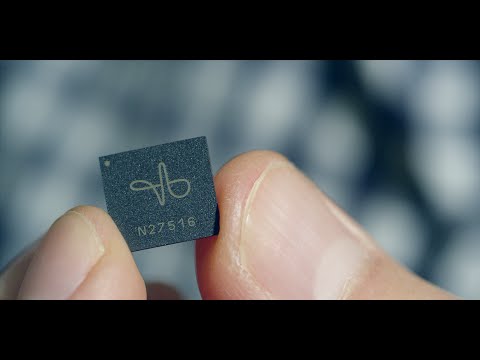
is that you can shrink the entire radar
and put it in a tiny chip.
That's what makes this approach so promising.
It's extremely reliable.
There's nothing to break.
There's no moving parts.
There's no lenses.
There's nothing, just a piece of sand
on your board.
Schwesig: Now we are at a point where we have the hardware
where we can sense these interactions,
and we can put them to work.
We can explore how well they work
and how well they might work in products.
Poupyrev: It blows your mind, usually,
when you see things people do.
And that I'm really looking forward to.
I'm really looking forward
to releasing this to the development community,
and I really want them to be excited
and motivated
to do something cool with it, right?