en English
Untitled English subtitles
Report a problem
Advertisement
English transcript
An exoplanet is a planet that
orbits a star other than the sun.
In recent years, astronomers
have discovered exoplanets as
small as the Earth, but none
of these Earth-size planets
have orbited stars close enough
to study in detail. Now, a group
of astrophysicists have
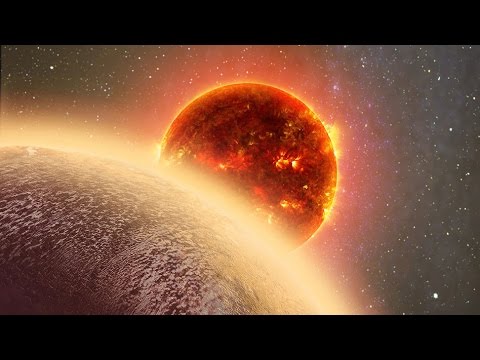
discovered a new exoplanet
that is Earth-sized, and rocky,
orbiting a star only 39 light-
years from Earth, making it the
closest Earth-sized exoplanet
discovered to date.
The researchers identified the
new planet using an array of
40-centimeter-wide robotic
telescopes, located in the
mountains of Chile. The
telescope array searches for
planets by monitoring the
brightness of nearby, small
stars - taking measurements of
starlight every 25 minutes.
If there is a dip in a star's
brightness, it could indicate a
planet passing in front.
On May 10, 2015, one telescope
picked up a faint dip in
starlight from GJ 1132, a star
located 39 light-years from
Earth. To confirm this was
indeed a planet, the telescope
observing this star upped its
observations from 25-minute
intervals to every 45 seconds.
Coupled with observations from
other large telescopes in the
area, they found that GJ 1132's
brightness dimmed by .3 percent
every 1.6 days - a clear signal
that a planet was regularly
passing in front of the star.
Based on the amount of starlight
the planet blocked, and the
radius of the star, the group
calculated that the planet is
about 1.2 times the size of
Earth. From the planet's size,
and its proximity to its star,
the scientists estimate the
planet's average temperature
to be around 450 degrees
fahrenheit. The planet is also
likely tidally locked, meaning
that it has a permanent day
and night side, presenting the
same face to its star, similar
to how our moon faces the earth.
Although the surface temperature
may be inhabitable, compared to
most rocky exoplanets that have
been discovered, this planet
is actually cool enough to have
a substantial atmosphere.
With more powerful telescopes,
such as the James Webb Space
Telescope, launching in 2018,
scientists may be able to
uncover many more details
about the planet's atmosphere,
including the speed of its winds
and the color of its sunsets.