en English
Untitled English subtitles
Report a problem
Advertisement
English transcript
[MUSIC PLAYING]
Hey there.
You may be wondering what you're doing
at the front of a bioengineering lab,
and why a total stranger is talking to you right now.
But I'm here to talk about some of the awesome experiments
that Herbert Boyer and Stanley Cohen did in the 1970s.
You might be thinking to yourself, uh-- the '70s?
Isn't that like, when the dinosaurs lived?
Boring.
Well, have you ever gotten a vaccine
or eaten groceries from a grocery store?
That's all thanks to some of the experiments
that these two lab pals did in the '70s,
where they took enzymes that cut DNA, and were
able to enter these pieces into new bacterial DNA.
They pioneered the field of genetic engineering.
And thanks to all the work that they did,
we have medications for people with diabetes and heart attack
victims.
You know what?
Why don't you guys just follow me inside.
So the first thing that Cohen and Boyer did
was they took DNA from a frog and cut it up into pieces.
I should probably explain to you guys
what's going on in this tube.
Here's some DNA from the frog.
It encodes certain traits that affect how the frog develops,
how it survives, how it looks.
Now there's a piece of DNA in this genome whose job is
to encode for certain proteins that the frog uses to survive.
We're going to cut this piece out using a restriction enzyme.
This is the thing that Boyer discovered.
It's kind of like a pair of scissors.
By cutting the DNA at specific points,
we can get different pieces.
Now there are tons of different kinds of restriction enzymes,
and they all cut in different places in DNA.
Our enzyme that we're using today is called EcoR1.
Now this piece of DNA has more than one spot
that EcoR1 can cut, as shown by the dotted lines.
So we're going to end up with other pieces of DNA
in addition to the one we actually want.
Now that's actually OK, because we're
going to deal with that problem later.
What's going on the tube is we're literally just cutting up
our piece of DNA, just like this.
Now here's a tube full of plasma.
It's basically a circular ring of DNA
that can exist in bacteria.
And it basically encodes for certain traits
that affect how bacteria look, or act, or survive.
Now to add our DNA from the frog DNA to our bacterial DNA,
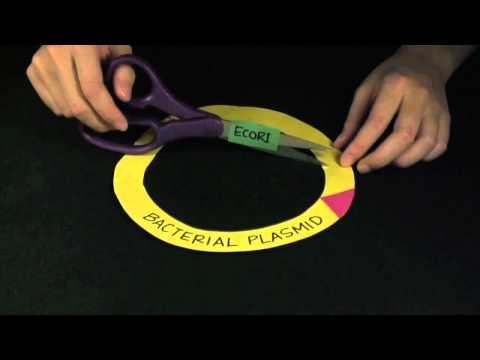
we need to cut the plasmid open too.
So we've got to add our EcoR1 scissors,
and they're going to cut at this site.
You let this reaction proceed, letting all the ingredients--
the plasmids, the restriction enzyme, and some water
and buffers to hang out together until all the plasmids are
cut like this.
Now we need to add the DNA pieces from the frog
and allow them the pieces to join our cut plasmids.
Here's what's going on in the tube now.
I've got pieces of frog DNA.
And I've got cut plasmids, like this.
I need to add this guy into this plasmid.
And the way I'm going to do that is by adding an enzyme
called DNA ligase.
This enzyme kind of acts like tape,
and it fixes the DNA insert into the plasmid.
Now another important thing about the plasmid
itself is that it carries a marker that
makes it resistant to a certain kind of antibiotic called
tetracycline.
This will come in handy in a little bit.
After a little while, we'll have a couple types of DNA going on.
This is the one that we want.
It's plasmid, and it has the purple frog DNA insert.
But we'll also get things like this.
We'll get plasmids that had other parts of the frog's
genome inserted into it.
And we'll also get plasmids that just
close back up on themselves.
So now that we have these new plasmids,
we've gotta stick them into some bacteria.
Here we're gonna take some E. coli.
As you can see, it already has some DNA in it.
The important thing about these guys
is that they'll actually die if you
add the tetracycline antibiotic, which we
talked about earlier, to them.
What Boyer and Cohen did to get the plasmids inside of these E.
coli is that they cooled all the cells down, and then quickly
heated them up, creating little holes in the cell membrane.
Then the plasmids could slip through and get into the cell.
These are the kind of bacteria that we have now.
Bacteria that got the plasmid we wanted.
These are the guys we wanted.
But we'll also get bacteria that got the plasmids
that we didn't want.
Say, this one with the wrong piece of DNA,
or this one with just a plain plasmid without any frog DNA.
And more than likely, we'll get ones that just didn't pick up
any of the plasmids.
Now what I'm going to do next is plate these cells
on some tetracycline agar plates,
which is basically some fancy jello that
has antibiotic in it.
So these guys won't be able to grow.
But these guys will.
I've plated the E. coli that we transformed
with our new plasmids onto this plate, which
has tetracycline in it.
We're going to let this sit in the incubator
overnight and allow our bacteria to grow.
And we'll check on it again in the morning.
Alright.
So as you can tell, we've definitely
got some colonies that grew on our plate overnight.
So now the problem that we have is
we need to be able to distinguish the bacteria that
got these plasmids from the ones that
got these plasmids, which don't have our frog DNA in them.
So what we're going to do is use the same techniques
that we did at the very beginning of this experiment,
and extract the plasmids from all these bacteria.
Then we're going to use the same restriction enzymes
and cut up these plasmids.
You might be able to notice that our frog purple insert is
a different size than the pink that comes from the background
frog DNA.
So what we can use is something called a gel box,
and use a technique called gel electrophoresis.
And what it's going to do is it's
going to separate our different pieces of DNA out.
And from this experiment, we'll be
able to tell the plasmids that took up the frog
DNA from the ones that didn't, or s the ones that just closed
up on themselves.
Thanks to these cloning techniques that me and my buddy
developed, the field of genetic engineering was pioneered.
Things like insulin are being made these days
using these very same techniques.
Well, that's all I've got time for today, guys.
Thanks for stopping by.
Hopefully you have a better appreciation
for some of the cloning techniques
you saw today, and just have a better understanding
of genetic engineering.
See you guys later.
[MUSIC PLAYING]