en English
Untitled English subtitles
Report a problem
Advertisement
English transcript
In the 17th century, when Galilei discovered
that the earth turned around the sun instead of the other way around,
many people were in a state of great shock.
They had thus far believed that humans were at the center of
the cosmos and around this idea they had built their whole belief system.
Suddenly, this did not seem to be the case anymore.
Foucault's theory can be clarified by pointing out that,
in relation to culture, he takes a sort of Galilei-type standpoint.
Since the time of Galilei, people have thought that
when it came to culture and society, humans do were at the center.
After all, it is they who created these.
Foucault denies this.
It is not the subject that counts to culture he argues,
but the structure, the universal.
Something that is in itself already understandable
if one realizes that the rules according to which mankind behaves
for the largest part were already invented long before one was born.
And the name of the inventor remains completely unknown to us.
One can compare Foucault to Galilei, but from another perspective,
one can also compare Chomsky to Galilei
because his work in the science of language -- linguistics --
has had a great revolutionary influence over the whole world.
Chomsky has brought about a major transformation in the field of linguistics.
Interestingly, Chomsky's theories point in the exact opposite direction
as the theories of Foucault.
Chomsky gives much more primacy to the subject.
In the confrontation between these two completely different thinkers,
it is moreover good to remember that they work in very different fields.
Foucault is a cultural researcher; Chomsky is a language researcher.
In other words, Foucault's interest lies in the history of scientific language.
While Chomsky's interest lies in the daily language we use.
It is interesting, and maybe also not coincidental,
that the debate between these two thinkers only really gets exciting
in the second half when they start discussing politics.
Still I believe it is good that this is preceded by a theoretical part.
This because in any discussion about philosophy and society,
what matters are not the political standpoint certain thinkers happen to take
but rather on the basis of which arguments they do so.
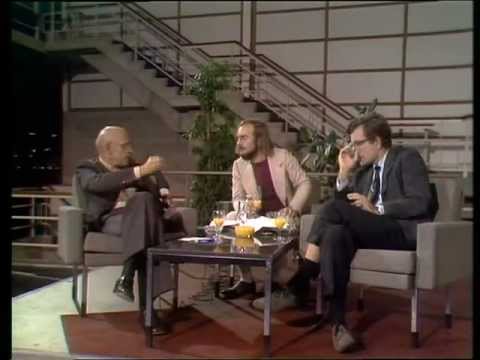
It might be nice to note that this discussion took place
in the auditorium of the technical college of Eindhoven (NL).
A discussion between two philosophers, two researchers, whose work is characterized
by great precision, great detail and also great clarity.
Further I thought it quite symbolic it took place in a space with lots of glass:
the inner- and outer-world blended together.
During the broadcast you could see the traffic outside passing by:
symbolic indeed, because the relationship between inner- and outer-world
is central to the first half of the fourth philosophers debate
about human nature and the ideal society.
Ladies and gentlemen,
welcome to the fourth debate of the International Philosophers' Project.
Tonight's debaters are Mr. Michel Foucault of the College de France
and Mr. Noam Chomsky of the Massachusetts Institute of Technology.
Both philosophers have points in common and points of difference.
Perhaps the best way to compare both philosophers
would be to see them as mountain-diggers working at opposite sides
of the same mountain with different tools, without even knowing
if they are working in each other's direction.
All studies of humanity, ranging from history to linguistics and psychology,
are faced with the question of whether in the last instance,
we are the product of all kinds of external factors
or if, in spite of our differences, we have something we could call
a common human nature by which we can call each other human beings.
So my first question is to Mr. Chomsky,
because you often employ the concept of human nature
in which connection you even use terms like "innate ideas" and "innate structures".
Which arguments can you derive from linguistics
in order to give such a central position to this notion of human nature?
Well, let me begin in a slightly technical way.
A person who is interested in studying languages
is faced with a very definite empirical problem.
He's faced with an organism, a mature, let's say adult speaker,
who has somehow acquired an amazing range of abilities,
which enable him in particular to say what he means,
to understand what people say to him,
to do this in a fashion that I think is proper to call highly creative.
Now, the person who has acquired this intricate and highly articulated
and organized collection of abilities
-- the collection of abilities that we call knowing a language --
that person has been exposed to a certain experience; he has been presented
in the course of his lifetime with a certain amount of data,
of direct experience with a language.
We can investigate the data that's available to this person; having done so,
in principle, we're faced with a reasonably clear and well-delineated scientific problem,
namely that of accounting for the gap between the really quite small quantity of data, small
and rather degenerate quantity of data that's presented to the person, to the child, and
the very highly articulated, highly systematic, profoundly organized resulting knowledge that
he somehow derives from this data.
Furthermore -- even more remarkable -- we notice that in a wide range of languages,
in fact all that have been studied seriously, there are remarkable limitations
on the kinds of systems that emerge from the very different kinds
of experience to which people are exposed.
There is only one possible explanation, which I have to give in a rather schematic fashion,
for this remarkable phenomenon, namely the assumption
that the individual himself contributes a good deal, an overwhelming part in fact,
of the general schematic structure and perhaps even of the specific content of the knowledge
that he ultimately derives from this very scattered and limited experience. That is,
to put it rather loosely: the child must begin with the knowledge, certainly not with the
knowledge that he's hearing English or Dutch or French or something else, but he does start
with the knowledge that he's hearing a human language of a very narrow and explicit type,
that permits a very small range of variation. And it's because he begins with that highly
organized and very restrictive schematism, that he is able to make the huge leap from
scattered and degenerate data to highly organized knowledge.
I would claim then that this instinctive knowledge, if you like,
this schematism that makes it possible to derive complex and intricate
knowledge on the basis of very partial data, is one fundamental constituent of human nature.
And I assume that in other domains of human intelligence, in other domains of human cognition
and even behavior, something of the same sort must be true.
Well, the collection, this mass of schematisms, innate organizing principles
which guides our social and intellectual and individual behavior,
that's what I mean to refer to by the concept of human nature.
Well, Mr. Foucault, when I think of your books like
The History of Madness and Words and Objects, I get the impression that you are
working on a completely different level and with an opposite aim and goal;
when I think of the word 'schematism' in relation to human nature
I suppose you are trying to elaborate
several periods, several schematisms. What do you think about this?
Well if you permit, I will answer in French
because my English is so bad that I would be ashamed of answering in English.
It is true that I mistrust the notion of human nature a little.
And for the following reason: I believe that of the concepts
or notions that a science can use, not all have the same degree of elaboration.
Let's take the example of biology. Within the field of biology
there are concepts that are more or less well established, like the concept of a "reflex".
But there also exist peripheral notions, which do not play an "organizing" role within science,
they are not instruments of analysis and they are not descriptive either. These notions
simply serve to point out some problems, or rather to point out certain fields in need of study.
For instance, there exists a very important concept in the field of biology:
the concept of life. In the seventeenth and eighteenth centuries, the notion of life was
hardly used when studying nature: one classified natural beings, whether living or non-living,
in a vast hierarchical tableau. Life was a concept they didn't use and didn't need.
At the end of the eighteenth century a number of problems arose, for instance in relation
to the internal organization of these natural beings. Moreover, thanks to the use of the
microscope, different sorts of phenomena and mechanisms that had been unclear in the past
and could not have been perceived until then suddenly came to light.
The developments in chemistry have also highlighted certain problems in relation
to the connections between chemical reactions and the physiological processes of organisms.
And that's how an entire field appeared,
one that was completely new for biologists, one that is nowadays known as life.
Life was a concept that served to point out new fields of study that science still
had to discover. I would say, as a historian of science, that the concept of life was an
epistemological indicator; an index of the problems that still had to be uncovered.
And I ask myself whether perhaps one could say the same thing about human nature.
Foucault is therefore comparing Chomsky's concept of human nature
with the concept of life as used in biology and in the history of that science.
He does this because his sees of the concept of human nature
more as an indication of a research program
rather than as an indication of humanity's potential for achievement.
For him, human nature acts as a scientific shopping list and nothing more.
Chomsky is willing to accept this as long as it is clear that the fields
of biology, physiology and neurology still don't have the means
to adequately describe human nature and humanity's capacity for language.
Quite early on in the debate, moderator Mr. Elders
finds it difficult to keep the interaction flowing between the two speakers.
This is partly due to the different languages they speak, but most importantly due to the
fact that Chomsky and Foucault inhabit such different worlds of thought, to the point
in which their ideas easily slide past each other. We actually observe the curious phenomenon
of two brains thinking simultaneously, where one picks up the last claim of the other in
order to further elucidate it from his own system of thought.
For Chomsky the concept of creativity plays an important role,
and the following part of the debate will be largely dedicated to this issue.
For Chomsky creativity is actually acharacteristic of all human beings.
Everybody uses it. People stuck in traffic who unexpectedly and on the spot,
have to think about what to do next.
The educator who doesn't want to fall into a pattern of authoritarian behavior
and when confronted with a difficult pupil, has to invent new behavior.
But above all, this creativity applies to the child
who learns a language and who curiously learns to produce new language.
Foucault is opposed to this idea. He constantly emphasizes
the so-called "epistemological field" within which human activity takes place.
This "epistemological field" or "épistèmè"
is described as the totality of unconscious rules
that manage the totality of all separated fields of knowledge.
Foucault also talks of "tableau", and also calls it "system of elements",
and in the debate the word "grille" is mentioned: bar or grid.
Perhaps it's best to speak of a network within which everybody in
a particular culture thinks whether they want it or not.
It is a certain set of rules to which everybody's thinking obeys
and with which people search for identity, coherency and so forth.
This system is not a creation of particular individuals:
it decides the rules of the "think-and-do" habits we call culture, which every individual
is subjected to. Such a system is not a thing or idea, but lies precisely in between these.
For Foucault the history of thought is not be associated with the history of ideas
or even of the development of the mind,
but rather it should be understood as discontinuous transformations.
transitioning from one network to another.
That is a totally different approach from that of Chomsky,
for whom creativity plays a central role. At this point we encounter
Foucault's dethroning of the subject, as already illustrated with the example of Galilei.
The philosophy of Foucault is a philosophy in which the philosopher
constantly disappears from sight.
One could say that, paradoxically, it is a philosophy without philosophers:
an idea to be generalized because humans are, according to Foucault, greatly absent
within their own culture. In this respect, Foucault's strong and negative reaction
towards the moderator who showed interest in private matters of his life.
When Foucault debates, it is about everything except Foucault himself.
This is an introduction to the following -- quite detailed -- theoretical part of the debate
which seems to mainly focus on one question:
to what extent is the individual able to discover something new,
and if so, how should we make sense of this? This seems to me to a very relevant question,
especially if we remind ourselves that we need quiet some new forms
of behavior, knowledge and science if we want to survive together in this world.
We resume the debate where Foucault explains why he doesn't pay much attention
to the creativity of the individual from a historical perspective.
Within the traditional history of science,
the creativity of individuals has been accorded maximum importance. The history of science,
up until recently, essentially consisted of showing how an individual -- whether it was
Newton or Mendel -- had been the creator, or rather the discoverer of a reality that
was already existing in things and in the world, a reality that no other person had
previously discovered. I believe the postulate that lies at the core of the traditional history
of science is that truth exists in order to be known; yet the human mind, due to the effect
of a number of inhibitions or obstacles, has not managed to see this truth. The mind is
made to see the truth and a contingent obstacle is impeding him to see it. According to some
historians, this obstacle could be linked to socio-economic conditions, or to different
forms of mentality, or to the belief and naivety in old religious myths and moral themes.
All of these could act as obstacles, as blinders to those who want to see the truth. In reality,
the mind is meant to see, it is made to have access to the truth. In this traditional conception
of the history of science, on the one hand there is an emphasis on the creativity of
the individual who has the right to possess the truth, and yet a system of obstacles will
prevent him from capturing, formulating and constructing this truth to which he is essentially
entitled to possess. I believe the problem that is being posed is the exact opposite.
What happens when we witness a great scientific transformation? In a great scientific transformation
-- for instance the birth of biology mid seventeenth century, or the birth of philology
at the end of the eighteenth and the beginning of the nineteenth century -- it is true that
a number of obstacles, prejudices, preconceived ideas tumble and disappear. What strikes me,
however, is that science, at the moment of its birth, not only gets rid of a certain
number of obstacles but also eliminates and masks a certain amount of existing knowledge.
It's as if applying a new grid, which allows for the appearance of phenomena
that had been previously masked while at the same time masking already existing knowledge.
Therefore, a science, the advancement of science and the acquisition of science, is not simply
the oblivion of old prejudices, or the fall of certain obstacles. It is a new grid that
masks certain things while allowing for the appearance of new knowledge. Therefore, when
I criticize the notion of creativity, what I mean is that truth is not acquired through
a kind of continuous and cumulative creation, but rather through a set of grids stacked
on top of one other, which leak old and collect new knowledge.
I think in part we're slightly talking at cross-purposes,
because of a different use of the term creativity. In fact, I should say that
my use of the term creativity is a little bit idiosyncratic
and therefore the onus falls on me and not on you in this case.
But when I speak of creativity, I'm not attributing
to the concept, the notion of value that is normal when we speak of creativity.
That is, when you speak of scientific creativity,
you're speaking, properly, of the achievements of a Newton.
But in the context in which I have been speaking about creativity,
it's a normal human event.
I'm speaking of the kind of creativity that any child demonstrates when he's able
to come to grips with a new situation: to describe it properly, react to it properly,
tell one something about it, think about it in a new fashion for him and so on.
I think it's appropriate to call those creative acts,
but of course without thinking of those acts as being the acts of a Newton.
It's the lower levels of creativity that I've been speaking of.
Now, as far as what you say about the history of science is concerned, I think
that's correct, illuminating and particularly relevant in fact to the kinds of enterprise
that I see lying before us in psychology, linguistics and the philosophy of the mind.
That is, I think there are certain topics that have been, in your words, repressed
or put aside during the scientific advances of the past few centuries.
But now, I think, we can overcome those,
it is possible to put aside those limitations and forgettings, and to
bring into our consideration precisely the topics that animated a good deal of
the thinking and speculation of the seventeenth and eighteenth century,
and to incorporate them within a much broader and I think deeper
science of man that will give a fuller role
-- though certainly not expected to give a complete understanding to such notions as
innovation and creativity, freedom and production of new elements of
thought and behavior within some system of rule and schematism.
Those are concepts that I think we can come to grips with.
In reality, I believe there is a quite strong similarity
between what Mr. Chomsky said and what I tried to show:
in other words there exist in fact only possible creations, possible innovations.
One can only, in terms of language or of knowledge,
produce something new by putting into play a certain number of rules
which will define the acceptability or grammaticality of these statements, or which
will define, in the case of knowledge, the scientific character of the statements.
Thus, we can roughly say that linguists before Mr. Chomsky mainly insisted on
the rules of construction of statements and less on the innovation
represented by every new statement, or the hearing of a new statement.
And in the history of science or in the history of thought,
we placed more emphasis on individual creation
and we had kept aside and left in the shadows these communal,
general rules, which obscurely manifest themselves through
every scientific discovery, every scientific invention,
and even every philosophical innovation. These are not only linguistic rules
but also epistemological rules, which characterize contemporary knowledge.
Well I think... Perhaps I can try to react to those comments
within my own framework in a way which will maybe shed some light on this.
How is it that we are able to construct any kind of scientific theory at all?
How is it that, given a small amount of data, it's possible for various scientists,
for various geniuses even,
…