en-GB English (United Kingdom)
Untitled English (United Kingdom) subtitles
Report a problem
Advertisement
English (United Kingdom) transcript
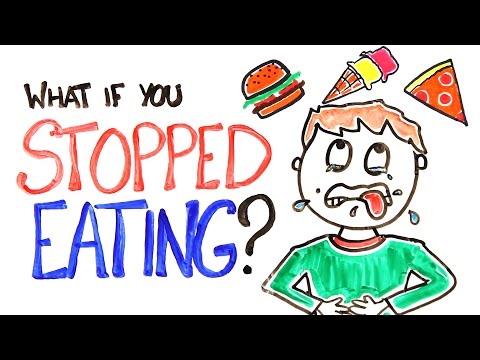
Food is a favourite pastime for many, which is convenient because we need it to live.
But what would happen to you and your body if you were to completely stop eating food,
right now?
In the first 6 hours, all is fairly normal. Your body begins to break down glycogen - which
stores energy in your body - into glucose, which your cells use as fuel. Around 25% of
energy generated this way is used for your brain alone, while the rest goes to muscle
tissues and red blood cells. But after about 6 hours this method of energy production halts
as the glycogen stores deplete, which can lead to the notorious ‘hangry’ or hungry
and angry feeling that many of us know too well.
At this point [6-72 hours] your body enters a state called ketosis as it begins to fast
or starve. Because there is very little glucose in your blood, your body must begin to break
down fat for energy. This fat is in turn broken down into fatty acids. However, your brain
cannot use long chain fatty acids which...is a problem! Because there is no more glucose
and the fats are too large to cross the blood-brain barrier, your brain changes modes and begins
to use ketone bodies for energy, which are short-chain derivatives of fatty acids. This
works for the time being, but ultimately only 75% of the brain's energy requirements can
come from ketones - it still needs glucose! Which means your cognitive functioning becomes
impaired.
Now, it’s important to mention that you don’t have to be starving to be in ketosis.
Many people enter this phase if they are on a low-carb diet, or professional athletes
who use all their carbs for an extended period of time - like marathon runners - will be
in this state as well.
However, beyond 72 hours, not only will your mood and energy suffer, but your brain will
start to break down your body’s own protein. The proteins release amino acids which can
be converted into glucose - which is great news for your brain, but bad news for your
body. Basically, you’re body is cannibalizing itself by destroying your muscle mass. In
women, undernutrition often shuts down the menstrual cycle as the body tries to reduce
energy expenditure. Bone density diminishes, and both men and women may experience loss
of libido.
Within a few weeks, the body’s immune system will be so weakened without
any vitamins or minerals, that many will die from disease. Otherwise, it will continue
to use up all energy sources until there is no glucose, fat, tissue, or muscle mass left.
One of the more common causes of death is cardiac arrhythmia or heart attack, due to
the tissue degradation in the heart, diaphragm and body. This is fairly common in those suffering
from anorexia. Of course, the body experiences severe organ failure all around.
Starvation can lead to death in as short as three weeks, or up to 70 days as documented
during the Irish Hunger Strikes in 1981. Though the duration of survival is greatly influenced
by how hydrated you are and the amount of fat reserves your body has. Which in some
ways is incredible - that the body can sustain for so long with no food.
And yet, approximately 795 million people around the world have to deal with this reality.
The good news is that the 7 richest countries have pledged to lift 500 million people out
of hunger and malnutrition by 2030 - but we need to hold them accountable. We’re working
with an organization called Global Citizen to do just that, and here’s a really easy
way you can help too!
By sharing this video and then heading to the Global Citizen website form *here* you’ll
be adding your voice to an important educational movement towards ending hunger worldwide.
You can click the screen or use the links in the description - it really only takes
a few moments.
And subscribe for more weekly science videos!