en English
Untitled English subtitles
Report a problem
Advertisement
English transcript
PATRICK WINSTON: Welcome to 6034.
I don't know if I can deal with this microphone.
We'll see what happens.
It's going to be a good year.
We've got [INAUDIBLE] a bunch of interesting people.
It's always interesting to see what people named their
children two decades ago.
And I find they were overwhelmed with Emilys.
And there are not too many Peters, Pauls, and Marys, but
enough to call forth a suitable song at some point.
We have lots of Jesses of both genders.
We have a [INAUDIBLE]
of both genders.
And we have a Duncan, where's Duncan?
There you are, Duncan.
You've changed your hairstyle.
I want to assure use that the Thane of Cawdor is not taking
the course this semester.
What I'm going to do is tell you about artificial
intelligence today, and what this subject is about.
There's been about a 10% percent turnover in the roster
in the last 24 hours.
I expect another 10% turnover in the next 24 hours, too.
So I know many of you are sightseers, wanting to know if
this is something you want to do.
So I'm going to tell you about what we're going to do this
semester, and what you'll know when you get out of here.
I'm going to walk you through this outline.
I'm going to start by talking about what artificial
intelligence is, and why we do it.
And then I'll give you a little bit of the history of
artificial intelligence, and conclude with some of the
covenants by which we run the course.
One of which is no laptops, please.
I'll explain why we have these covenants at the end.
So what is it?
Well, it must have something to do with thinking.
So let's start up here, a definition of artificial
intelligence, by saying that it's about thinking,
whatever that is.
My definition of artificial intelligence has
to be rather broad.
So we're going to say it's not only about thinking.
It's also about perception, and it's about action.
And if this were a philosophy class, then I'd stop right
there and just say, in this subject we're going to talk
about problems involving thinking,
perception, and action.
But this is not a philosophy class.
This a Course six class.
It's an engineering school class.
It's an MIT class.
So we need more than that.
And therefore we're going to talk about models that are
targeted at thinking, perception, and action.
And this should not be strange to you, because model making
is what MIT is about.
You run into someone at a bar, or relative asks you what you
do at MIT, the right knee jerk reaction is to say, we learned
how to build models.
That's what we do at MIT.
We build the models using differential equations.
We build models using probabilities.
We build models using physical and computational simulations.
Whatever we do, we build models.
Even in humanities class, MIT approach is to make models
that we can use to explain the past, predict the future,
understand the subject, and control the world.
That's what MIT is about.
And that's what this subject is about, too.
And now, our models are models of thinking.
So you might say, if I take this
classic will I get smarter?
And the answer is yes.
You will get smarter.
Because you'll have better models of your own thinking,
not just the subject matter of the subject, but better models
of your own thinking.
So models targeted at thinking,
perception, and action.
We know that's not quite enough, because in order to
have a model, you have to have representation.
So let's say that artificial intelligence is about
representations that support the making of models to
facilitate an understanding of thinking,
perception, and action.
Now you might say to me, well what's a representation?
And what good can it do?
So I'd like to take a brief moment to tell you about
gyroscopes.
Many of you have friends in mechanical engineering.
One of the best ways embarrass them is to say here's a
bicycle wheel.
And if I spin it, and blow hard on it right here, on the
edge of the wheel, is going to turn over
this way or this way?
I guarantee that what they will do is they'll put their
hand in an arthritic posture called the right hand screw
rule, aptly named because people who use it tend to get
the right answer about 50% of the time.
But we're never going to make that mistake again.
Because we're electrical engineers,
not mechanical engineers.
And we know about representation.
What we're going to do is we're going to think about it
a little bit.
And we're going to use some duct tape to help us think
about just one piece of the wheel.
So I want you to just think about that piece of the wheel
as the wheel comes flying over the top, and I
blow on it like that.
What's going to happen to that one piece?
It's going to go off that way, right?
And the next piece is going to go off that way too.
So when it comes over, it has to go that way.
Let me do some ground f here just to be sure.
It's very powerful feeling.
Try it.
We need a demonstration.
I don't anybody think that I'm cheating, here.
So let's just twist it one way or the other.
So that's powerful pull, isn't it.
Alex is now never going to get the gyroscope wrong, because
he's got the right representation.
So much of what you're going to accumulate in this subject
is a suite of representations that will help you to build
programs that are intelligent.
But I want to give you a second example, one a little
bit more computational.
But one of which was very familiar to you by the time
you went to first grade, in most cases.
It's the problem of the farmer, the fox, the goose,
and the grain.
There's a river, a leaky rowboat that can only carry
the farmer, and one of his four possessions.
So what's the right
representation for this problem?
It might be a picture of the farmer.
It might be a poem about the situation, perhaps a haiku.
We know that those are not the right representation.
Somehow, we get the sense that the right representation most
involve something about the location of the participants
in this scenario.
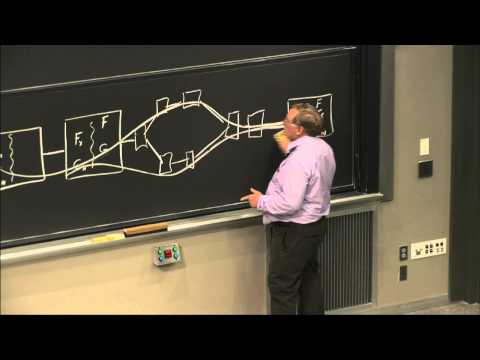
So we might draw a picture that looks like this.
There's the scenario, and here in glorious green,
representing our algae infested rivers is the river.
And here's the farmer, the fox, the goose, and the grain.
An initial situation.
Now there are other situations like this one, for example.
We have the river, and the farmer, and the
goose is on that side.
And the fox and the grain is on that side.
And we know that the farmer can execute a movement from
one situation to another.
So now we're getting somewhere where with the problem.
This is at MIT approach to the farmer, fox,
goose, and grain problem.
It might have stumped you when you were a little kid.
How many such situations are there?
What do you think, Tanya?
It looks to me like all four of individuals can be on one
side or the other.
So for every position the farmer can be, each of the
other things can be on either side of the river.
So it would be two to the fourth she says aggressively
and without hesitation.
Yes, two to the fourth, 16 possibilities.
So we could actually draw out the entire graph.
It's small enough.
There's another position over here with the farmer, fox,
goose, and grain.
And in fact that's the one we want.
And if we draw out the entire graph, it looks like this.
This is a graph of the situations and the allowed
connections between them.
Why are there not 16?
Because the other--
how many have I got?
Four?
10?
The others are situations in which somebody gets eaten.
So we don't want to go to any of those places.
So having got the representation, something
magical has happened.
We've got our constraints exposed.
And that's why we build representations.
That's whey you algebra in high school, because algebraic
notation exposes the constraints that make it
possible to actually figure out how many customers you get
for the number of advertisements you place in
the newspaper.
So artificial intelligence is about constraints exposed by
representations that support models targeted to thinking--
actually there's one more thing, too.
Not quite done.
Because after all, in the end, we have to build programs.
So it's about algorithms enabled by constraints exposed
by representations that model targeted thinking, perception,
and action.
So these algorithms, or we might call them just as well
procedures, or we might call them just as well methods,
whatever you like.
These are the stuff of what artificial intelligence is
about-- methods, algorithms, representations.
I'd like to give you one more example.
It's something we call, in artificial intelligence,
generated test.
And it's such a simple idea, you'll never hear it again in
this subject.
But it's an idea you need to add to your repertoire of
problem solving methods, techniques, procedures, and
algorithms.
So here's how it works.
Maybe I can explain to best by starting off with an example.
Here's a tree leaf I picked off a tree on
the way over to class.
I hope it's not the last of the species.
What is it, what kind of tree?
I don't know.
I never did learn my trees, or my colors, or my
multiplication tables.
So I have to go back to this book, the Audubon Society
Field Guide to North American Trees.
And how would I solve the problem?
It's pretty simple.
I just turn the pages one at a time, until I find something
that looks like this leaf.
And then I discover it's a sycamore, or something.
MIT's full of them.
So when I do that, I do something very intuitive, very
natural, something you do all the time.
But we're going to give it a name.
We're going to call it generate and test.
And generate and test method consists of generating some
possible solutions, feeding them into a box that tests
them, and then out the other side comes mostly failures.
But every once in a while we get something that succeeds
and pleases us.
That's what I did with the leaf.
But now you have a name for it.
Once you have a name for something, you
get power over it.
You can start to talk about it.
So I can say, if you're doing a generate and test approach
to a problem, you better build a generator with certain
properties that make generators good.
For example, they should not be redundant.
They shouldn't give you the same solution twice.
They should be informable.
They should be able to absorb information such as, this is a
deciduous tree.
Don't bother looking at the conifers.
So once you have a name for something, you can start
talking about.
And that vocabulary gives you power.
So we call this the Rumpelstiltskin Principle
perhaps The first of our powerful ideas for the day.
This subject is full of powerful ideas.
There will be some in every class.
Rumpelstiltskin Principle says that once you can name
something, you get power over it.
You know what that little thing is on
the end of your shoelace?
It's interesting.
She's gesturing like mad.
That's something we'll talk about later, too--
motor stuff, and how it helps us think.
What is it?
No one knows?
It's an ag something, right?
It's an aglet, very good.
So once you have the name, you can start to talk about.
You can say the purpose of an aglet is pretty much like the
whipping on the end of a rope.
It keeps the thing from unwinding.
Now you have a place to hang that knowledge.
So we're talking about this frequently from now into the
rest of the semester, the power of being
able to name things.
Symbolic labels give us power over concepts.
While we're here I should also say that this is a very simple
idea, generate and test.
And you might be tempted to say to someone, we learned
about generate and test today.
But it's a trivial idea.
The word trivial is a word I would like you to purge from
your vocabulary, because it's a very dangerous label.
The reason it's dangerous is because there's a difference
between trivial and simple.
What is it?
What's the difference between labeling something as trivial
and calling it simple?
Yes?
Exactly so.
He says that simple can be powerful, and trivial makes it
sound like it's not only simple, but of little worth.
So many MIT people miss opportunities, because they
have a tendency to think that ideas aren't important unless
they're complicated.
But the most simple ideas in artificial intelligence are
often the most powerful.
We could teach an artificial intelligence course to you
that would be so full of mathematics it would make a
Course 18 professor gag.
But those ideas would be merely gratuitously
complicated, and gratuitously mathematical, and gratuitously
not simple.
Simple ideas are often the most powerful.
So where are we so far?
We talked about the definition.
We talked about an example of a method.
Showed you a representation, and perhaps also talked about
the first idea, too.
You've got the representation right, you're
often almost done.
Because with this representation, they can
immediately see that there are just two solutions to this
problem, something that wouldn't have occurred to us
when we were little kids, and didn't think to draw the
[? state ?] diagram.
There's still one more thing.
In the past, and in other places, artificial
intelligence is often taught as purely about reasoning.
But we solve problems with our eyes, as well as
our symbolic apparatus.
And you solved that problem with your eyes.
So I like to reinforce that by giving you a little puzzle.
Let's see, who's here?
I don't see [? Kambe, ?] but I'll bet he's from Africa.
Is anyone from Africa?
No one's from Africa?
No?
Well so much the better--
because they would know the answer to the puzzle.
Here's the puzzle.
How many countries in Africa does the Equator cross?
Would anybody be willing to stake their
life on their answer?
Probably not.
Well, now let me repeat the question.
How many countries in Africa does the Equator cross?
Yeah, six.
What happened is a miracle.
The miracle is that I have communicated with you through
language, and your language system commanded your visual
system to execute a program that involves scanning across
that line, counting as you go.
And then your vision system came back to your language
system and said, six.
And that is a miracle.
And without understanding that miracle, we'll never have a
full understanding of the nature of intelligence.
But that kind of problem solving is the kind of problem
solving I wish we could teach you a lot about it.
But we can't teach you about stuff we don't understand.
We [INAUDIBLE]
for that.
That's a little bit about the definition and some examples.
What's it for?
We can deal with that very quickly.
If we're engineers, it's for building smarter programs.
It's about building a tool kit of representations and methods
that make it possible to build smarter programs.
And you will find, these days, that you can't build a big
system without having embedded in it somewhere the ideas that
we talk about in the subject.
If you're a scientist, there's a somewhat different
motivation.
But it amounts to studying the same sorts of things.
If you're a scientist, you're interested in what it is that
enables us to build a computational account of
intelligence.
That's the part that I do.
But most this subject is going to be about the other part,
the part that makes it possible for you to build
smarter programs.
And some of it will be about what it is that makes us
different from the chimpanzees with whom we share an enormous
fraction of our DNA.
It used to be thought that we share 95% of our DNA with
chimpanzees.
Then it went up to 98.
Thank God it stopped about there.
Then it actually went back a little bit.
I think we're back down to 94.
How about if we talk a little bit now about the history of
AI, so we can see how we got to where we are today?
This will also be a history of AI that tells you a little bit
about what you'll learn in this course.
It all started with Lady Lovelace, the world's first
programmer, Who wrote programs about 100 years before there
were computers to run them.
But it's interesting that even in 1842, people were hassling
her about whether computers could get really smart.
And she said, "The analytical engine has no pretensions to
originate anything.
It can do whatever we know how to order it to perform."
Screwball idea that persists to this day.
Nevertheless, that was the origin of it all.
That was the beginning of the discussions.
And then nothing much happened until about 1950, when Alan
Turing wrote his famous paper, which
introduced the Turing test.
Of course, Alan Turing had previously won the Second
World War by breaking the German code, the Ultra Code,
for which the British government rewarded him by
driving him to suicide, because he happened to be
homosexual.
But Turing wrote his paper in 1950, and that was the first
milestone after Lady Lovelace's comment in 1842.
And then the modern era really began with a paper written by
Marvin Minsky in 1960, titled "Steps Toward Artificial
Intelligence." And it wasn't a long after that Jim
[? Slagle, ?]
a nearly blind graduate student, wrote a program that
did symbolic integration.
Not adding up area under a curve, but doing symbolic
integration just like you learn to do in high school
when you're a freshman.
Now on Monday, we're going to talk about this program.
And you're going to understand exactly how it works.
And you can write one yourself.
And we're going to reach way back in time to look at that
program because, in one day discussing it, talking about
it, will be in itself a miniature artificial
intelligence course.
Because it's so rich with important ideas.
So that's the dawn age, early dawn age.
This was the age of speculation, and this was the
dawn age in here.
So in that early dawn age , the integration program took
the world by storm.
Because not everybody knows how to do integration.
And someone, everyone, thought that if we can do integration
today, the rest of intelligence will be figured
out tomorrow.
Too bad for our side it didn't work out that way.
Here's another dawn age program, the Eliza
[? thing ?].
But I imagine you'd prefer a demonstration to
just reading it, right?
Do you prefer a demonstration?
Let's see if we can demonstrate it.
This is left over from a hamentashen debate of a couple
of years ago.
How do you spell hamentashen, anybody know?
I sure hope that's right.
It doesn't matter.
Something interesting will come.
OK, your choice.
Teal?
Burton House?
Teal.
So that's dawn age AI.
And no one ever took that stuff seriously, except that
it was a fun [INAUDIBLE]
project level thing to work out some matching
programs, and so on.
The integration program was serious.
This one wasn't.
This was serious, programs that do geometric analogy,
problems of the kind you find on intelligence tests.
Do you have the answer to this?
A is to B as C is to what?
That would be 2, I guess.
What's the second best answer?
And the theories of the program that solve these
problems are pretty much identical to what you just
figured out.
In the first case you deleted the inside figure.
And the second case is, the reason you got four is because
you deleted the outside part and grew the inside part.
There's another one.
I think this was the hardest one it got, or the easiest one
it didn't get.
I've forgotten.
A is to B as C is to 3.
In the late dawn age, we began to turn our attention from
purely symbolic reasoning to thinking a little bit about
perceptual apparatus.
And programs were written that could figure out the nature of
shapes and forms, such as that.
And it's interesting that those programs had the same
kind of difficulty with this that you do.
Because now, having deleted all the edges, everything
becomes ambiguous.
And it may be a series of platforms, or it may be a
series of--
can you see the saw blade sticking up if you go through
the reversal?
Programs were written that could learn from a small
number of examples.
Many people think of computer learning as involving leading
some neural net to submission with thousands of trials.
Programs were written in the early dawn age that learned
that an arch is something that has to have the flat part on
top, and the two sides can't touch, and the top may or may
not be a wedge.
In the late dawn age, though, the most import
…