en English
Untitled English subtitles
Report a problem
Advertisement
English transcript
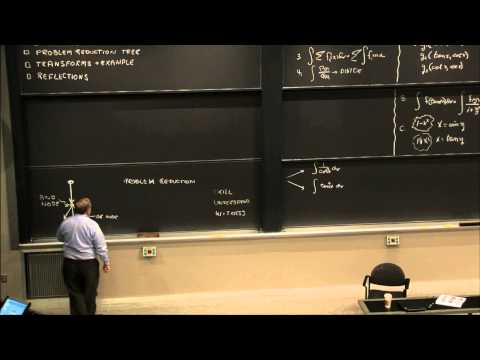
What we're going to talk about today, is goals.
So just by way of a little warm up exercise, I'd like you to look at that integration problem
over there. The one that's disappeared.
So the question is, can you do it in your head? Probably not. The question is, if a
program can do that, is a program, in any sense of the word, intelligent? That's a background
task I'd like you to work on as I talk today.
So today we're going to be modeling a little bit of human
problem solving, the kind that
is required when you do symbolic integration. Now, you all learned how to do that. You may
not be able to do that particular problem anymore, but you all learned how to integrate
in high school 1801, or something like that. The question is, how did you do it, and is
the problem solving technique that we are trying to model by building a program that
does symbolic integration, is that a common kind of description of what people do when
they solve problems.
So the answer to the question is, yes. The kind of problem solving you'll see
today is like generating tests, which you saw last time. It's a very common kind of
problem solving that we all engage in, that we all engage in without thinking about it,
and without having a name for it.
But once we get a name for it, we'll get power over it. And then we'll be able to deploy
it, and it will become a skill. We'll not just witness it, we'll not just understand
it, we'll use it instinctively, as a skill.
So there you are, you've got that problem, there's your problem, and what do you do to
solve it? I don't know, look it up in a table? You'll never find it in a table because of
that minus sign and that 5. So you're going to have to do something better than that.
So what you're going to do, is what you always do when you see a problem like that. You try
to apply a transform, and make it into a different problem that's easier to solve. And eventually,
what you hope is that you'll simplify it sufficiently, that the pieces that you've simplified to
will be found in some small table of integrals. So how long is this table? It's not the case
that we're going to look at a table with 388 elements, because this is not a big table
of integrals. This is what a freshman might have in a freshman's head, after taking a
course in integral calculus.
One of the interesting questions is, how many elements have to be in that table to get an
A in the course? We're interested in how much knowledge is involved, that's one of the elements
of catechism that I've listed over there, that will be part of the gold star ideas suite
of the day.
So we'd like to take that problem, and find a way to make it into another problem that's
more likely, or closer to being found in the table. So what we're going to do is very simple,
graphically. We're going to take the problem we're given, and convert it into another problem
that's simpler. And we're going to give that process and name, and we're going to call
it problem reduction.
And so, in the world of integral calculus, there are all sorts of simple methods, simple
transformations, we can try that will take a hard problem and make it into an easier
problem. And some of these transformations are extremely simple and always safe. Some
of them are just, well let's try it and see what happens. But some of them are safe, and
I'd like to make a short list of safe transformations right now.
Now I'm going to be going into some detail. And that detail will be grungy. And the question
is, why do I do it? And it's educational philosophy, is why I do it. So here's the educational
philosophy. At one level, you want to have a skill. But if you're going to have a skill,
you have to understand it. So if you're going to have a skill you have to understand it
one level down. If you're going to understand it, you have to have witnessed it on a level
lower than that.
So I'm not just going to talk about the idea of problem reduction, because if I were just
going to do that, then we could all go home now. So I'm going to show you a particular
example of it, so you understand it better, and I'm going to show you the detail at an
even lower level than that. So you will witness the stuff that makes it possible, to understand
the stuff that makes it possible, to build a skill. So that's why I'm going through the
grungy detail.
So I don't know, let's see. Maybe we can get some hints from that example, but I wonder
if somebody could volunteer a simple transformation that always is a good thing to do. Yes, Sebastian.
AUDIENCE: Take the constants out.
SPEAKER 1: Take the constants out. So we'll make that number two. And we'll say that the
integral c f of x dx is equal to c times the integral f of x dx. Other suggestions? Yes.
AUDIENCE: Trig substitution.
SPEAKER 1: Trig substitution. Now this is-- no, that's for day two. We don't do trig substitution
here under stuff that's safe, always works, never any doubt, there are simpler things.
These are the safe transformations. What you're giving me is a heuristic transformation. Often
is helpful, doesn't necessarily always work. We're going to divide our transformations
into those two categories. So I need another safe one.
AUDIENCE: [INAUDIBLE]
SPEAKER 1: The architects are sitting over there. Divided not only by nationality, but
by course. What?
AUDIENCE: The sum of integrals is the integral of the sum.
SPEAKER 1: The sum of integrals is the integral of the sum. Now what's missing? What's number
one? You're probably thinking it's already there, because you've given me the transformation
that involves a constant. And you can think of minus 1 as a constant.
But whether you use a separate transformation or not, of course depends on how you represent
the knowledge. And all of this knowledge, all of this whole thing, was written in an
early form of Lisp. As a consequence, the way in which minus was represented is different
from the way minus 1 is represented. So we need one more transformation. Or rather, Jim
Slagle needed one more transformation, when he wrote his famous transformation program.
And that was that if you have the integral of minus f of x, that's equal to, minus the
integral of f of x.
So that almost completes our safe transformation set. There's one more that I'm going to supply
you, because I don't think you'd guess it. Why should you? It's number four. There are
more than this, this is a sample. And these are the ones we're going to need in order
to solve that problem, by way of illustration.
So the fourth one is that, if you have the integral of p of x, over q of x, then you
divide. If you can reach way back into high school and figure out how to divide polynomials.
But if the degree of the numerator is greater than the degree of the denominator, then it's
a knee-jerk always win, you must do it, divide it out.
So this, then, forms the core of an integration program, that will integrate almost nothing.
But actually, almost nothing is integrable anyway, so it's a good head start. So let's
see how we would put this into some kind of procedure. Some kind of framework for deploying
the knowledge that we're beginning to develop.
What we're going to do is, apply all safe transforms. That's our first step. Then we're
going to look in the table, and then we're going to do a test to see if we're done. And
if we are, we report success. But, we're not likely to get done with just that stuff.
But you know what, there was one transformation up here, which breaks my little diagram. Which
one is it? It's the third one, right? Because this picture does not reflect what happens
when you apply number three. Because it breaks the problem up, not into just one problem,
but into a whole bunch. So we have to extend our graphical device for talking about this
by a little bit, and show what is called an "and node".
So we've got a program core, we've got a table of integrals, we've got a few transformations,
we've got an architecture, a way of putting that stuff together. And now we can try it
out on our sample problem. So let's have a go at that.
Let's see, this one immediately transforms into 5x to the fourth over 1 minus x squared
to the 5/2 dx. And that in turn, immediately transforms into the integral of x to the fourth
over 1 minus x squared to the 5/2, dx.
This program, by the way, is a dawn-age program. This was written by a nearly blind, and subsequently
completely blind, graduate student by the name of James Slagle in 1960, a long time
ago. The reason I gave it to you today is because, that by describing it, I am giving
you a one-lecture course in artificial intelligence. He anticipated so much of the subsequent 20
years, that talking about his program, which is possible in one day, is a miniature introduction
to the whole field.
So Slagle, as he was doing this on an antique computer, almost no memory, almost no speed,
only slightly faster than mice running around on a treadmill. He was able to write a program
that did extremely well when benchmarked against freshmen. And the way you benchmark against
freshman, of course, is you give it an examination, drawn from the previous MIT finals for four
or five years, the hardest problems. And this was the hardest problem that it solved.
So at this point, with what we've got so far, we would be stuck. We have no transformation
that can take us further, so we need something else. And what we need by way of something
else, is some transformations that we will describe as-- perhaps we'll call them, heuristic
transformations. A funny word, meaning a method that often works isn't guaranteed to work.
It's not an algorithm in the usual sense that we talk about algorithms. But rather, it's
an attempt.
So these things I'm going to talk about now, are sometimes useful, not always useful. Sometimes
take you into a blind alley, don' always work. But you can't get an A in calculus without
knowing some of them. So you said, some kind of trig substitution. So here is some kind
of trig substitution. We'll call this heuristic transformation A.
You have a function sine x, cosine x, tangent of x, cotangent of x, secant of x, and cosecant
of x. And we all know from high school trigonometry, that we can rewrite that as a function of
sine x, and cosine x. Or we can rewrite that as a function of tangent of x, and cosecant
of x. Or we can rewrite that as function of cotangent of x, and the secant of x. So that's
a transmission from trigonometric form, into another trigonometric form. It's not always
a good idea, sometimes it helps.
Well that's just part one of our suite of heuristic transformations. Stop. There are
others that we need to have in our repertoire, in order to solve the problem. One of them
is a family of transformations, which I'll show you only one. It goes like this, if you
have the integral of a function, of the tangent of x, then you can rewrite that as the integral
of a function of y over 1 plus y squared dy. So that's a transformation from a trigonometric
form into a polynomial form. So it gets rid of all that trigonometric garbage we don't
want to deal with. And there's a whole family of things like that, just as there's a family
of transformations like so, but this is enough to give you flavor.
Now there's a C that we need as well. And that's going to be your proper knee-jerk reaction
when you see something of the form 1 minus x squared. What do you do when you see that?
AUDIENCE: [INAUDIBLE]
What's that Rhana?
Rhana: 1 + 6 * 1 - 6
Well wait a second. We could do that. But there's another thing we can do.
Christian, have you got something you can suggest? Where's our Hungarian? Our Turk,
our young Turk. Yeah, what do you think?
AUDIENCE: I actually don't remember. I mean, I think it might have been 10.
SPEAKER 1: Well, let's see. Cosine squared plus sine squared equals 1. So, what's that
suggest to you? So it suggests that we make a transformation that involves x equals sine
y. So [? Silla ?] doesn't actually have to remember that anymore because going forward,
she will never have to integrate anything personally in her life, she can just simulate
the program.
So these go from polynomial form, back into trigonometric form. So you have three of these
heuristic transformations. We've got four safe transformations. Let's see if we can
make any progress on our integration problem.
OK so keeping track of what we've been using, this is safe transformation number one, this
is safe transformation number two. What do we do next? We decided there were no more
safe transformations that apply. But now we can look at our heuristic transformations
and behold, we see what?
AUDIENCE: C
SPEAKER 1: What?
AUDIENCE: Applying transformation C.
SPEAKER 1: Transformation C suggests that we do x equals the sine y.
And now we get the integral of sine to the
fourth y over cosine to the fourth y dy, right. All good, I see some confused, worried, concerned
looks. Maybe I've made a mistake, perhaps I should use notes. Well no, wait a minute.
For those of you who have a concerned look, remember that if x equals a sine y, then dx
is equal to cosine y dy. That's why it's cosine to the fourth not cosine to the fifth, as
you were perhaps thinking it might be.
So now we've made some progress. We look at this, we say, are there any safe transformations
that apply? And the answer is, no. Now we look for a heuristic transformation that might
apply, and I say, what do you see? Which one? What's that?
AUDIENCE: [INAUDIBLE].
SPEAKER 1: She said something unintelligible, but what she probably said is, that this looks
like a pattern that might match with the heuristic transformation A, right? Because we have a
function in which the variable is buried, universally in sines, or cosines, or tangents,
or cotangents, or secants, or cosecants. And we know we can rewrite that in one of three
ways. It's already written as a function of sine and cosine. But we can also rewrite that
in terms of tangent and cosecant. Or cotangent and secant.
So when we do that, we can go this way, and we can get the integral of 1 over the cotangent
of x dx. That's g3 up there. Or we can do it down this path, and get the integral of
tangent of x dx. And of course, those are both to the fourth.
But know what, I've broken my little graphical diagram again. Where did it go, it's disappeared.
There it is. How have I broken it? Because with transformation A, I've introduced a possibility
that a particular problem can be transformed into more than one kind of problem, any of
which will be the solution to my problem.
So far I've got an and node, but now I've got to introduce an or node. Because now we
have an example of something that can be solved one of two different ways, and we don't care
which one it is. Now you'll notice that there's already some confusion here, because how can
you tell the difference between an and node and an or node. So the universal convention
is, you draw an arc over the and nodes. And that makes it look like an A, so it's easy
to remember. So those are and nodes.
And now, we have the method of problem reduction, and this is sometimes called a problem reduction
tree. Sometimes it's called an and/or tree, and sometimes it's called a goal tree, because
this tree of problems is a tree that shows how our goals are related to one another.
So these are items for your vocabulary that are all synonymous. Problem reduction tree,
and/or tree, goal tree, all the same thing. Now you have a name for it, you've got some
power over it. So when we get a situation like this, unlike the previous situation,
which we suggested might come up in transformation A. Let's see, we've got one, two, C, and this
one is A, it's an or node. Which one of these problems do we work on?
Well Slegle, who considered himself to be modeling a freshman, modeling the intelligence
of a freshman, modeling something that, after all, you have to be pretty smart to do, right.
Most people don't know how to do integration. Everybody at MIT knows how to do integration.
You would think that somebody, therefore, that knows how to do integration is pretty
smart. What would a smart person do, when faced with this choice?
Well, a smart person would say, which of these two problems is easier? So how do you think
you might determine which of two, or many algebraic expressions is the easiest to integrate?
What's your name?
AUDIENCE: Andrew Carrol.
SPEAKER 1: Andrew, what do you think?
AUDIENCE: Based on whichever one feels more familiar.
SPEAKER 1: Feels.
AUDIENCE: Yes.
SPEAKER 1: Feels.
AUDIENCE: You asked, how would I decide.
SPEAKER 1: Yeah, how would you decide? How would you feel it?
AUDIENCE: I would feel that the tangent is more familiar.
SPEAKER 1: Which one?
AUDIENCE: I feel that the tangent [INAUDIBLE].
SPEAKER 1: Yeah, but I wonder how we could make it a little bit more precise, this idea
of simplicity. The young Turk has a suggestion. What?
AUDIENCE: I had a suggestion until you said this idea of simplicity. So then I realized
that what I was about to suggest wasn't going to clarify simplicity, but I was going to
say, whichever one we've had more encounters with, or more experience with.
SPEAKER 1: Yeah, if there was something here with a hyperbolic tangent, you might say,
well, stay away from that. [? Yinid ?]?
AUDIENCE: To which one of those the easier transformation is applied on the next step.
SPEAKER 1: Like, somebody do a little look ahead, and see which kind of thing would be
next to you? I don't know, maybe. Oh, we've got lots of people, all at the same time.
I don't know all your names yet. Shoot. Erica, I know you.
AUDIENCE: What's look it up in the table and see [INAUDIBLE].
SPEAKER 1: Oh, you could look it up in the table and see if something is in it, you could
do that. But this is tangent to the fourth, so that's not in the table. Ariel?
AUDIENCE: I choose the one without the reciprocal.
SPEAKER 1: Why?
AUDIENCE: It is because when people see one it's like, oh man, it jut not going to work.
SPEAKER 1: Yeah, we're on the right track. Claire?
AUDIENCE: On an extremely simple level, I choose whichever one has the least symbols
in it.
SPEAKER 1: The fewest symbols in it. Now we're really getting somewhere, because you can
measure that, right, there's a little program Why Brett, there you are.
AUDIENCE: I would say, every [INAUDIBLE] expression can be written as, having a number of functions,
we could say all these functions, multiplied together, divided, and you can just choose
with the least amount of [? iterations ?].
SPEAKER 1: Well I heard it, perhaps others didn't but what Brett said, is he suggested
that we should measure depth of functional composition. So the number of symbols may
not matter, because if you have x plus x plus x plus x, out to a hundred, that would not
be hard to integrate. But if you've got something that is really deeply nested under a lot of
functional compositions, that could be a problem. And that's in fact, what Slegle decided to
use, after trying several alternatives.
So if we measure the depth of the functional composition, this is the winner, and we put
the other one on the shelf, at least for the moment. And now we have tangent to the fourth
x dx. Do I need the safe transformation supply? No. Which of the-- you know something has
to apply, otherwise it wouldn't be up here as an example. So what of the heuristic transformation
supply? Elliott.
AUDIENCE: [INAUDIBLE]
SPEAKER 1: Yeah, B bravo. Military background or something like that. Maybe
he flies airplanes. OK so B says, it is in fact a function of the tangent. And when we
do that, we've got to make a substitution, that y is equal to the tangent. So that means
that this becomes the integral of y to the fourth over 1 plus y squared. And that's by
transformation B, and the transformation is y equals tangent of x. The tangent-- I guess
I've lost track of the fact that I've already transformed a y, but relabeling doesn't matter.
All right so that's progress, maybe. But don't see this in any of the heuristic transforma
…