en English
Untitled English subtitles
Report a problem
Advertisement
English transcript
The following content is provided under a Creative
Commons license.
Your support will help MIT OpenCourseWare
continue to offer high-quality educational resources for free.
To make a donation or view additional materials
from hundreds of MIT courses, visit MIT OpenCourseWare
at ocw.mit.edu.
PROFESSOR: Hope everyone had a great Veteran's Day break
yesterday, spending it, of course,
as I check my test audience, spending it mostly doing
your [INAUDIBLE] research or PSETs.
But at least one person got to watch TV.
So at least one person got to have a real break,
and that's something truly amazing and special.
So now we're going to talk about SVMs.
They're pretty much the hardest thing in 6.034.
However, in recent years a few shortcuts
have popped up that will sometimes
allow you to solve the question, depending on what they're
asking for, without solving some vast ugly set of equations
with a vast ugly number of unknowns.
So I'm going to show that to you guys.
I'm also going to try to explain all the alphabet
soup that's in [INAUDIBLE] and what all the letters stand
for because it took me a few times going through SVMs.
It took me a few times going through SVMs
to actually find out for sure what
all those letters stood for.
And if you guys figure it out first try,
that's going to be great, and you guys will be just fine.
So let's take a look at the problem that's perhaps
most optimized for using some of the shortcuts to solving it
and not putting up all the equations.
Then I will-- not because I'm sadistic,
but because I'm being nice, I will force you with me
to solve some of the things they didn't ask for us to solve so
that you can see that we can't get away
with everything without doing some of the harder stuff.
And of course, definitely ask questions as always,
but this time even more so.
You guys, well, if you were looking around,
you saw nobody in this entire lecture hall
raised their hand that they are already set and ready
and know SVMs.
So if you have a question, maybe everybody else does.
So let's go.
We'll start right here.
As always, pretend that I can draw,
and that therefore all the pluses and minuses are only
on integer coordinates.
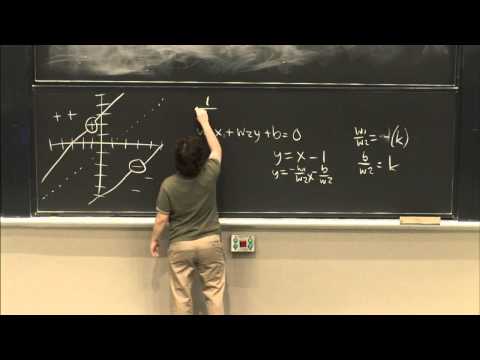
So we are asked in this problem to circle the support vectors.
Draw the edges of the street and then the dotted line
in the middle that separates them,
the separator, as a dashed line.
And then to give w and b.
So what are w and b?
Well, there's a few important equations in SVMs
that we really hope-- and I'm going
to tell you we're lucky in this because we don't have to--
but we really hope that we don't have
to use because they provide a huge number of variables.
So one of those crucial equations
is that for a plus support vector, w vector dot x plus,
the plus support vector, plus b equals 1.
w dot x minus plus b equals minus 1.
And w dot that dotted line-- I don't know,
we'll call it dot dot dot-- plus b equals 0.
So what does this mean?
There are a lot of vectors.
Well, I mean, we're usually in two-dimensional space,
so we can basically just say that there's
two components of this w vector, w1 and w2.
And they're just two coefficients
in a linear equation.
So for instance, what we're interested in finding,
this dot dot dot line, we'll just
call that x, so with nothing on it.
Actually, maybe that'll be easier.
This is equivalent to saying w1x1 plus w2x2 plus b equals 0,
where x1 is this, and x2 is this.
We would possibly call them x and y.
So one way to think about it is w1,
we'll call it a, ax plus-- call w2 b-- by.
Oh, don't call it b.
Well, ax plus cy plus b equals-- I'll put this all in
parentheses-- this is basically an equation like this.
Or y equals negative a over c x minus b over c.
It's basically y equals mx plus b.
Does everyone see that?
This thing that we're looking for,
this w dot x plus b equals 0, is the equation
of a line in Cartesian coordinates.
It just looks uglier.
Normally, when we're doing all this solving for w and b,
we would have to put in tons of equations,
plug in all of the support vectors in there.
And we'd have to use these little devils called alphas.
Alphas essentially-- if it wasn't clear
in the lecture, which it usually isn't completely
clear to everyone, wasn't clear to me completely-- alphas,
the way I like to think about them,
the alphas in this problem is they
are the weight of how significant any particular
point on the graph is towards creating the boundary.
The higher the alpha is, the more
that that point narrows in the boundary.
The lower the alpha is, the less that that point narrows
in the boundary, the wider the road can be.
And if that point doesn't do anything,
if that point is irrelevant and could be removed
and it wouldn't affect the boundary, the alpha is?
Everyone?
AUDIENCE: Zero.
PROFESSOR: Zero.
Well, that was one person, but you can suffice for everyone.
The alpha is 0.
And that means if it's not a support vector, if it's not
one of the vectors on the boundary lines,
it will always have an alpha of 0 because it doesn't affect.
So keeping that in mind, there's a few fun
and important equations about alphas
that we'll need if we're solving many equations
for many unknowns, which hopefully we won't have to do.
The sum over the positive alphas equals
the sum over the alphas-- the negative points.
And this is true over all the points.
But since all of the alphas are 0,
except for the support vectors, it also
means the alphas of the positive support
vectors are equal to the alphas of the negative support
vectors.
Additionally, our old buddy, the w vector,
is equal to the sum over all i that
are plus vectors of wi alpha i minus m over j
minus vectors of wj alpha j.
Now, all of these equations can be used in a bloody mess
to figure out the answer to what we're trying to find,
which is circles-- well, actually, they
can't be used as circle support vectors
and draw the dotted line.
But once we do that, all these equations
can be used in a bloody mess to give us the next thing that we
want, which is w and b.
So fortunately, there's another way to get w and b.
If you guys really want, at the end of the hour
we can also try to derive w and b using
the many equations in many unknowns,
but it's a bit painful.
We'll try to do it the cool way.
So let's start off.
This is the one we're looking at.
We need to find where the support vectors are.
So the first thing we need to do is simply eye it.
Fortunately, on the test, there will always
be ones that you can eye if you're supposed
to circle the support vectors.
There's obviously some number of pluses
and some number of minuses.
I say obviously, but maybe not.
But hopefully obviously, and we'll
find out because I'm going to call on random people.
So give me a positive support vector.
AUDIENCE: Um, going to the one that looked like [INAUDIBLE]?
PROFESSOR: Which plus sign, [INAUDIBLE]?
AUDIENCE: One on the right.
PROFESSOR: The one all the way on the right.
Yeah, that plus sign is a positive support vector.
That's good.
All right?
Excellent.
Now, give me a negative support vector.
That one?
No?
AUDIENCE: Yeah, sorry.
PROFESSOR: Ah, no problem.
Give me a negative support vector.
AUDIENCE: I should definitely ask
you, what's a support vector?
[LAUGHTER]
PROFESSOR: That is a good question.
The question is, what is a support vector?
How many other people will admit to having this question?
See?
You're not alone.
OK.
Before I go on, I'm going to assume-- you guys make
sure I'm correct-- Monday was, just being sure
so I can tailor based on this.
Monday was the support vector machine lecture.
But it was also very difficult to follow.
That's what I usually expect.
So what is a support vector?
Well, all these pluses and minuses, if we were me,
and if, I guess-- yeah, if we were me
and if I was describing this problem, the one that we work
out in class, I would call them points
because they're on the graph.
They're points.
They're data points.
But however, in more difficult versions of this problem
that have n dimensions, where n is
some ridiculous number of dimensions
that you're never going to graph.
Like say some of the research I'm doing now,
I could use support vector machines
on some of these articles that I'm reading about cyber events
to try to figure out if there's a real event
or if it's just someone complaining about how we're
really vulnerable or something like that
and no event actually happened.
So the reason why they call these guys vectors is
when you're not able to graph them on a Cartesian plane,
there's still this long vector of many different dimensions.
Right now, though, these points represent the vectors.
This is very simple.
It's easier to view them this way.
But for instance, that plus at negative 1, 2
represents the fact that there is
a vector going in the direction of negative 1, 2
with a magnitude such that it reaches negative 1, 2.
So all these points are just a point representation
of a vector.
You probably, in any class that worked with vectors,
saw this, saw vectors being represented as points.
Question?
AUDIENCE: Always from the respect to the origin?
PROFESSOR: Yes.
The question is always with respect to the origin.
The answer is canonically, when vectors
are represented as points, yes, it's always
with respect to the origin.
So that's the basic idea is that all these points are vectors.
So what are support vectors?
Well, you could call them support points for this case.
But the reason we call them support vectors
is again, in the generalized case
that you might be doing in the real world with real AI,
you're going to have a giant vector.
And it's not just going to be points on a graph.
Well, usually.
So the support vectors, the support points,
we found one of them correctly.
It's this guy.
They're going to be the ones that again, they
don't have an alpha of zero.
They're the ones that bind in the, as Petra calls it,
the road, the boundary lines.
They're going to be on the edge of plus.
Whichever direction we draw it, this plus
is the edge of the plus region.
If we made this the edge of the plus region
and everything on this side is plus and everything
on this side is minus, we'd be screwed
because there's two pluses on the other side of that.
Generally, when trying to find a support vector,
you do something a little bit similar to my crazy method
of doing nearest neighbors, and try
to find a plus-minus pair that's close to each other.
Sometimes though, it's not just two points
because sometimes if you try to draw the simple-minded
thing, which is the perpendicular
bisector of the two points, you get screwed because there's
another point in your way.
So now that I've given away a clue,
let's go-- and hopefully that made sense to you guys.
The support vectors are the ones on the edges that
are just barely a plus for sure, or just barely
a minus for sure.
Let's go back.
Can you give me a negative support vector?
AUDIENCE: The top one?
PROFESSOR: Hmm?
AUDIENCE: The top negative point?
PROFESSOR: The one on the top left?
Yes.
And does anyone think that there's a third support vector?
Well, let's simple-mindedly try the thing that-- remember,
support vectors always attempt to have
the widest possible space between the pluses and minuses
that they can.
So let's simple-mindedly try to do the perpendicular bisector
and see if screws us over.
So when we simple-mindedly do the perpendicular bisector,
it goes through here like this.
And it's just fine.
So these are the only two support vectors.
And there's our divider line.
So we're on the home stretch.
But we have to find w and b.
In olden days, we would find w and b by plugging in w dot
the plus support vector, plus b equals 1.
Oh, that's very crucial.
These w dot x plus x minus are only
true equaling 1 or negative 1?
Or only true for support vectors?
It's always true that w dot any positive point plus b will
be some positive number.
But it won't always be 1.
In fact, it will always be greater than 1 up over here.
It will always be less than -1 down over there.
In olden days, we would plug in -1, 2 into this equation.
We would plug in 3, -2 into this equation.
We'd plug in alpha plus equals alpha minus in its sums.
And since there's only 1 plus 1 minus,
we'd know they were equal.
And then we'd fidget around with this w equation.
However, there is a better way to do it.
And so let's use this cheap strategy
to solve this version of the SVM.
Here's how.
First, and I know I didn't draw these completely straight.
Sorry.
But can anyone, by looking at-- this is three, -2.
2 And this is -1, 2.
Can anyone tell me what the equation-- you can do y
equals mx plus b.
Can anyone tell me what the equation of the dotted line
is supposed to be if I was good at drawing?
AUDIENCE: [SEVERAL ANSWERS]
PROFESSOR: People say y equals x minus 1.
And I say yes, y equals x minus 1.
So therefore, the pluses would be
y is greater than or equal to x minus 1 indeed.
So we've already seen that w dot x plus b somehow can
be converted into this form.
Right?
So therefore, if we have y equals x minus 1,
then we know that we have we have w dot x plus b equals 0.
Let's do that here.
So we know that w1 x1.
We can even call it x and y.
I think it'll be fine.
No one will come after us.
w2 y plus b equals 0.
But we also know that y equals x minus 1,
which means that if y equals x minus 1,
then according to this thing we have over here,
then negative w1 over w2 equals--
So we know that negative w1 over w2-- and we have -b over w2.
So y equals x minus 1.
And if we solve this equation to make it look like this,
we would have y equals negative w1 over w2 Minus b over w2.
So we know that in some way, shape, or form-- we know that
then therefore, w1 over w2 is some scalar
multiple of minus 1.
And we know that b over w2 is, in fact, some scalar
multiple of positive 1.
Scalar multiple, what's a scalar multiple?
Well, why is it a scalar multiple?
Why isn't it just going to be negative 1 or positive 1?
Just because in this equation, we
can multiply the entire equation by any number
and it will still have the same boundary line.
You guys see that?
Oh, there's an x here.
If we multiplied everything, since it's all divided by w2.
If we double w2, but also doubled b and w1,
it would be the exact same equation.
Do you guys agree?
So there's, in fact, infinitely many possible equations.
You say, well, great, Mark.
You've figured out what form it is.
So you figured out that w1 over w2
equals some scalar multiple of negative 1.
So it's negative 1 times-- what's
everyone's favorite letter?
AUDIENCE: k.
PROFESSOR: k.
Negative 1 times k.
And we figured out that b over w2 is--
I guess we can just do negative -- is positive k.
But what's k?
How are we going to figure it out?
Well, it's a good question.
And I will tell you how.
I will assert the following fact as true without proof.
Then I will not prove it.
1 over the magnitude of w, which is this vector here
with w1 and w2, equals this where
this is that line that I just drew, the line from here
to this point.
1 over the magnitude of w equals this.
Therefore, since 1 over the magnitude of w equals this,
and this equals, I believe, 2 root 2,
because we're going over to, down to,
Pythagorean Theorem, 2, root 2.
So therefore, flip everything over.
Magnitude of w equals 1 over 2 root 2.
So therefore, magnitude of w equals root 2 over 4.
But why are we OK?
Well, how do we calculate the magnitude of w?
Do people know, in general, magnitudes of vectors?
Generally, for these vectors, we do it
by the square root of the sum of the components squared.
So the square root of w1 squared plus w2 squared
equals root 2 over 4.
But that's not all.
That's not all, we say, because we know from this over here
that the ratio of w1 and w2 is--
AUDIENCE: [SEVERAL ANSWERS]
PROFESSOR: Yeah, the ratio of w1 and w2
is going to be-- actually, sorry.
I shouldn't put a k here.
I realize I probably have been confusing you guys a lot.
w1 over w2 is just -1.
B Over w2 is just 1.
That's just a fact.
There's no k.
The k is to determine what w1 and w2 are.
So w1 equals -k.
And w2 equals positive k.
And b equals also positive k.
By the way, here's a question for you.
Could I have put the negative sign on w2 and b
instead of on w1?
So many people said yes.
That's a very smart answer.
Actually, no, because of the fact
that the pluses are on the negative x-axis.
It's just a little trick I picked up.
When one of them is negative and the other one isn't, follow
the pluses.
So we know that w1 is -k, w2 is positive k,
and b Is positive k.
w1 over w2 is -1.
b over w2 is positive 1.
So what do we know about the ratio of w1 and w2?
It's equal to -1.
And that means that when we square it,
w1 squared equals w2 squared.
So therefore, this is the square root
of 2 w1 squared, which equals root 2 w1.
Well, actually no, it doesn't equal root 2 w1
because w1 is actually negative.
So it's negative root 2 w1.
It doesn't matter.
The point is that if that equals root 2 over 4,
then w1 is-- everyone?
AUDIENCE: Negative 1/4.
PROFESSOR: Negative 1/4.
Bingo.
And if w1 is -1/4, 1 everything else falls into place.
What are w2 and b?
Everyone?
AUDIENCE: Positive 1/4.
PROFESSOR: Positive 1/4.
We got it.
We're done with this part of problem.
However, bonus.
Let's come to the alphas, which they
didn't ask you to calculate.
Actually, you know what?
We'll do the alphas if we have enough time,
since they didn't actually ask you to calculate them.
However, my recommendation is since there's only
one alpha-plus and one alpha-minus,
they must be equal from this equation,
since the sum of the alpha-plus equals the sum of alpha-minus.
And so therefore, w equals the sum of w-- sorry,
this should be an x.
Of course, there's not a million w's in this equation.
The sum of the positive data points times their alpha
is minus the negative data points times their alphas.
So we're looking at here -1/4, 1/4 equals-- what
do we got here?
Positive point negative 1, 2?
So we've got alpha, alpha of that point negative 1, 2 minus
alpha of that minus point.
And what is that?
It's 3, -2.
3, -2.
So if both of the alphas which are equal were 1,
we'd have -4, 4.
But we want -1/4, 1/4.
So actually both of the alphas are 1/16.
And that's the answer.
We'll do that more in depth if we have time.
But we won't.
So let's do number two.
So let's go into faster mode.
Number two, very similar to number one in many ways.
But as you can see, one of the main things that they added
an extra minus sign at 2, -1.
So I think we can all agree that this will still
be our plus-- Actually, they added another plus sign there,
too.
So maybe this plus sign is a support vector.
But it's not.
This plus sign is a support vector.
What do you guys think about the new negative sign?
Will it become a support vector since it is strictly
closer to the pluses?
Yep, you're right.
OK, so this is a very beautiful division
because if I do this correctly, which I didn't, but if we
pretend that I did.
Then the dotted line is--
AUDIENCE: [INAUDIBLE].
PROFESSOR: y equals x.
OK, so with the dotted line at y equals x, then
just like we did up here, we know that if y equals x plus 0,
we know that first of all, b equals 0.
Second of all, we know that if y equals x, then
we know that -w1 over w2 equals 1.
The pluses are still on the left and up,
so we know that w1 is some negative number, -k,
and w2 is some positive number k.
Great.
How are we going to figure it out?
Well, let's call this d for distance,
or whatever you want to call it.
So 1 over w equals d.
d In this case is not 2 over 2.
Can everyone tell what d is here?
AUDIENCE: [INAUDIBLE]
PROFESSOR: It's actually-- so it goes over 2 and 1.
So it should be 1 1/2 root 2 since this width distance,
which is twice as much, goes over 3 and 3,
which is 3 root 2.
So it's 1 1/2 root 2.
I don't like putting in decimals and stuff there.
So we'll say that 2 over magnitude of w
equals 2d equals 3 root 2.
So therefore, right, Pythagorean, one, two, three,
one, two, three, 3 root 2.
So therefore, magnitude of w equals-- let's see.
Switch
…