en English
Untitled English subtitles
Report a problem
Advertisement
English transcript
In the aftermath of a terrorist attack, we’re always left asking the question: how could
anyone do this to another person? While nothing can excuse their actions, maybe psychology
can help us understand the mind of a terrorist.
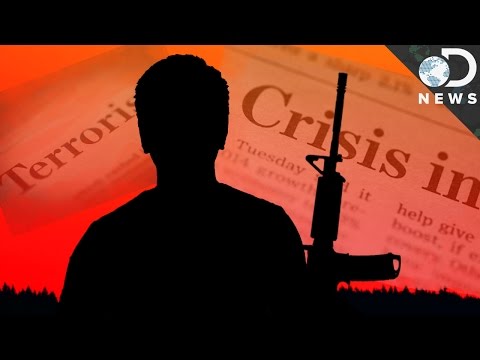
Hello everyone, I’m Julian and this is DNews. Terrorists are defined as a non-state group
that use violence against non-combatants for political gain. Their goal is to instill fear,
and they achieve it by targeting innocent people where they feel safe. This brutality
is hard for us to comprehend, so some may reason that a terrorist must be mentally unstable
in some way.
According to psychologist John Horgan, who has written multiple books on the subject
of terrorism, psychologists have been trying for over 40 years to identify the personality
disorder that defines a terrorist. Are they psychopathic? Are they anti-social? Is there
one defining characteristic that unites them?
Unsatisfyingly, there is no one archetype that every terrorist neatly conforms to. There
are risk factors and common threads though. Recruits are often motivated to join terrorist
groups because they feel alienated or disenfranchised, or think they are the victims of a social
injustice. They may be frustrated by other methods of political change, want to take
immediate action, and don’t have a problem with violence against the state.
Psychologist Steve Taylor from Leeds Beckett University in the UK writes that it’s often
adolescent men who are drawn to this life, because they’re at a point when they are
looking for a sense of belonging and purpose. Once in the group, they develop an “us”
vs “them” mentality that makes it easy to switch off empathy to the victims of their
attacks. To them the deaths they cause are more akin to destroying an object than ending
a life. Strangely though, sometimes they draw arbitrary lines. Horgan interviewed a former
Irish Republican Army bombing instructor who left the group after the IRA murdered a pregnant
officer. Other people Horgan spoke to became disillusioned when their group robbed a bank.
To them the killing was acceptable, but theft was not.
Sometimes though, recruits are just bored and looking for adventure, or they’re worried
about not leaving a lasting legacy. People with little going for them in their former
lives are more likely to support the actions of a group rather than form opinions as an
individual and voice dissent. This groupthink can lead to further radicalization of all
the members. Wanting to support and look out for each other also becomes another motivation
for killing. Dr. Clark R. McCauley, director of the Solomon Asch Center for Study of Ethnopolitical
Conflict at Bryn Mawr College, points out, modern militaries use the same techniques
by stripping soldiers of individuality and placing the goals of the group first. Terrorists
who do disagree with the group will feel pressure to remain silent, because they fear the consequences
of voicing dissent. Horgan points out they don’t have the option to really leave either,
as state governments will offer little sympathy to deserters.
It’s tempting to boil down terrorists to one trait or other. The so-called "Islamic
State," or ISIS, is a group that’s stated goal is to create, well, an islamic state,
and so a facile conclusion is their faith is to blame. But according to political scientist
Dr. Max Abrahms, groups like that are quote, ”ignorant people with respect to religion
and they are generally the newest members to the religion." Horgan agrees with that
assessment, saying that young converts are more susceptible to recruiters because they
lack a deeper religious knowledge that would help them reject extremist arguments.
But Horgan insists that even if a perfect model of a terrorist could be identified,
it wouldn’t be very useful. After all you can’t arrest people just because they have
the potential to join violent extremists. Instead he says we should be focusing on understanding
the paths that lead them there and giving them options to get out. Plenty of people
who join up with radicals eventually become disenchanted. They realize that the group
doesn’t really serve their ideals, or isn’t the utopian society the recruiters made it
out to be.
Of course, Horgan and the people who study terrorists have a tough job cut out for them.
Terrorist groups rely on fear tactics because they are tiny minorities, and the people who
leave and are willing to talk to researchers are an even smaller subset of that. It’s
a pressing problem that’s tough to study, so hypotheses abound but there’s very little
in the way of actual data. Once again, more research is needed.
Even though there are a lot of paths people take to join groups like ISIS, for some reason
an unusually high number come from one town in Belgium. Lisette explains why over on Seeker
Daily.
Whether you’ve been directly affected by terrorism or not, we encourage you to find
a way to help. Doing good anonymously is great, but if you want to share what you’ve done
or give others ideas on how to get involved, we have a comments section down there. Let’s
try and make the world a better place, and I’ll see you next time on DNews.