en English
Untitled English subtitles
Report a problem
Advertisement
English transcript
Say if we found life on Mars that had a similar genetic structure as life on Earth. Does that
mean we discovered aliens? Sadly not. It’s more likely a sign of a dirty, DIRTY robot.
Hello! I’m Ian O’Neill, space producer for Discovery News and I wanted to take a
few minutes to talk about Martians. Unfortunately, THESE Martians may not be from Mars at all.
Confused? Well, if you’ve ever seen those signs in public toilets urging you to wash
your hands to avoid the spread of germs and viruses, you will probably already have a
fairly good grasp of planetary protection and why spreading bacteria far and wide can
be a bad thing.
And this rationale goes for Mars where we recently discovered short-lived flows of liquid
water. This discovery isn’t “just another” Mars water discovery -- we already knew water
exists in the ground, in the atmosphere and at the poles in the form of ice and vapor
-- but this is the amazing finding that liquid water exists on the surface of modern Mars.
On Earth, where there’s liquid water there’s life, so when NASA made this discovery, astrobiologists
got really excited. Although it would be totally unadvisable to drink Mars water from the source
-- because it contains highly toxic salts -- there’s the possibility that some kind
of basic Mars life may be using this water as an oasis.
To test the hypothesis, scientists would LOVE to send a Mars rover mission to the slopes
where these water flows have been found. But there’s a problem.
Although NASA goes through great pains to sanitize their hardware before it leaves Earth
to land on Mars, some hardy Earth bacteria are known to be particularly adept at surviving
in extreme conditions, surviving the decontamination procedures. Also, as cleaning solar panels,
circuit boards, gears, bolts and cables costs a lot of money, NASA has cut back on some
decontamination measures to save cash. ###[[$$$]]
Interestingly, the cleanest Mars surface mission was actually the Viking landers that explored
the red planet in the 1970s -- these first missions were designed specifically to seek-out
life, so NASA spared no expense making sure they were crazy clean.
Now that NASA’s Mars program is more focused on seeking out “habitable environments”
rather than specifically searching for life, have terrestrial bacteria hitched a ride?
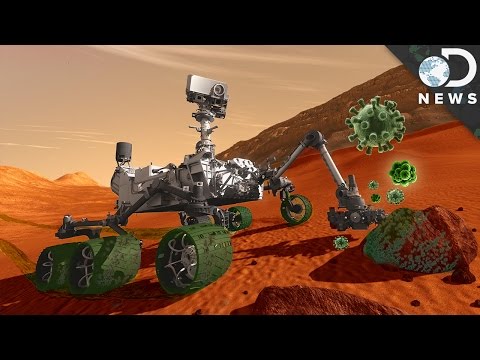
For example, there’s been concerns about NASA’s Curiosity rover currently exploring
Gale Crater. After the rover was launched to Mars before landing in August 2012, the
rover’s wheel tread and drill bits were singled out as possible safe-havens for microbes.
Although some of the flows of liquid water have been discovered in the vicinity of Curiosity,
astrobiologists have warned NASA that the rover may be contaminated enough to deposit
some Earthly microbe on these slopes and they could POTENTIALLY set up home on Mars, using
this toxic water as fuel.
Of course, it’s a long-shot, but when searching for arguably the most important discovery
for human-kind, it would be great to know that the aliens we discover are indeed EXTRA-TERRESTRIAL
microbes and not TERRESTRIAL germs taking a camping trip.
Currently scientists are hard at work identifying which bacteria might be able to survive the
cold, highly radioactive conditions of space and be able to colonize the red planet. One
bacteria identified -- Bacillus pumilus SAFR-032 -- is known to be hanging out in NASA’s
clean rooms after decontamination. So, astrobiologists are sending samples of this bacteria up on
high-altitude balloons to see if they die in a near-vacuum environment in the upper
atmosphere.
The concern about contamination could, however, be moot. There’s the idea that Mars may
ALREADY be contaminated with Earth microbes as, over the evolution of the solar system,
chunks of Earth rock filled with bacteria have been blasted from the surface via asteroid
impacts and floated over to Mars, landing as meteorites. This hypothesis, known as “panspermia,”
would have spread life far and wide long before the first NASA Mars lander touched down.
For more information about the discovery of liquid water on Mars and its implication for
Mars bacteria, check out Trace’s recent video.
Make sure you check out that video, there’s a link in the description if you’re on your
mobile device. And let us know in the comments below if you think planetary protection is
a valid concern or not.