en English
Untitled English subtitles
Report a problem
Advertisement
English transcript
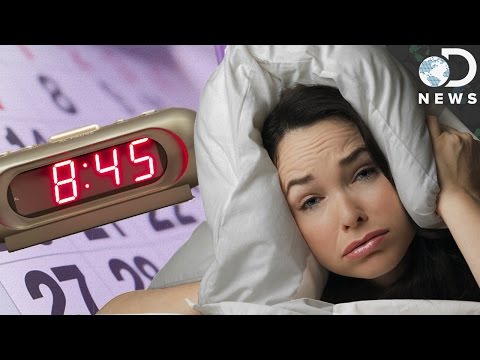
I love laying in bed on a sunday as much as the next guy, unless the next guy has to lay
in bed on sunday, monday, tuesday, wednesday, thursday, friday, saturday, sunday, monday…
Early to bed, early to rise makes space science
move forward. Except the rising part. Just stay in the bed. That's the message NASA is
putting out there in this new research they're conducting. Back in 2014, Drew Iwanicki joined
a NASA-funded study excitingly titled Countermeasure and Functional Testing in Head-Down Tilt Bed
Rest Study -- abbreviated to CFT70. Science is the best with headlines. Iwanicki was famously
paid 18,000 dollars to lay in bed for 70 days. He was monitored 24/7, and was only allowed
to sit up onto elbows for 30 minutes while eating. No napping, no sitting up, no getting
out of bed for ANY reason, plus, constant monitoring; for two and a half months… It
sounds torturous!
The study simulated long term inactivity in space in these participants. NASA researchers
figured if participants lay in bed with their feet slightly elevated their face will get
puffy, and their blood will move differently -- not unlike in space travel. Doing that
for 70 days should simulate how the body reacts to long-term spacefaring. They have to be
careful though… because too much bedrest might not be the best… rest.
Even when bingeing on DNews, sleeping, or reading a long book, your body is constantly
moving itself. You twitch, you change positions, and you shift your weight all in an effort
to keep your tissue safe from developing pressure-ulcers. Pressure-ulcers, also known as bedsores, are
caused when we don't shift our weight and allow blood to flow throughout our skin. If
the skin is deprived of blood for too long, it suffocates and dies. If the ulcers reach
Stage IV the tissue damage can reach bone. Too much bed rest can seriously damage the
human body and in extreme cases can kill; pressure-ulcers kill 60,000 Americans every
year. Nurses are trained to move paralyzed patients every 2 hours to minimize bedsores,
but even if you ignore bedsores, bedrest itself may be harmful to some. A 2004 study in the
journal Joint, Bone, Spine, found patients with lower back pain who were prescribed bedrest
ended up coming back with chronic pain 17 percent more often.
AND, in a 2008 Journal of Applied Physiology study, rats who were hindlimb-unloaded, sort
of like bedrest for rats, showed signs of depression after only two weeks. Eventually,
they developed higher cardiovascular stresses on top of their psychological issues. Other
studies have found long periods of bedrest can cause forgetfulness, confusion, anxiety,
and respiratory problems or blood disorders.
Even Hippocrates, considered the Father of Western Medicine, who died in 370 BC, had
found bedridden patients could experience muscle loss, bone loss and even tooth loss!
Now, to be clear, science isn't saying bedrest is evil! Hippocrates would recommend it for
some minor illnesses, and that practice continues today. A study done at the Boston Children's
Hospital found those who were treated for concussions who took time to rest their brains
recovered more quickly than those who didn't rest. A little sloth is good once in awhile!
The concussed kids weren't even allowed to read, text, or play video games for several
days!
To bring it all back, NASA is studying bedrest because of deep-space exploration. The CFT70
study is slated to be completed in December 2015, but they hope to "help understand which
mission tasks might be affected by changes in physiology during space flight and design
countermeasures to prevent or minimize impairment to these physiological systems" for extended
space flight... Like for going to Mars... Or further. Hopefully, they'll learn just
how much "muscle, bone and cardiovascular functions" will be affected thanks to all
that bed rest. Hippocrates would be proud. if you like digging deep into science of space.
Check out my new show, TestTube Plus. I recently had astrophysicist Dr. Ian O'Neill on to talk
about black holes, white holes, wormholes, and all sorts of other spacey crazy for a
whole WEEK of episodes. TestTube Plus is a deep dive into science. You can subscribe here or in
the link in the description!! Also it's an audio podcast on iTunes, which has gotten
pretty good reviews so far!