en English
Untitled English subtitles
Report a problem
Advertisement
English transcript
I love my drive through coffee in the morning as much as the next gal, but the cup it comes
in? Not so much. It could stay in landfill FOREVER. But hey maybe the early worm gets
the disposable foam.
Hey guys Julia here for DNews
Plastic can be great. It’s durable, flexible, and used in everything from medical equipment
to floss, to the cup my coffee comes in. Buuuut, unfortunately, most plastics either don’t
or take a very long time to break down. Most plastics are made from processes like heating
up petroleum, this rearranges the molecules so it becomes polypropylene, forged together
by strong carbon-carbon bonds. These strong bonds are hard to break apart, and because
it takes a lot of energy to make molecules like polypropylene, nature doesn’t break
them down by itself. Kenneth Peters, an organic geochemist at Stanford University, told LiveScience
that "Nature doesn't make things like that, so organisms have never seen that before."
But we seem addicted to the stuff. It makes things cheap and disposable and makes getting
your morning cup of joe a little easier. Speaking of those cups of coffee, they are one of the
worst offenders!
While great at holding hot coffee, it’s terrible at breaking down. It could sit there
in a landfill for thousands of years. But there is some good news two studies published
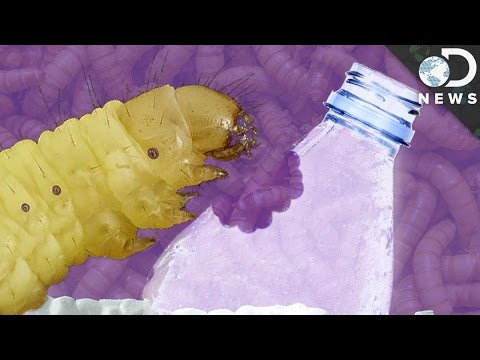
in the journal Environmental Science and Technology suggest the creepy mealworm is to the rescue!
The researchers found that the mealworm has microbes in their guts that can break down
the foam. How? Well by feeding them nothing but the nasty stuff. But they're not big eaters,
100 worms ate about 34 and 39 milligrams a day! Okay that’s really not that much. But
still, it’s better than nothing. After digesting the stuff the worms released half as carbon
dioxide and pooped out the other half as little pellets. Early results say that the pellets
might safe enough to use as soil! WHAT WAY COOL. Still preliminary though.
Earlier studies also published in the journal Environmental Science & Technology found other
microbes that could help. These microbes live in the guts of another worm, the waxworm which
is a moth larva. These microbes chow down on polyethylene, the most common plastic;
it's often used in packaging.
But these worms aren’t alone in their dining habits, there’s a fungus in the rainforests
in Ecuador that can eat only plastic. Described in the journal Applied and Environmental Microbiology,
the fungus Pestalotiopsis microspora could survive on polyurethane alone. And the researchers
say there could be loads of other fungus species that could be great bioremediation candidates,
but we just haven’t found them yet. The only problem though is we’re losing precious
rainforest at five thousand kilometers a year. So we might not have enough time to find the
fungus we need.
But maybe mother nature doesn’t have all the answers. To take down something man-made,
maybe we have to give mother nature a hand. For the past ten years, MIT hosts a competition
that encourages students to design a living cell. Yeah, you heard that right, design.
Every year students from all over their world try their hand at genetic engineering in The
International Genetically Engineered Machine (iGEM) Competition. While not all students
try to make bacteria that eats plastic, in 2013 a group of students at UC Davis tried
creating a bacteria that would eat a type of plastic called PET. But genetic engineering
can be controversial. What happens if you release it into the wild? We don’t know
if or how the new organism might mutate, or how if it could become an invasive species.
And as for more “natural” bacteria it’s not a silver bullet solution. We should be
very cautious before we go spraying bacteria and fungus over everything plastic. We have
no idea how these kinds of organisms could handle a new environment. There’s a real
fear they could TAKE OVER. Like the fungus from the rainforest? Yeah it’s known to
cause “rot and disease in a wide variety of plant species”, not good if it gets loose
across the planet.
So it’s clear more research is needed, but researchers are on the right track. Until
a perfect solution is found, maybe we should keep plastic out of landfills and out of the
environment with the old standby of reduce, reuse and recycle.
But the other question is, does it really help? We are told every day that we should
be recycling, but why? What happens to plastic bottles when they’re not recycled? Amy’s
got the answers in this video right here.
So what do you think about plastic eating animals? Let me down in the comments below