en English
Untitled English subtitles
Report a problem
Advertisement
English transcript
Snow is great for skiing, making Calvin-style snowpeople, and also for drinking or boiling
to make mac n' cheese and sausages. Where did you think that water came from?
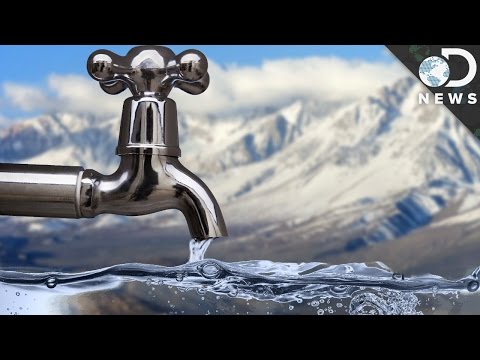
The Sierra Nevada mountains in California are beautiful snowcapped peaks at any time
of year. During the October to May rainy season, the Sierras might see as much as 30 feet of
snow, and they keep at least a little bit even during the summer. But a new study published
in Nature Climate Change, found the Sierras have almost no snowpack this year; less than
the area has seen in more than 500 years, actually. That… sounds bad…
Snowpack is what scientists call the total amount of snow and ice on the ground. According
to the National Resources Defence Council (NRDC) the state's snowpack used to store
15 million acre-feet of water (1,850,000 hectare meters). Put another way, the historical average
snowpack is 28.3 inches (71.8cm) but a survey in April 2015 found only 1.4 (3.6cm).
And it's not just bad for skiers and snowboarders, most of the precipitation that falls in California
comes in the form of mountain snow and that snow melts to become our drinking water. Water
from the Sierra snowpack helps generate electricity, and provides one-third of ALL DRINKING WATER
in California. In fact, 65 percent of all water comes from rivers and streams. Because
snow on mountains can build and build, its a good measure of how much water will be added
to the region as the snow melts. As it melts, the snowpack refreshes rivers, lakes and reservoirs
used for irrigation and public water supplies. So, when the snowpack is low, rivers, lakes
and reservoirs aren't replenished, and the drought continues (or worsens).
This same process works around the country. If you turn on a faucet in Seattle, the Cedar
and Tolt rivers come out of your faucet, in New York the Delaware River basin flows outta
there, the Mississippi River streams out in Minnesota's Twin Cities and Atlanta gets the
Chattahoochee and Flint rivers. Here in California, we're getting snowmelt from those distant
mountains. Surface moisture is what keeps us alive and cooking. It's the great circle...
of life.
So, the implications of a light snowpack are massive, we know this is the worst by comparing
data, data, data. Scientists take cores of blue oak trees and compare the rings to determine
which seasons were wet or dry. In wetter seasons, trees grow as much as they can, but when it's
dry, growth slows drastically. Researchers compared snowpack measurements taken over
the last few decades by satellites and by scientists in the field, to ring data from
1500 blue oak trees, and found a perfect match! Using these two datasets, they've found this
is the lightest snowpack in five centuries… FIVE HUNDRED YEARS. Why? Well, we're in a
record one-in-a-thousand-year drought, but that drought has been exacerbated by human
effected climate change. Don't just take my word for it, bioclimatologist A. Park Williams
from Columbia University told the New York Times, "even though the chances of a drought
like this were extremely unlikely in the past, in the future it will be more likely to occur"
because of rising temperatures contributing in the 8 to 27 percent drop in soil moisture
in California. No soil moisture, no tree growth. No snow pack, no water for people who live
in Cali. That's REAL hashtag calilife y'all.
85 percent of United States residents get their water from public utilities replenished
or fed by the water cycle. I grew up with well water, which is super rare! But when
people can't get water from dried-up rivers and streams to add to reservoirs or irrigate
their fields, they go for aquifers! Earth's surface has pockets of water in it that have
trickled down over the eons, and we're sucking it out at a rate so fast, it cannot be replenished,
and the pumping causes the surface to LITERALLY drop into the empty space. Some groundwater
is being pumped down "50 to 100 feet below previous historical lows," according to the
California Department of Water Resources.
Water is a precious resource! Even if you live in the lush East Coast, or in countries
where water is easy to come by; conserving water is a good habit to get into for now
in case drought hits in the future. California built a whole farming industry in a desert,
after all, you never know what the future will bring. Turn the water off when doing
dishes, washing faces or hands, and forgo baths for short showers. This is good to follow
even in places that AREN'T currently affected by drought. Freshwater in the ground, lakes
and rivers only accounts for 1 percent of all the water on our planet. Don't waste it.
How do you conserve water? Got any tips? I always read in the comments how you guys
love my cool nerdy t-shirts— I get them from all over the Internet. And now I’m
super psyched to announce that DNews is designing a line of our own science t-shirts over on
a completely news ForHumanPeoples.com! The link is in the description to Check out our
favorites like THIS one and also other fun stuff like phone cases, shirts, leggings,
backpacks and hoodies! Click the link in the description!