en English
Untitled English subtitles
Report a problem
Advertisement
English transcript
Right before I do any kind of public speaking my hands start shaking uncontrollably and
i feel like my heart is exploding. Thanks adrenaline. How do I STOP this?
Adrenaline is one of the most famous hormones in the animal kingdom and it's our response
to a "stressor." Stressors can be anything; a sudden scare, playing sports, skydiving,
or even performing in a play, or talking to a crush.
After it's secreted by the adrenal glands, adrenaline kicks your body into high gear,
increasing blood circulation, breathing and metabolism rates; and gets the muscles ready
for action. All this activity can have some strange side-effects on your body, especially
if you don't end up running for your life or fighting a rival for your next meal. Adrenaline
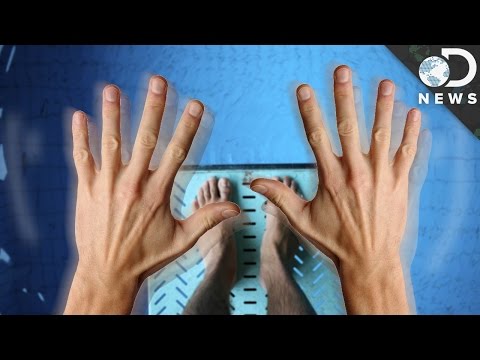
is why your hands shake when you're nervous (your muscles are all aquiver with excess
energy), and the blood pumping in your ears? That's adrenaline’s fault too.
Adrenaline is also called epinephrine and it can make us do some amazing things. For
example, when epinephrine dumps into the body, it causes us to turn carbs into glucose, the
body's fuel source, and our skeletal muscles actually get stronger. It's almost like we're
naturally overclocking our muscles; letting them run hotter with this boost of energy
for a short time. They think this is how hysterical strength works -- that's when people lift
cars to save their kids and stuff. It's not recognized by science, but we can see the
level of potential strength in our muscles when we're hit by a massive electric shock.
Because it's not the shock that throws us across the room, but our own muscle contractions.
We can throw ourselves across a room in an instant, we're that strong, and adrenaline
can hack into that power.
Epinephrine is synthesized and released under orders of the hypothalamus. The hypothalamus
is a control region of the brain responsible for homeostasis -- or the general equilibrium
of our body. It regulates circadian rhythms, body temperature, hunger and thirst as well
as the balance between stress and relaxation, among other things. When humans feel stressors
and thus are flooded with epinephrine, we have an instinct to run, cry or yell, and
all are valid. Tears contain stress hormones and crying releases them from the body. Yelling
fills the lungs and activates the amygdala, the part of our brain that manages fear responses,
and ultimately releases feel-good brain chemicals, and rigorous activity works the adrenaline
out of our system. But there is another way!
New York City police are trained to combat the effects of adrenaline on the job, as are
members of the military, and other high-risk professionals; they all use a fairly simple
body hack -- breathing. Most of the time breathing is controlled by the sympathetic nervous system,
the same system that controls the fight-or-flight response, heartbeat, digestion and so on...
It's automatic, and not consciously controlled. Breathing, however, can be consciously controlled,
as you are probably doing right now because you're thinking about it. This a bridge between
the sympathetic and parasympathetic nervous systems.
Think of your body as an engine, the sympathetic system is the gas. GO GO GO FIGHT OR FLIGHT.
The PARAsympathetic system is the brake. Calm. Calm. Caaaalllmmmm… During times of high-stress
(and high adrenaline) the body shuts down digestion, and muscle shaking can affect fine
muscle movements, or mess up your big speech or monologue during the school play. So when
this happens, you can forcibly engage the calming parasympathetic system by forcing
yourself to breathe. Tactical or "combat" breathing (according to the military) involves
breathing in for a four count, holding for four, breathing out for four. That's it. If
you do that a few times, the Vagus nerve, the 10th cranial nerve that connects your
brain to your torso, will activate, slowing your heartbeat, stimulating digestion, and
throttling down blood pressure and so on. With training, professionals can use this
to force their bodies to stay calm and only feel the effects of adrenaline when needed,
rather than becoming a victim of those effects.
So next time you’re super nervous try breathing, and let me know what you think over on twitter.
It might seem kinda new-agey, but it's practiced by people like the Airmen of the U.S. Air
Force. Who we'd like to thank for sponsoring this episode of DNews. Every day American
Airmen go above and beyond to break barriers both professionally and personally. The United
States Air Force is powered by Airmen, fueled by innovation.