en English
Untitled English subtitles
Report a problem
Advertisement
English transcript
These days people are obsessed with water bottles, I think I have a dozen branded water
bottles on my desk, but I never use them! Am I dehydrated? How would I know?
We did a video a while back about how much water we should be drinking that said we sometimes
drink too much water. According to widely reported data published by the Associated
Press in 2013, we're drinking 58 gallons of water per year (220L)-- or about 2.5 cups
a day (0.6L), and that's a LOT. Way more than we did the late 90s, when soda topped the
beverage list. But as long as we don't overdo it, it's probably better we drink a little
more water, than a little less.
Water helps balance the chemicals that keep your body working. It fills our cells, helps
regulate our body temperature by respiration and sweating, flushes waste, forms saliva
to intake fuel, lubricates our joints, cushions our spinal cord and brain, and carbohydrates
and proteins are metabolized and transported by water in our blood! You commonly hear we
are 75 percent water, but different organs are different percentages of water. The brain
is 73 percent water, skin is a little less at 64 percent water, and muscles and kidneys
are a little more at 79 percent water; bones, however, are only 31 percent.
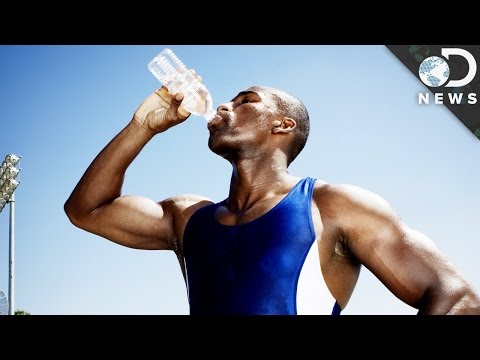
We can survive for weeks without food, but only a few days without water. During sports,
athletes can lose 6-10 percent of body weight simply from loss of water! It's important
to drink when thirsty, but don't PUSH FLUIDS. A study in the Journal of Applied Physiology
found a 15 percent reduced muscle endurance during dehydration but no effect on overall
muscle strength. Water does not alleviate muscle cramps or stop heat stroke, and too
much can cause hyponatremia, or a dilution of salt in the blood -- which can result in
your death.
That said, even mild dehydration (a 1.5 percent drop in water) can mess with focus, alertness
and short-term memory, which is why you should drink water before a test at school AND during
rigorous exercise. Even conditioned athletes who were mildly dehydrated scored highly in
"fatigue, confusion, anger, and vigor" on a subjective mood score.
Chronic dehydration puts people at a risk for type 2 diabetes, cancer, high blood pressure
and obesity! A study in Physiology and Behavior found hypohydration -- a.k.a. dehydration
-- can cause increased error rates while driving and altered mood states in men, and another
study with women found, while they don't experience diminished cognitive function, they do see
increases in fatigue, tension and anxiety! And that's just the mild stuff, excessive
dehydration is when things get really dangerous.
As full dehydration sets in and the body realizes water is not being replaced, it will stop
sweating, stop urinating, and attempt to conserve as much water as it can. This causes the blood
to thicken, which, in turn, causes increased blood pressure. The heart has to pump harder
to push the sludgy blood around the body and cholesterol increases as the water is lost
from cells. Ultimately, the heart suffers and chances of cardiac arrest increase, and
cognitive impairment worsens. It's pretty unlikely for this to happen while playing
sports, because eventually you'll have to stop. But, as we get older, the body's thirst
mechanism worsens, increasing the risk of dehydration without even knowing we're dehydrated!
If you're worried about dehydration, the best thing to do is watch your fluid intake, and
how much you're sweating. Sweat allows the body to cool, so as dehydration sets in, the
body will get increasingly warm, and yet sweat less. Sweat ALSO contains electrolytes, which
are salts and minerals it needs to survive; like sodium and potassium. If you're drinking
water on an empty stomach it can be absorbed through the intestine and hit the bloodstream
in less than five minutes -- but if you've eaten, it can take as long as 45 minutes up
to 120 minutes to fully "digest" the water! Drinking water and/or sports drinks both during
and after vigorous activity can help the body recover from all that fluid loss AND help
you cool off! Even RIGHT AWAY.
But as long as we're talking about cool. Toyota has been doing some really cool stuff with
the TRD line of Toyota Trucks. Enhanced to rule the off-road!