en English
Untitled English subtitles
Report a problem
Advertisement
English transcript
It’s one of the most enigmatic mysteries of well… ever, how did such a prehistoric
people build Stonehenge? And what was it even for? It’s killing me that no one knows.
Hey guys Julia here for Dnews
From Druids, to aliens to sacred religious site, to burial ground, stories and theories
abound for what Stonehenge was actually used for. Some believe it was just a part of a
larger Neolithic ritual landscape that includes two other sites, one called Avebury and one
called Marden Henge.
Recently a Bronze Age Skeleton was found near Marden Henge, in Wiltshire. Marden Henge,
is even larger than the other more famous. The 4,000 year old teenager was burred with
an amber necklace and near the body were numerous other artifacts, like blades, pottery and
jewelry. Maybe this find will give researchers a clue into the life of those who built these
sacred sites, dental examinations could reveal diet and these artifacts could hint at their
culture and who was it that built such massive monuments.
The University of Reading headed the dig, which researchers hope would shed some light
on the mysteries of Stonehenge. And one of the researchers wonders whether Stonehenge,
Marden Henge, and Avebury “competed against each other or were used for different rituals
by the people who lived near them”. So as scientists are working out Marden Henge, what
do we even know about Stonehenge?
Stonehenge was probably named that in anglo-saxon times, it’s translated to roughly, “hanging
stones”. But the name has taken on a life of its own. Other archaeological features
are now called “henges” as well. The term henge now refers to any earthwork where there’s
a small ditch inside or outside of an embankment.
The ground the site is built on was probably a burial site dating as far back as 3000 BCE
Over the centuries the site went through a few iterations, some of the earliest involving
earthenworks like long ditches. But it was consistently used as a site of cremation.
"It's now clear that burials were a major component of Stonehenge in all its main stages,"
said Mike Parker Pearson, archaeology professor at the University of Sheffield in England.
Some of the oldest parts of the monument include 56 fire pits, most of which contain evidence
of cremation.
The ritual site we know today, stones and all, was probably erected in 2600 BCE and
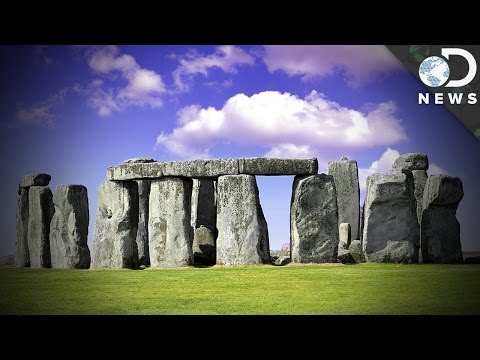
work continued on the site for a millennium. The stones form concentric rings. The outer
ring has huge sandstone blocks weighing up to 30-tons and an inner ring and horseshoe
are made of 3- to 5-ton volcanic bluestone blocks. While big stones are from a local
quarry, it seems odd to find those smaller blue stones in the middle of field in the
middle of England. It’s a bit of mystery of where they came from.
For nearly a century people thought the blue stones came from the Preseli Hills in Wales,
nearly 155 miles (250 km) away. But a 2013 study published in the Journal of Archaeological
Science found that stones were from Carn Goedog in Pembrokeshire, a few miles away from the
Preseli Hills. And some researchers think THESE stones were the real draw for the prehistoric
people visiting the site, not the large ones we seem to be in awe of. Perhaps the blue
stones were thought to have healing powers.
But how did they get there? NO ONE KNOWS. UGH WHY DON’T WE KNOW. One hypothesis suggests
that maybe they came there by way of glacier, another idea includes massive amounts of man
power and a little float down a river.
As for what went on there, well we might never know. It does seem like it was part of a large
ritual landscape where a long procession might have taken place. Near the site lies the Stonehenge
Cursus or the Greater Cursus- a two mile track of ditches. Angled with the sun and with pits
that line up during the midsummer solstice, it seems the whole thing had some ritual purpose,
something to do with the sun, as well as being a place of burial.
The rituals performed during the solstice might have been grand processions with people
walking for miles as part of an elaborate ceremony. There’s a series of graves near
the site, and the seem to be aligned in a way that tracks the movements of the sun on
the solstice. So the participants might have walked around the site to each of the sites.
But that’s just one idea. Other researchers believe the stone site was erected as monument
to the unification of people from around what we call Britain. Just the hauling and shape
of the stones would have been an act of unification because it was such a huge undertaking that
everyone had to pitch in. The building also coincided with a time when a similar culture
spread throughout the island. Houses and tools started to look the same and made from the
same materials.
No matter the story, it's’ clear that stonehenge was part of a constantly changing sacred landscape
that remained significant for thousands of years. Will the site ever reveal its mysteries?
Probably not, but that won’t stop us from wondering and searching for answers.