en English
Untitled English subtitles
Report a problem
Advertisement
English transcript
Birds do it. Bees do it. Hermaphroditic flatworms do it. To their own face!
Hey there sexy, Julian here for DNews and today we’re gonna do it like they do on
the Discovery channel, which it turns out can be super weird sometimes.
A recent observation of flatworm insemination got our curiosity aroused, so to speak, about
strange animal sex. The worm in question, Macrostomum hystrix, has a needley penis.
Usually it would use its needley penis to wound another flatworm and inseminate it.
But when there’s not a lot of stabbing/loving victims around, the worm will stab itself.
In the head. To get pregnant. It’s like I always say, “Love yourself, even if you’re
f*cked in the head.”
You see most flatworms are hermaphroditic, meaning they have male and female sex organs.
Some large aquatic species of flatworm actually mate with a behavior called penis fencing.
It’s exactly what it sounds like. Winner gets laid and the loser gets stabbed and pregnant.
One such species is, and I’m not making this up, the Pseudobiceros hancockanus. It’s
probably pronounced hancockanus but I think marine biologists just have dirty minds.
Hermaphrodites are more common than you might think. Like clownfish. Yes, those clownfish.
But instead of having male and female sex organs simultaneously like the flatworms,
they’re what’s called sequential hermaphrodites. Clownfish first develop into males, but will
change over their lifetime as they move up the social hierarchy. Female clownfish are
the largest and most aggressive in the colony, but if she is removed then the most dominant
male will change his sex and take her place. So if Finding Nemo were scientifically accurate,
Marlin would have become a she and Nemo would have mated with her. Did… Did I just ruin
finding nemo for everyone?
Sequential hermaphrodites don’t always go from male to female. 75% of hermaphroditic
fish actually go the other way, like parrotfish, angelfish, groupers, and some sea stars.
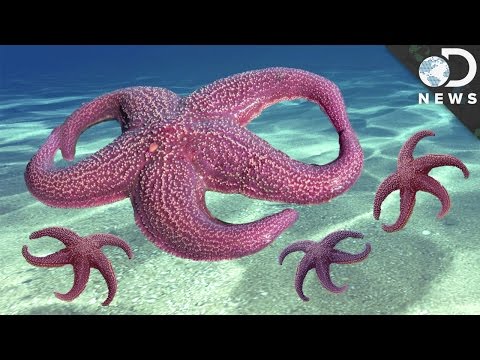
One such sea star is Nepanthia belcheri, and it’s a special one. It’s a sequential
hermaphrodite, and can make babies when males and females release sperm and eggs into the
environment and hope they find each other. That’s actually how most sea stars mate.
Gross, Patrick.
But Nepanthia belcheri and some other species can reproduce asexually. It doesn’t help
their genetic diversity, but boy does it make them hard to kill. These sea stars can make
entirely new sea stars by splitting in half and regenerating until they’re whole again.
Other species will shed arms that are autonomous, even though they’re severed from the nervous
system and the hydraulic system. They’re just like a zombie’s severed hand, if the
hand could then regrow an entire zombie after several months. Sea stars like this can be
problematic, and there’s no better example than the Crown-of-Thorns sea star. This nasty
guy eats the great barrier reef around Australia, and it’s venomous, because of course it
is, it’s Australian. It’s going to town on the reef and Australians have to cull their
numbers to save the reef. Originally they tried killing them by cutting them up. If
you cut them into thirds, they die. But if you cut them in half, 75% of the time you
get two new venomous 20-armed environment destroying monsters. Curse you, asexual reproduction!
If asexual reproduction is so great, why do we have sex? Aside from it being fun. Trace
has the explainer here.
Do you know of any other weird animal sex stories you want us to disseminate on the
internet? Let us know in the comments or on facebook or twitter, subscribe for more, and
I’ll see you next time on DNews.