en English
Untitled English subtitles
Report a problem
Advertisement
English transcript
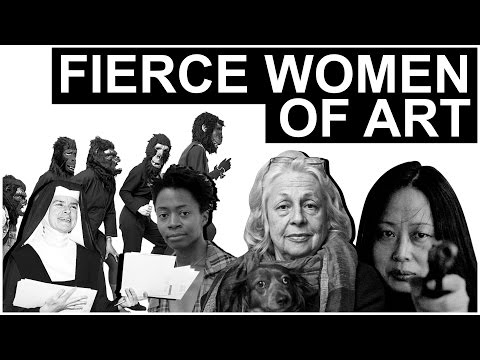
This year the anonymous group of women
who call themselves the Guerrilla Girls
are celebrating their 30th anniversary
of questioning and disrupting art world practices,
asking important questions about whose work gets seen
in art institutions and why.
In 1985, the Guerrilla Girls put out this public service
message, calling attention to the paucity of solo shows
by women artists in New York's art museums.
And this year, they updated this list,
showing only modest improvement.
There's still deeply entrenched discrimination
across the board in arts institutions,
and the Guerrilla Girls have been
steadfast in calling it out.
I have tremendous respect for what they do.
And for me, they fall into a category
of truly inspirational artists who take risks,
are supremely awesome, unapologetic,
and who happen to be women.
I'm going to call them Fierce Women of Art.
They make a wide range of work, and we're only
going to touch on a tiny portion of it today.
But I feel the need to single out and celebrate
some of the most inspirationally brazen women who've made art
in the last several decades.
Today, I'm going to talk about five of them.
First up, the aforementioned Guerrilla Girls.
This art collective got together after the Museum
of Modern Art in New York had a survey exhibition in 1984
of what they considered to be the most
important art of the time.
Out of 169 artists, only 13 were women.
And all the artists were white and from Europe or the US.
Picketing was organized outside the museum,
but it seemed to make no impression on visitors.
So they decided to try some different tactics.
The group made posters and stickers to plaster
around the city that displayed cold, hard statistics
demonstrating that unambiguous gender imbalance in museums
and galleries.
In 1989, they conducted what they call a weenie count
at the Metropolitan Museum of Art.
They compared the number of nude males to nude females
in the art on display.
They shared their results on a billboard made
through the Public Art Fund and updated their findings
in 2005 and 2012.
Their efforts extend beyond gender concerns.
And their work has also brought attention
to racial inequality in the art world and beyond.
Playing upon the word "guerrilla"--
as in freedom fighter-- and its homonym "gorilla"--
the animal-- the group members wear masks when in public,
each choosing the name of a woman artist of the past to go
by.
It injects humor in their activism
but also works to protect their individual careers.
And as founding member Frida Kahlo once said,
"If you're in a situation where you're a little afraid to speak
up, put a mask on.
You won't believe what comes out of your mouth."
As their statistics continue to show,
this is an issue that has not gone away--
making their work of using, quote, "facts, humor,
and fake fur to embarrass and transform
the powers that be as relevant and important as ever."
Corita Kent was a sister of the Immaculate Heart of Mary
in Los Angeles and taught art in the 1950s and '60s
at Immaculate Heart College.
During that time she forged her own printmaking aesthetic while
also inspiring and opening the minds of her students, peers,
and scads of others.
Even before Warhol, Sister Corita
was experimenting with silk screening and iconography
of advertising.
She made posters, serigraphs, banners,
and murals that combined her interest in faith, literature,
and activism-- creating dynamic, powerful images that
asked the critical questions of her time.
Her work was highly political, addressing the Vietnam
War and civil rights.
And her banners and posters could often
be seen at rallies in the '60s and '70s.
She left the order in 1968, but remained
a member of the Catholic church and continued
making work until her death.
Her brand of activism was bold and unflinching, but wholly
positive and inclusive.
Rare is the figure who can inspire and engage
such wide audiences and present a kind of idealism that
is intelligent and unrelenting.
Lynda Benglis came to the fore in the late 1960s
with her poured pieces, hybrids of painting and sculpture
made by her pouring latex and foam directly onto the floor.
These bright, bold, and central works
one-upped the gestures of the abstract expressionists
and also ran counter to the rigid minimalism
that was currently reigning supreme.
But she became famous not just for her pioneering work
but also for a legendary ad she put in the November 1974
issue of "Artforum" magazine.
Before that, she'd already begun to cheekily reference
the male domination of the art world
by including a picture of herself
as a child wearing a traditional Greek boys
costume on her announcement card for a 1973 exhibition.
Then in April of '74, you see her
in an ad in "Artforum" for another show,
wearing aviators and leaning against her silver Porsche.
A card announcing her show at Paula Cooper Gallery
in May of '74 includes this photograph
of Benglis taken by Annie Leibovitz.
But the real kicker was the November "Artforum" ad
which she purchased herself, called a centerfold,
and considered a work of art.
It included an unforgettable photograph of Benglis nude,
holding a large double-headed dildo between her legs.
Google it.
The image was shocking and hugely divisive,
causing resignations from two of the magazine's editors
who considered it pornographic.
Love it or hate it, the picture made
fun of the machismo of the art and artists
who ruled the market, while also subverting the male gaze.
Benglis owned it.
And for me, this image represents
her absolutely taking command of her sexuality, her career,
and her public image.
The controversy has abated, but the picture
is still remarkably powerful-- although difficult
to find in libraries due to theft.
For many artists, this kind of act could subsume a career.
But Benglis has continued to make ever-new and innovative
work throughout her career.
Her decades-long exploration of biomorphism and materiality
has earned her enormous influence,
and the impact of her work is strong today.
In 1989, the National Gallery of Art in Beijing
hosted a show called "China Avant-Garde",
which was the country's first ever,
government-sponsored exhibition of experimental art.
The show opened on February 5 at 9:00 AM
and was closed down by 3:00 PM on the same day
after one of the artists whose work was included
in the show, Xiao Lu, walked into the galleries,
took out a pellet gun, and fired two shots
into her installation.
Made in collaboration with the artist Tang Song,
the piece consisted of two telephone booths
with a male figure in one, a female figure in the other,
and a red telephone dangling off its receiver in between.
Titled "Dialogue", the piece was clearly about a lack thereof.
And Xiao Lu's performative act of shooting on it,
while she claimed it was personal and not politically
motivated, resounded strongly as an act of rebellion
at a time, post-cultural revolution,
when the government was just beginning
to loosen its control and censorship of artistic output.
She was lauded as a hero of the cultural and political vanguard
just as tensions were rising toward the pro-democracy
demonstrations and subsequent massacre that
would take place in Tiananmen Square just months later.
Few if any other women artists in China
have achieved this kind of a notoriety,
even as the market for contemporary Chinese art
has expanded and provided international platforms
for a number of male artists from China.
Xiao Lu has continued to make work since 1989,
although with considerably less attention--
exploring controversial issues through works
like "Sperm", which documents her quest for a sperm
donor and a doctor who would artificially inseminate her as
well as her ultimate failure.
Another work titled "Wedding" documents her performance
of marrying herself-- arriving by a coffin in a wedding gown,
slipping rings onto both ring fingers, and releasing a dove.
Xiao Lu's brand of activism is intensely personal
but resonates strongly within a culture
constrained by censorship and largely dominated by men.
Kara Walker burst onto the New York art
scene in the mid-1990s with her installations
of large-scale, cut-paper silhouettes that bring to life
imagined narratives of the pre-Civil War American South.
Her characters and scenery represent
exaggerated stereotypes drawn from historical depictions
of the time, presenting grotesque and violent tableaus
of plantation life.
Her diverse body of work expanded
to include drawing, painting, projection, and video.
But her focus and work has remained
steadfastly trained on histories of slavery;
discrimination; and what she has called
her ever-present, never-ending war with race.
In 2014, Walker created her largest work to date,
call "A Subtlety" in a former sugar factory in Brooklyn.
Within the space, she installed a colossal sphinx-like female
sculpture coated in sugar, surrounded
by smaller molasses-coated figures of little boys
carrying bananas and baskets.
Its subtitle tells you all you need
to know-- "the Marvelous Sugar Baby, an Homage
to the unpaid and overworked Artisans who have refined
our Sweet from the to the Kitchens of the New World
on the Occasion of the demolition of the Domino Sugar
Refining Plant".
It's Walker's unsubtlety in many cases that captivates us.
Recapitulating painful stereotypes in order
to critique them.
Her works are deliberately provocative and often
difficult to look at, but they effectively
get at the very worst of America's past
as well as its present.
Walker's work reminds me again and again
of that Faulkner line. "The past isn't dead.
It isn't even past."
Her work is a stalwart testimony to that.
There are many more artists I admire regardless of gender.
And I'm definitely aware that there
are other disparities in the art world
that prevent artists from rising to the top.
But who are the fierce artists you admire?
Let's talk about it in the comments.