en English
Untitled English subtitles
Report a problem
Advertisement
English transcript
[MUSIC PLAYING]
Today, we're outside the Indianapolis Museum of Art,
where we're going to be meeting up with Michelle Grabner.
She's based in Milwaukee and Chicago,
but she currently has a show up here at the museum
that features a wide range of her work,
including paintings, works on paper, video, and sculpture.
Along with her studio practice, Michelle
is also an art critic, a professor,
and a curator, who's run exhibition spaces including
The Suburban in Oak Park, Illinois, as well as The Poor
Farm in central Wisconsin.
It becomes quickly evident when looking at Michelle's work
that she's preoccupied with pattern.
Be it those she finds and uses as source material
for her paintings and prints or the one she devises herself
through the paper weaving she's made for the past 20 years.
The space of the home and domestic life
is a focus of Michele's work, not only
evident in her abstract paintings that
reproduce the patterns of gingham, cotton
blankets, and paper towels, but also
through the labor intensive, repetitive
processes required to create them.
She creates a kind of abstraction
that is firmly rooted in the materials
and actions of our daily life, but that also transcends them.
Hi.
I'm Michelle Grabner, and this is your art assignment.
I'm drawn to all patterns, and a lot of it
has to do with repetition and order.
All right?
So you have information that's ordered,
sometimes in a very simplistic way,
and sometimes in a more complicated, baroque way.
So you think of William Morris' wallpaper, gorgeous, baroque,
and complex, or a simple weave, like a gingham weave, a check
pattern.
It's all ordered.
It's all information that takes a kind of order.
And when one thinks about contemporary life
and how information moves through our lives
on a regular basis, that order is becoming
more and more important.
We have to do it.
We have to order the information in our lives.
So to see that represented in their visual world
is very compelling.
It's always been very compelling to me.
As an early artist in an emerging studio,
I would say, thinking about pattern,
thinking about indexing, my son came home from kindergarten
at that time presenting me with a little project
he did in school.
It was a blue and red paper weaving.
And I think the exercise was based on fine motor activity,
how to use the scissors, how to slip paper in and out.
It was crude.
It was basic.
Maybe there were four slits within the paper itself.
And then they started to think about that
as a way of making pattern, the simplicity of weaving
being played out in paper.
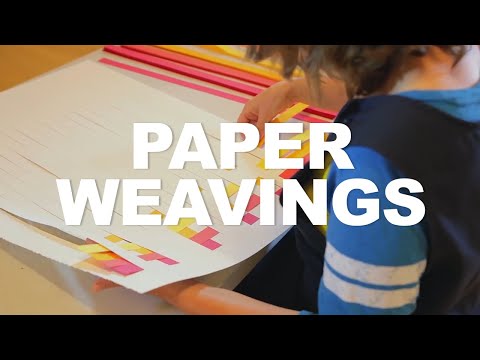
So your assignment is to make a paper weaving.
So you'll want to have on hand some paper.
One paper, one sheet, that you will then make cuts into,
even cuts, in this case.
And then you'll also want some paper which can be colored.
That you'll want to make strips.
And the strips can be various, but I'm
going to give you examples in which the strips and the cuts
in the paper are the same.
And then what you're going to do is simply
weave those strips into that paper, into that base paper.
What I'm going the warp.
And it's really quite that simple,
and you'll have a lot of options in terms of building pattern.
I would probably encourage multiple colors,
and then you can see, again, what the array of the patterns
will-- what are available to you in terms
of different kinds of patterns.
John, I thought you'd really like this one,
because it's an obsessive, repetitive action.
Yeah, I do enjoy my obsessive, repetitive actions.
I like signing my name over and over again.
I like print making in very repetitive ways.
So I'm very excited about this.
I'm also a huge fan of Michelle Grabner's work,
so I think it's really cool that she gave us an art assignment.
And this one is awesome.
I'm psyched to do it.
And I can do it.
Yeah. [LAUGHS] It's deceivingly simple.
Right.
I mean, yes, even a kindergartner could do it,
but I think there's a lot of hidden resonance here.
And you can think a lot about pattern and color.
When I'm looking at these and thinking about this assignment,
I think about Joseph Albers' color studies.
Yeah, but it's not just color studies.
I mean, these weavings also make me
think about physical objects in the world.
They're abstractions that lead me
to thinking about representational things.
Yeah, and I also think we should go back and think
about the foundations of early childhood education
and why Friedrich Froebel who founded kindergarten,
came up with this exercise in the first place.
SARAH URIST GREEN (VOICEOVER): In 1814, Friedrich Froebel
began working at a mineralogical museum in Berlin,
organizing and classifying its collection.
He was fascinated by the various shapes of crystals
and became convinced that investigating
the natural laws that cause their growth
was the key to unlocking the mysteries of a higher power.
Froebel was guided by this belief when
he founded a school for young children in Blankenburg,
Germany in 1837.
He called it kindergarten and formulated
a system of activities that would teach kids to recognize
and appreciate natural harmony.
He designed a set of 20 tools referred to as "gifts"
to help with the process, including
building blocks, colored paper, mosaic tiles,
and gridded tables.
The 14th gift was paper weaving, and it
was a version of this activity that Michelle's son would
encounter many years later, and that she would take up as well.
By weaving together strips of paper,
kindergartners explore color, pattern, counting,
and simple math, and come to know forms that
can be found out in the world.
We're asking you to do the same, to tap into the seemingly
inexhaustible potential of this activity
and discover how abstract forms can
point to countless processes and structures
in the world around us.
Just as we were saying that this is a Froebel exercise that
happens in kindergarten, it's also a two-dimensional design
activity that happens when one enters
into an art program as a freshman, in these foundations.
And I always like to flip it.
I think these are exercises that we're privileged to do,
and we should continue to do them.
If not, maybe, taught as in our senior year,
as opposed to our freshman year.
So we're going to make a paper weaving.
So what you're going to want to do
is get yourself a sheet of paper, a straight edge,
and an X-Acto knife, and you're going
to want to cut these slats in a paper.
So these are 1 inch slats.
I'm leaving an edge all the way around.
And then you're going to want to mark it,
of course, with a pencil, so you're even with your cuts.
Then you want to flip it over.
You actually want to work on the side
that you have your graphite notations on.
You also want to have your strips.
And again, I'm working with 1 inch strips today.
They can be various sizes.
That's not a problem.
What I'm going to be developing is
a pattern that will be a negative when I flip it over.
So very simply, start thinking about the pattern.
Start thinking about that math, in terms of over and under
and how many.
So I'm going to go under three, over one, under three,
over one.
And then you're going to have-- again,
depending on numbers-- in this case,
I only want under two at the very end,
because I ran out of cuts.
And then you want to tightly pull the paper in,
making sure it stays flat and doesn't buckle.
And in this case, I'm going to go through a spectrum
of warm colors, red to yellow.
And then you want to not use the same number pattern,
but a different number pattern.
So I'm going to, in this case, over two, under three.
And then I line all the strips up on one side,
just so it's easy.
I only have to cut one side when I'm finished.
And then you're going to want to slip the next band down,
so it's pushed right up against the previous strip.
To linger in systems of order, repetition,
is hugely important.
To think about ordering information,
to think about patterns, when they break, when they pull,
when there is this funny tension between what is being indexed
and the geometry or the support.
To people to see that.
That's important.
But there's also the condition of boredom, which
is really important for me.
Not in necessarily a place of meditation
or a place of just pure discomfort,
but I think within that space and time, one
gets to play with time, think about those qualities,
think about values.
I've been referring to it as a state of boredom,
which is a human condition, and I think
we all need to embrace that.
OK.
So once you've finished weaving the field of slats,
you're going to want to finish it off.
So I've been using-- you can use this acid-free tape.
You're going to want to flip it.
And trim any extras.
OK.
And then you're going to want to tape this end down as well.
And then flip it over and see what the result is.
So you can see here, I've actually
given you two patterns, right?
So you see this column, here.
So if you divide it vertically, instead of being continuously
even throughout the field, you have a pattern
on-- in this case, with the left side or the right side.
And then you have another pattern going on here.
And then you can also see the pattern developed by the color.
No, I'll continue making these weavings
until they put me in a grave.
I have been thinking, though, about weaving
with other materials.