en English
Untitled English subtitles
Report a problem
Advertisement
English transcript
A few weeks ago we got a question
from Trey Willetto, who asked how we respond to people who
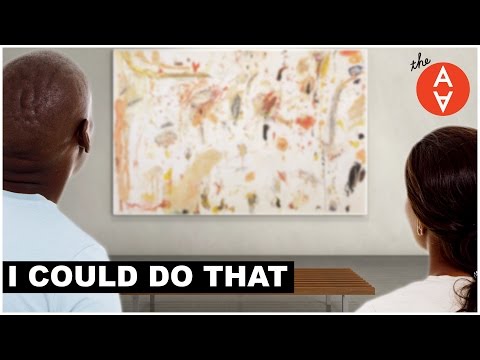
say "I could have done that.
It's so simple" about art, for example, Felix Gonzalez-Torres.
John and I answered that A, you probably actually
couldn't do it.
And B, you didn't do it.
But some of you, like Becky, were dissatisfied.
She said doesn't that imply that the artist has no merit
outside of some guy thought about doing this first
and now we care about it?
It just seems like a really lazy answer.
Challenge accepted, Becky.
I'll give you a less lazy answer.
OK, if you're looking at a work of art and feel
compelled to say I could do that, or my kid could do that,
the first thing you want to do is assess
if you really could do that.
Take some hard edge abstraction, like this painting,
by Piet Mondrian that may, at first glance,
seem fairly easy to execute.
But if you've tried to use oil paints before,
you'll know that it can be really
tricky to create such smooth lines and a consistent, flat
application of color.
There's also a little details, like a line that
stops just short of the edge of the canvas that clues you
in that no amateur did this.
Or Cy Twombly's work gets a lot of heat
for looking like a bunch of kid's scribbles.
But take a closer look.
The quality and character of his line work is astounding.
The restrained use of color is exquisite.
This isn't Crayola crayon on construction paper.
This is pretty masterful handling of paint and pencil
and crayon.
They may be scribbles.
But they're freaking amazing scribbles.
And if you still think you could do it, I say give it a try.
It could be a really productive exercise
to see how something is made.
And it may help you learn a new skill
or take your work or life in a new direction.
But let's move on to what happens when you really
could have made the thing in question.
If you think about Felix Gonzalez-Torres,
the example Trey brought up, we can
look at work like "Untitled" (Perfect Lovers)
from 1991, that pairs two commercially-available clocks
and synchronizes their time.
Yes, you can go to a store, buy two clocks,
and hang them on the wall, just like this.
And you know, it would still be a pretty cool experiment
to see how long they stayed synchronized
and which runs out of batteries first.
But you'd be missing something key here.
The title clearly asks you to consider
these clocks to be a metaphor for lovers
and how two individuals with hearts beating,
like the ticking of clocks, can be in perfect sync
and then inevitably fall out of sync.
The title further suggests that the lovers remain perfect,
even after they've fallen out of sync.
But there's even more.
Because this work wasn't just made by any person at any time.
It was made by Felix Gonzalez-Torres,
who was openly gay and who made the work after his partner
Ross was diagnosed with AIDS.
Gonzalez-Torres's work was overtly and strategically
political.
And this lovely and heartbreaking work
is unquestionably made more resonant
when you know that his partner died in 1991
and he died in 1996.
His battery lasted just a little bit longer.
And if you think a work of art should tell you
everything you need to know without the help of wall
labels or the like, then I'm probably not going
to convince you otherwise.
But for me, whether it's the "Mona Lisa," a landscape
painting in a thrift shop, or an iPhone,
every object is created within circumstances
that are important and is distributed in ways
that add to its meaning.
But back to Gonzalez-Torres because we're
not quite done with him yet.
Many of his works depend on reproducibility-- stacks
of paper or piles of candy viewers are invited to take.
He wanted his work to spread and to be in multiple places
at the same time and to be created in participation
with you, the viewer.
With this work, it's not that you could do.
It's that he wants you to.
You're invited to.
And that's part of the work.
It also means his art can exist in perpetuity,
beyond the confines of his own life.
And you can still experience it today, and maybe
take it home with you too.
When you say I could do that, what you're really saying,
and what I would encourage you to say next time is,
this doesn't display a remarkable amount
of technical skill.
And that's what I really look for in art.
I think it's perfectly fine to have a preference for art that
displays manual talents unavailable to most.
But there's a history of artists,
beginning in the early 20th century, who
took on new approaches to material, purposefully avoiding
showing off technical skill, and for lots of good reasons--
to upset the dominant art trends at the time,
to question the value of unique objects,
to undermine the commercial system of art
by creating work that is unlikely to be trophies
for the rich, or to reconsider the separation of art and life.
There's been some theorization about the so-called de-skilling
of art in the 20th century, a word
first used to describe the replacement of skilled laborers
by technologies and less skilled workers who operate them.
Industrialization also had a profound effect on art,
introducing new methods of reproduction.
And we can't forget about the dawn of photography
that certainly called into question the relevance
of spending loads of time learning how to paint something
realistically.
Rather than devote their lives to mastering
a particular medium, some artists
began to push the boundaries of those mediums
and even forgoe them all together.
There's sculpture that is purposely unmonumental,
paintings purposefully non-virtuosic,
drawings purposefully simple.
It's not that these things don't take skill.
They just take different kinds of skill-- research, deduction,
collaboration, exploration of new materials, radical thought.
Just as we value professions other than skilled labor,
we should also value work by artists focus
not just on craftsmanship but on the effective execution
of good ideas.
It's the thought they bring to the form,
or have others bring to the form, and not
just the form itself.
Next time you're compelled to say
I could do that I think you should stop yourself and ask
why did they do that?
What are the circumstances that led
me to not doing that and them being so
driven to make the thing that they not only thought
of the idea but then completed it
and found an audience for it?
What are the social, political, and economic circumstances
surrounding their doing this thing?
You can still admire impressive technical skill.
But you can also open yourself up to appreciating
a much wider world of art.