en English
Untitled English subtitles
Report a problem
Advertisement
English transcript
We’re in Indianapolis today and we’re actually filming in the very same location
we did a while back for Sopheap Pich’s imprint assignment, but this time we’re filming
with Brian McCutcheon, who’s a master fabricator, whose studio helped build an artwork for Sopheap
Pich, but who’s also an artist in his own right. Brian’s work explores play, notions
of masculinity, and the intersection of the everyday and the extraordinary. And while
he works in a range of media, his starting point is often the common materials around
us. Past works have seen him re-imagine charcoal grills, lawn chairs, and the iconography of
suburban American life. His work has been heavily informed by his interest in cars,
speed, and flight. And a recent series of works engaged he and his son's fascination
with the phenomenon in forms of space exploration. We are surrounded by things, mostly mass produced
things and Brian has the uncanny ability to find the potential for resonance in them.
So lets go talk to him and see what kind of assignment he has for us.
Hi, I’m Brian McCutcheon and this is your Art Assignment.
I spent a lot of time with my mother’s brother, my uncle, and uh he is an obsessive maker
of cars. And so if I wanted to find my uncle, I would go to his garage or the garage he
was working in at the time. And then uh, so I sort of look back at my first uh, sculptural
experiences of fixing up my first car when I was 16. You know, I had a $400 beater and
I uh, I made it nice by doing the body work and stuff to it. So, um, yeah I think that’s
definitely when I discovered I liked to make things.
I am of the opinion, and I might get in trouble for this a little bit but I think the purpose
of art is not about functionality. I think the purpose of art is about ideas, you know?
About conveying attitudes, um, and so I don’t have a problem if the thing still works, and
certainly there is a lot of art work out there that, that "works," um…um. But the work
that I make, like I think of them as sculptures. When I was at the Bemis and I was working
on an abstracted sculpture but I was using automotive materials, um, I was reading hot
rod magazines at night. And because I grew up in Michigan, and the history of Detroit
auto and, and my relationship a lot with my uncle and, and that ability to apply identity
to the vehicle. I decided that I should-- I should not step around the issue of art
as abstraction and apply it to the things around me that I thought had something to
do with maleness. I guess this was really when I started thinking more about male Americana,
was in Omaha. You know, like everybody there, like every time you turn around "Hey do you
want to do a barbecue?” You know? And uh of course well I was thinking at the time
a barbecue was something that has a male identity associated with it and um but there’s also
this weird like feminine or cooking aspect. You know? Like I thought about guys in their
aprons with the naked lady on it. [laughs] You know? That kind of um facade? At the time
I was also looking at baroque artwork and men in the baroque period like through dress.
Like-- And how do we, as contemporary men, ornate ourselves? And it’s through our automobile
a lot of the time. And so I was trying to mash those ideas together of maleness, of
work, of automotive, of decorative to sort of make this thing.
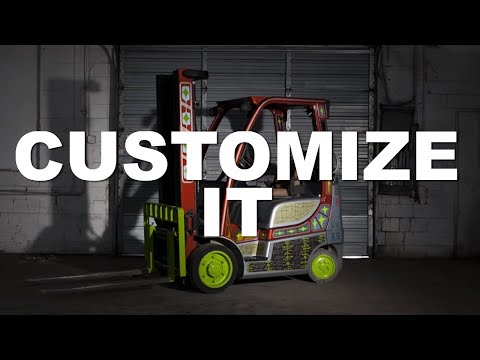
So your assignment is to customize a common object. Find a common object that you find
interesting. Make a list of identifying traits of that object and then customize the object
while thinking about and playing with one of those traits.
JOHN: So Sarah this Art Assignment is pretty similar to a previous one Brian Odum’s artistic
alchemy, where you take an old object and repurpose it while thinking about it’s history.
SARAH: Yeah, it’s similar in ways but the thinking behind it is actually really different.
This time you’re looking at that object, your thinking about its use value, it’s
intended function and then you are sort of focusing on one of those things and upending
it.
JOHN: Right, okay, so it’s kind of like, you know how we have that cup that we pour
on the kid’s head when we are shampooing them?
SARAH: Yes.
JOHN: I put a bunch of holes in that cup so that Henry could see it come down like rain.
SARAH: Right.
JOHN: But then it stopped performing its function of being the shampoo cut because it didn’t
hold water any more. Like that?
SARAH: Like that, but in the context of this assignment there are more interesting things
you can do with a cup.
JOHN: Ah, really?
SARAH: Yeah, actually I am thinking of one in particular thing that has been done with
a cup and that’s this work by Meret Oppenheim, one of the key artists behind Surrealism.
Uh, and she did something extremely interesting with a cup.
JOHN: I would like to hear about this extremely interesting cup.
SARAH: I will tell you.
SARAH: So as the story goes, in the mid 1930s young Meret Oppenheim was having lunch with
Picasso and Dora Maar in a Paris cafe. Picasso admired the fur covered bracelet she was wearing
and remarked that you could cover anything with fur. Oppenheim shot back, “Even this
cup and saucer?” Soon after, Andre Breton asked her to participate in the first exhibition
of surrealist objects. And so she went out and bought a teacup, saucer, and spoon at
a department store and covered them in the fur of a Chinese Gazelle. At the time there
were a number of artists taking found objects and arranging them in unexpected, irrational
combinations with the aim of summoning our unconscious thoughts and desires. With the
fur-lined tea cup, Oppenheim pretty much did this assignment. A tea cup is common, inanimate,
washable, appropriate to drink tea from. It’s lady like and proper. Lining it with fur transformed
it into a bizarre [background gasp], animal like thing. More appropriate to touch than
to place to your lips. More sensuous than gentile. While the surrealists' goals may
have been different from yours or mine, their use of unexpected juxtaposition is instructive
in approaching any common object be it a pair of shoes, a telephone, or a fork lift.
BRIAN: The thing that I feel like would be critical about the assignment is that um it’s
not just about decorating, right? It’s not… It’s about trying to change our opinion
about the thing that we are looking at whether it functions or not. For my art assignment
uh I decided that I would customize the shop’s forklift. The fork truck is a tool in the
shop that gets thoroughly abused and no one thinks about. And so I felt like if I applied
the customizing to it it would change our perspective of what it is. What I’ve done,
or what we’ve done as a collective, we’ve disassembled it; we’ve disassembled the
forklift. It was pretty battered. So um, and it’s one that we got used although it is
in pretty good condition so I ended up stripping off all this terrible body work on it uh and
then so we body worked all of the panels and put them into a primer and put a base coat
of color on it and then I’ve started striping and paneling and prepping it for the sort
of the custom paint aspect of it. You do it because it should enrich the environment in
which you live in. And you know if it’s great work, maybe it will change or enrich
the life of some one else who sees it.
Hi, I’m Brian McCutcheon and this is your Art Assignment. [engine revs] Ahhh. Gotta
do it again. That will be the cut out at the end right?