en English
Untitled English subtitles
Report a problem
Advertisement
English transcript
Here at The Art Assignment we're big fans of not breaking the law, as we pointed out
several times when signing off:
Sarah: "Please don't break the law."
Sarah: "and please don't break the law." John: "Don't break the law."
After the Meet in the Middle and Stakeout episodes, many of you expressed concern about
tresspassing or violating privacy. So we asked you to try to execute the assignments without
breaking the law because, you know, we don't want anyone to get hurt or arrested, and most
of all, we don't want anyone to sue us. But, in fact, art history has seen many occasions
where good art involved breaking the law.
As commenter ljmasternoob4 asked, "What about civil disobedience?" Breaking the law can
be socially and artistically constructive, so today I'm gonna share with you a few stories
of artists who did break the law.
Okay, let's begin with Modernism, by which I don't mean up-to-date or clean-lined furniture,
but the historical period from about 1850 (industrialism, etcetera) to about 1960. During
that time, art changed a great deal along with the world. Everything from war to mass
production to Freudian psychology shaped art making, and we saw more abstract artwork and
the use of new technologies like photography.
Modern artists were those whose ideas reflected the realities of a changing world, and sometimes
it went beyond reflecting that world and can be seen as actively pushing society in a new
direction. And sometimes that means breaking the law.
Okay, so before avant-garde was used to describe, like, experimental music and fancy coffee,
it was a military term describing the first soldier out in battle, who valiantly put themselves
out there and risked death. When it started being used to describe artists, it was in
the early 1820s, and it referred to someone whose work served the needs of everyday people
rather than the rich and powerful.
And then avant-garde started to be used to describe people who weren't breaking the law,
but were breaking the rules of art; you know, using abstraction, putting a urinal in an
exhibition, and so forth.
While capital-M Modernism did end, and what is helpfully called Post-Modernism began,
artists continued to push the boundaries of acceptable behavior, and they still do.
You can think of artists like Chris Burden, whose most famous work Shoot was a performance
in which he stood in a gallery and had his friend shoot him in the arm with a .22 rifle.
This was, needless to say, not legal, but the ethics of it are complicated and worth
thinking about.
Burden did this in 1971, during the height of the Vietnam War, the first so-called "living
room war" when extreme violence was broadcast in homes across the U.S. The performance can
be thought of as a commentary on accountability: when is violence entertainment, and when is
the audience obligated to intervene?
I'm gonna go ahead and go on record discouraging you from having someone shoot you. Or actually
just any kind of shooting of anyone.
And this brings us to something important: law-breaking art isn't necessarily good art.
In fact, I'd say it's usually quite bad; provocative, maybe, but not very interesting.
But when it is good and it brings attention to questionable ideas and systems of government,
then it's extremely important. It's not something you should immediately embrace and celebrate,
but it's something that can open up conversations about injustice.
In 1975, Burden defined art as "a free spot in society, where you can do anything," but
that DOES depend on which society you live in.
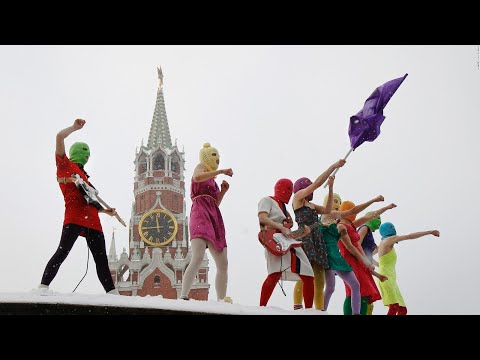
Let's take two contemporary examples, starting with Pussy Riot, the Russian feminist punk
band and art collective that stages guerilla-style protest performances. Three of their members
were arrested and imprisoned for a 2012 performance in which they danced on a church altar in
Moscow and later turned it into a music video entitled "Punk Prayer, Mother of God, Chase
Putin Away."
There's a lot going on here. Pussy Riot was challenging what they see as an unjust law
about protecting religious spaces in a supposedly secular society. It's also a criticism of
the patriarchal Russian orthodox church and some of its leaders, who interfere in Russian
politics by doing things like supporting a third term for President Vladimir Putin.
Nadya Tolokonnikova described it well in her closing statement at trial, "Pussy Riot's
performances can either be called dissident art or political action that engages art forms.
Either way, our performances are a kind of civic activity amidst the repressions of a
corporate political system that directs its power against basic human rights and civil
and political liberties."
Now released from prison, Pussy Riot continues their work of protesting anti-protest laws
themselves and exposing the stifling of speech in contemporary Russia. As they said in their
first English language tweet, "Russia is not China or Iran YET, so... we can still use
Twitter."
But speaking of China and Twitter, my second example is Ai Weiwei, who has completely blurred
the lines between artist and activist. His life was politicized from a very young age,
as his father was the well-known poet Ai Qing, who was labelled as an enemy of the people
during the cultural revolution and was exiled with his family to a labor camp, where Ai
Weiwei spent most of his childhood.
As an adult, Ai has involved himself in a wide and varied program of challenging the
practices of Chinese government and advocating for democracy and free speech. He is an accomplished
artist who has built a stunning body of conceptual artwork using sculpture, installation, photography,
and video.
But one of his greatest artworks can be seen as his blog, which he started in 2006 and
used as a platform to voice a stream of social commentary and political critique. Through
the blog, he started a Citizens' Investigation, to collect the names of the more than 5,000
schoolchildren who were killed in the May 2008 Sichuan earthquake. Not just an act of
memorial, this was also a way of openly questioning the government, who refused to admit any responsibility
for the shoddily built schools that caused a disproportionate number of young people
to die. Shortly after he published the list of names on his blog, it was shut down by
authorities.
In 2011, Ai Weiwei was stopped at the Beijing airport and placed into detention for 81 days
for vaguely defined economic crimes. Since his release, he has remained under constant
surveillance and still hasn't been given his passport back. But he continues to make work,
and is an exremely vocal activist on social media and in the international press.
A year after his release, Ai Weiwei said, "I'm just a citizen: my life is equal in value
to any other. But I'm thankful that when I lost my freedom so many people shared feelings
and put such touching effort into helping me. It gives me hope: stupidity can win for
a moment, but it can never really succeed because the nature of humans is to seek freedom.
They can delay that freedom but they can't stop it."
So these are all very complicated and nuanced issues, and there's a lot of great reading
to do on these subjects; you'll find some suggestions in the video info. But for now,
I'll leave you with this thought: when making art, and also when not making art, it's important
to consider which laws to break and how to break them.
In fact, the whole question of breaking the law is a pretty interesting lens into that
old question of what art even is. Is it art when a bunch of criminals pull off a stunningly
beautiful and complex bank robbery? I'd argue no.
But a Russian art collective that forms a punk band and performs on an altar for clearly
stated reasons, and with the intention of it being a form of protest art; to me, that's
art. It's avant-garde in the true sense of the term, and it's art I would never want
to discourage.
Let's continue this conversation in the comments. Thanks for watching and could you guys please
suggest a sign-off for us?
And please don't break the law. Unless you must. And you have a very good reason. And
you don't sue us.