en English
Untitled English subtitles
Report a problem
Advertisement
English transcript
Give me a head with hair, long beautiful hair, shining gleaming steaming flaxen waxen. HAIR!
It's Monday, so we're answering viewer questions today, and on our Why Do We Have Warts video,
Saihan, Elyse, and TheGamingWookiee all had questions about hair! Different types, why
do some have more than others, and why do we even need it!
Firstly, hair is a natural part of being human. We tend to associate it with our head, face,
armpits, pubic regions, and legs; but it's actually everywhere. We like to think of ourselves
as a naked ape, but we have the same number of hairs on our body as a chimpanzee; or around
five million hairs. Before you ask, hair and fur are the same thing. You and your fuzzy
dog or cat all have hair made of the same stuff: keratin.
Your skin is made of layers -- the epidermis, then the dermis underneath. In the dermis,
cells are constantly dividing, and the older cells are pushed out of follicles creating
hair all the time. On chimpanzees, hair protects skin from the sun, and provides warmth. When
you take into account thermoregulation, hair was a way to keep that body warmth in naturally!
Though, in modern humans it still protects our head from the sun's rays, and allows sweat
to travel along hair shafts and evaporate, cooling us down, but it doesn't keep our bodies
warm anymore.
There are many different TYPES of hair. Fetuses in the womb grow hair called lanugo; though
it usually recedes from the body before birth, it doesn’t always. A comforting reminder
of our primate history, perhaps? After birth, we humans grow soft, fine, unpigmented vellus
hair all over our bodies, though thicker, pigmented hair on the head, eyebrows, eyelashes,
and so on, is called terminal hair. During puberty, some of vellus hair transitions to
terminal hair or androgen hair -- named for the sex hormones that cause them. On the face,
and chest for men and in the armpits and pubic regions for both men and women.
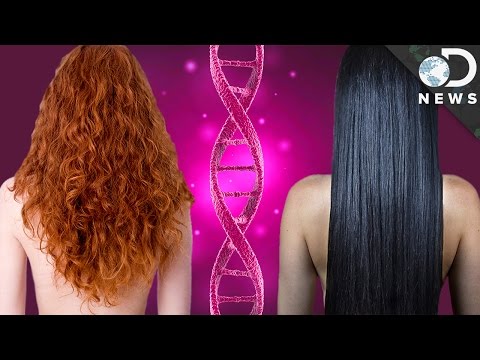
What hair you get depends a lot on your genes. A 2009 Cambridge study found the genes for
hair were 85 to 95 percent inherited, though some can be affected by the environment. Hair
curls for two reasons. First, an asymmetrical, or oval-shaped, follicle will force a curvy
hair to emerge; circular follicles produce straight hair; but a specific cellular receptor
called epidermal growth factor receptor regulates the growth of hair. If the EGFR puts too much
keratin on one side of the hair shaft as it grows, it will come out curly!
Hair is a holdover from our ancient ancestors. As we evolved, our genes mutated, and hair
thinned on some parts of the body, but the why in some places and not others is an evolutionary
mystery! Perhaps hair lessened for social interaction, to better see the eyes and face;
or as we became more upright and mobile evolution favored those with just enough to reduce skin-on-skin
friction in pubic regions and armpits; or perhaps ancient humans spent more time in
the water, and hair wasn't as useful there except on the exposed parts of the head. Perhaps,
hair remains in the pubic regions similar to eye, head, nose, and ear hair -- to block
dirt and other deuterium from the genitalia or to keep UV rays away from the sex organs?
Or maybe it allows pheromones to spread from the body for mating! The Economist writes
that perhaps mature women are more visibly hairless, on average, than men because, at
some point, hairlessness was selected by men as a sexually attractive trait; a similar
theory as to why human males have the largest average penis size of all primates. Again,
we don't exactly know.
What we DO know, is maintaining SOME, but not ALL body hair, may be due to parasite
detection. A study from England's University of Sheffield found people with more body hair
could detect bed bugs more quickly than those with less. Though by tracing the evolution
of lice alongside humans, scientists determined we started trying clothing on more than 170,000
years ago. This was great for the cooler temperatures of the coming ice age; and when we started
to move from Africa into Europe. More clothing, like thicker hair, means
more parasites… which is bad… damn, this is a hairy topic.