en English
Untitled English subtitles
Report a problem
Advertisement
English transcript
So the headlines going around on the internet say flies can feel fear. Excellent. (Laughs
maniacally)
Hello to all you fly honies, Julian at YouTube Space LA for DNews. Like I said, if the internet
is to be believed then we are giving poor wittle fruit flies spaz attacks just from
waving our hands at them. The news comes from a study from the California Institute of Technology
but there’s more grey area than some black and white headlines would lead you to think.
One of the study’s authors, Dr. David J. Anderson, says we can only know if a creature
is feeling emotions by asking them directly. Of course if you ask a fly anything, all they’ll
say is (rubs hands together flyishly) so the scientists had to set up some parameters that
separated emotions from a simple reflex.
The criteria they settled on was that any emotion has certain characteristics. These
“emotion primitives” were scalability, persistence, generalizability, and valence
(which in the context of psychology means how attractive or aversive something is).
The scientists put the flies in a chamber and occasionally passed a shadow overhead
to simulate a bird or Batman coming for them. When the shadow came, the flies would run,
hop, or freeze in place. When the shadows swooped by more frequently, they would run
and hop faster, which showed scalability. They repeated this with food in the flies’
chamber, and got the same result. This fulfils two other criteria of being generalizable
to different contexts and having negative valence that overcomes the attractiveness
of that sweet mushy brown banana.
The flies would also take longer to come back to the food the more they were antagonized,
and that demonstrates persistence. Rather than just hopping away and coming back when
the danger had passed, they lingered. If responding to the shadows were just a reflex, then the
flies should come back to the food in about time once the threat was gone, regardless
of how much they were threatened. It suggests to the researchers that they were calming
down from an emotional state, much like how it takes you time to come down after almost
getting in a car accident, even though the danger has passed.
All of this fly torture may sound like scientists just being bullies but there’s a good reason
for it. As first author of the study William Gibson points out, flies have the same fundamental
drives we do, the four F’s, which are “Feeding, Fighting, Fleeing and Fmating.” But the
deeper question is, “Do they have emotions that can drive these motivations or is it
a mechanical response?” Satisfied that the flies may be acting out of fear, the researchers
have proposed studying the simple neural network of the flies to see what molecules affect
emotional states. Maybe what we find in the flies brains can be compared to what happens
in other animals or us. We know other animals have similar survival circuitry to ours in
their brains, but we couldn’t know if they felt the same way we do. Maybe it can help
us nail down exactly what emotions are and give us an objective and universal yardstick
for what to date has been a very subjective experience. Maybe it can help us learn about
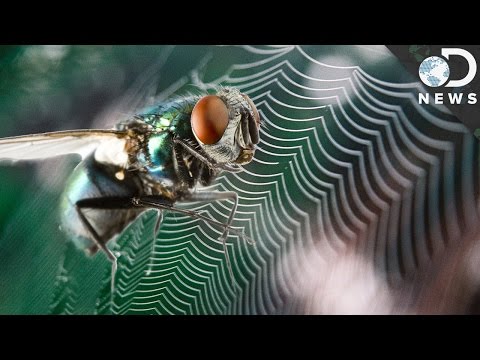
and combat irrational fears too, like fear of spiders! Actually maybe not, arachnophobia
would be a totally rational fear for a fly.
Most of us avoid fear but some of us can’t get enough of it. Trace explains adrenaline
junkies here.
Extreme! So I think this all raises an interesting philosophical question which is: At what point
does a survival instinct become an emotion? Do you think there’s a difference? Let me
know in the comments or on facebook or twitter @DNews, and I’ll see you next time.