en English
Untitled English subtitles
Report a problem
Advertisement
English transcript
Does the internet make us smarter or more distracted, let’s take a look at what the…
oh wait, what was that shiny thing?
Hey everyone Julia here for DNews
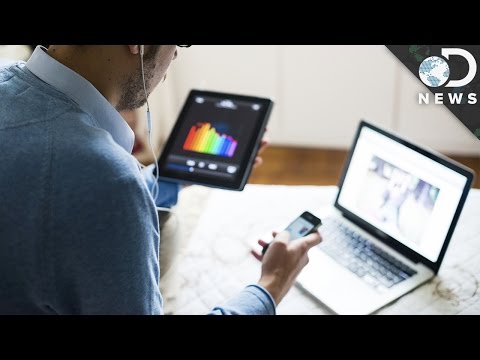
It seems like kids these days are spending a lot of time in front of screens. And according
to research published in the journal Archives of Disease in Childhood, it’s true. And
what’s more, these experiences are increasingly fragmented. You might pause this youtube video
to go check twitter or you might text your friend while watching a movie. But while these
new technologies change our experiences, is our attention becoming more fragmented as
well?
Research from University of Southern California Marshall School of Business found that we
consume a lot of digital media. I mean A LOT. The average American receives more than 15
hours a day of digital media, everything from YouTube videos and Netflix movies to computer
games and text messages.
By the age of 7, a child born today will have spent the equivalent of one full year watching
screens, according to a study published in the journal Archives of Disease in Childhood.
That’s basically spending a seventh of your life on the computer or checking your texts.
So what is this doing to our brains? Teachers seem to think it’s nothing good. According
Pew Research Center's Internet & American Life Project 87% of teachers think that technology
creates "an easily distracted generation with short attention spans,"
But the research isn’t so conclusive. It may seem easy to assume based on earlier studies
on tv watching habits that screen time does affect attention spans. A study published
in the journal Pediatrics reports that for “each hour of television watched per day
at ages 1-3 increases the risk of attention problems, such as ADHD, by almost 10 percent
at age 7.”
And that’s what a few studies show. Recent research from Microsoft of all places found
that average attention span has dropped. 15 years ago, attention spans were about 12 seconds
on average. Now they’re around 8 seconds.
But maybe this is a case of adaption. As we’re bombarded with more and more media, we’re
more discerning about how we consume it. Just like when used to get yelled at for flipping
channels too fast, it only takes an instant to decide if we want to watch something or
not. Maybe technology changes the way we focus our attention.
But some researchers caution that "Just because we may be allocating our attention differently
as a function of the technologies we may be using, it doesn’t mean that the way our
attention actually can function has changed.”
One study published in the journal Human Performance found that young people, under 30, begin to
lose concentration on workplace tasks after 5 to 15 minutes. But it also suggested that
the internet is both the poison and the cure. The study implies that young adults get a
boost in mood and attention after browsing the web for a few minutes, then returning
to a task. This wasn’t the case of older adults who didn’t receive the same benefits
from a leisurely scroll around the web.
That same poll from the Pew Research Center found that 77% of teachers think the internet
has a "mostly positive" impact on students' research habits. But while technology like
the internet and smartphones changes the way we tune into information, it literally gives
us the world of knowledge at our fingertips. And I wouldn’t trade that for anything.
Since you’ve paid attention this far, maybe you should check out this video where Trace
explains what ADHD is. Oh yeah there’s some great green screen action in this. Now.. . I’m
going to go check my twitter and watch some cat videos at the same time.
Alright guys, how often to you double up on screen time? Are you checking facebook as
you watch this? Tell us about your browsing habits in the comments below.