en English
Untitled English subtitles
Report a problem
Advertisement
English transcript
When I’m watching a movie you can pretty much do whatever you want to the hero and
I don’t mind, but if their dog dies I cry like a little baby with “no-tears” shampoo
in their little baby eyes. Why is that?
Hi everyone, Julian here for DNews from YouTube Space LA. We love our pets. And I don’t
just mean crazy cat ladies who eschew traditional human relationships for feline companionship.
According to a 2011 Harris poll, 90% of pet dog or cat owning Americans consider their
furry cohabitors part of the family. Moviemakers exploit our empathy for animals all the time;
if we’re supposed to like a character we just met, give him a loyal dog and boom! Instant
good guy. And yes, I realize supervillains have white fluffy cats on their laps when
they swivel their armchairs around, but c’mon, cats are like the physical embodiment of evil.
Full disclosure: I’m a dog person.
But I guess evil things need love too and so here we are, with cats and dogs as valuable
members of the family. They might even be the favorite member of the family, because
the American Animal Hospital Association surveyed married female dog owners... that is, dog
owners who were female and married, not owners of married female dogs, ugh, English. Anyway,
40% of the women surveyed said they got more emotional support from their pet than their
husbands or children, which… is terrible. C’mon people, call your mother.
So why do we care about animals? Or, I suppose I should narrow that down, why do we care
about certain animals. After all most of us still eat bacon or chicken, but cringe at
the thought of eating Mr. Whiskers. It’s probably because animals like our house pets
are cute. They have big eyes, they can be kind of clumsy and dumb, and they’re innocent.
In that way they’re an awful lot like babies, and we think of babies as cute because otherwise
it would be really easy to abandon a screaming, pooping chubby bald mini-person in the woods
somewhere. We feel attached to cute babies even if they’re not ours. A 2009 University
of Muenster study asked women who had never given birth to look at pictures of babies
inside an fMRI machine. The women were in the machine, not the babies. Argh, English!
The pictures activated parts of their brains associated with reward, and the cuter the
baby, the more that region lit up. Men had similar reactions, but not as strong.
Some of the same chemicals that make people go all melty for babies are present when we
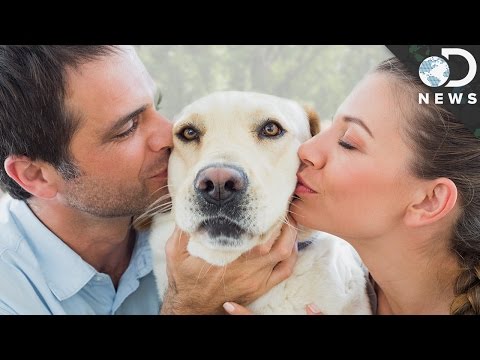
deal with pets. A recent study found that oxytocin, the hormone that facilitates bonding,
went up 300% in dog owners who gazed into their pet’s eyes. So it’s possible animals
are hacking into our love of cuteness and by extension our instinct to protect the helpless
and innocent. But the difference is we see puppies and dogs as almost equally innocent,
but it’s not the same at all with baby humans and adults. To illustrate this, 240 students
at northeastern university were given 4 different versions of a fake news story where assailants
either severely injured a toddler, a puppy, a dog, or an adult. They were surveyed on
their emotional reactions, and the puppy elicited a stronger reaction than the dog by only a
narrow margin. The adult human got the least amount of sympathy by far, and the toddler
got the biggest response.
The good news is that people, when it really matters, will opt to save a human life over
a dog. Probably. Georgia Regents University psychologists asked 573 people what they would
do if a bus was hurtling towards a person and a dog and they could save only one. If
the dog was their personal pet and the person was an unknown tourist, the tourist would
be a messy red hood ornament 40% of the time. If the choice was between a strange tourist
and a strange dog though, the tourist’s odds were much better. They’d be unwilling
bus passengers only 14% of the time. Interestingly, women were almost twice as likely to save
the dog, which fits in line with the cuteness hypothesis from earlier. So I guess if you’re
going to get hit by a bus, try to do it near a man?
So we like our pets more than adults but we don’t like them as much as our babies. For
that actual chemical explanation, Crystal explains what’s happening in your brain
meats down here.
POP QUIZ HOT SHOT! There’s a dog and a tourist in a hawaiian shirt and sandals with socks
in the street. A bus is speeding towards them at 50 miles per hour and it can’t slow down.
What do you do? WHAT DO YOU DO? Let us know in the comments and I’ll see you next time
on DNews.