en English
Untitled English subtitles
Report a problem
Advertisement
English transcript
Prof: Good morning.
Now we move to our last author in this course,
to Émile Durkheim.
There are really two Durkheims.
We have seen certainly two Marxs and two Webers.
There are also two faces of Émile Durkheim.
To put it bluntly, the young Durkheim has been a
functionalist and a positivist, and then late in his life he
has--his epistemological turn-- he became a cultural analyst.
Well it's not quite true, because each author is more
complex, and there were already elements of his culturalism in
the early work.
But there was certainly a dramatic change in the way how
Durkheim conceived what the job of social sciences,
later in his life, in his book The Elementary
Forms of Religious Life.
I think it had a lot to do also with his personal life,
and we will talk about this.
He was brought up in a rabbinical family and was
supposed to become a rabbi, and then he revolted against
the parental household-- much like Nietzsche did--and
turned probably into an atheist, but certainly not an active
believer in Judaism.
And later in his life he became again interested in religion,
and not only philosophically, but also existentially
interested in religion.
Well in the course we have only four lectures on Durkheim.
So I'll leave Durkheim the culturalist out,
and we will be doing work only on his earlier work,
The Division of Labor, the wonderful book
Suicide, and a somewhat difficult book,
The Rules of Sociological Method.
And I'll just leave The Elementary Forms of Religious
Life; I don't have time to fit this
into.
Durkheim had an extraordinary impact on American social
science.
Initially it was particularly the younger Durkheim,
the functionalist Durkheim, who had such an extraordinary
impact.
Unlike Weber or Marx, whose impact was broad and
affected history and economics and political science,
Durkheim's impact was much more focused on sociology.
So in this course the only author who, properly speaking,
is a sociologist is Émile Durkheim.
All the others you discussed were not really identified
themselves as sociologists.
Later in his life Weber did, but not on the whole.
Émile Durkheim identified himself and his
project as sociology.
It, of course, has a lot to do that these
disciplinary boundaries between economics,
political science, and sociology became much more
sharply drawn by the end of the nineteenth and early twentieth
century, and sociology as an academic
discipline was really established by the late
nineteenth century.
So this is Émile Durkheim--born in 1858 and died
in 1917.
Just very briefly about his life.
He was born in a small town, Épinal in France.
As I said, his father was a rabbi and he was expected to
become a rabbi himself.
In '79, he was admitted to the École Normale
Supérieure, which is one of these very
elite schools, MIT version in France,
and by the time he went to university--
École Normale Supérieure is a
university-- he lost his religious beliefs.
He was for some time a professor at the University of
Bordeaux.
Then he became politically active in the 1940s,
especially in the so-called Dreyfus Affair;
and I will just briefly mention what that was.
Then in 1902, he became professor at the
University of Paris, which is not quite as
distinguished as École Normale Supérieure.
His son was killed in the war, and shortly after this he died
in Paris.
So this is Alfred Dreyfus.
This is a very important event in French, and in many ways in
European, history.
What was the Dreyfus Affair?
You probably all know.
In 1894, Dreyfus, who was Jewish,
was falsely accused to be a German spy, and was imprisoned.
That was obviously an anti-Semitic trial,
and this mobilized the French intellectuals,
and not only French intellectuals,
but French intellectuals in particular.
Émile Zola, whom some of you may have read,
the leading French writer of this epoch,
wrote an important article which appeared in the leading
French daily newspaper: J'Accuse--
"I accuse the French judiciary of being
anti-Semitic."
Well Durkheim joined other prominent French intellectuals
to protest the trial.
It took them a long time but eventually they were successful.
Dreyfus was eventually exonerated of all charges and
made a Knight of the Legion of Honor.
So it was a happy ending of French anti-Semitism,
for awhile.
Then it came back with vengeance during the occupation,
Nazi occupation.
The French are not as innocent about anti-Semitism as you may
want to believe it.
Many were collaborating with the Nazis.
Well about the work.
In '93 he wrote a dissertation, which probably is still his
most influential book, The Division of Labor in
Society, and today's lecture will be
focused on this.
'95, it was followed by The Rules of
Sociological Method, which is his most positivistic
statement.
The Division of Labor is his most functionalist work.
And then in '97 he wrote Suicide.
Suicide is a very important book because it's
really the first piece of rigorous empirical social
science, which takes a very unusual,
very rare phenomenon, like suicide,
and crunches numbers extremely carefully to test whether he can
identify social determinants of such a rare phenomenon.
Fortunately even in countries where many people commit
suicide, it's still a rare phenomenon.
But he managed to come up with a very provocative theory,
what he demonstrated with very careful empirical analysis.
We will be looking at two parts of The Division of Labor.
Today we will be looking at the major arguments of Division
of Labor.
And then also we will look at, Thursday,
on his theory of anomie, which is a central piece of the
book, Division of Labor,
but a kind of by-the-way analysis.
And, as I said, in 1915 he wrote this book,
The Elementary Forms of Religious Life,
which is a major break in his work,
and shows his renewed interest in the spiritual and the
metaphysical.
Okay, just very briefly, what is in the books.
As I said, The Division of Labour was
his Ph.D.
dissertation.
But unlike many scholars whose only good book is their
dissertation, Durkheim followed it up with a
number of good other books.
Many professors are actually one book people,
or at least they should have been, because their only good
book was the dissertation and what they published later only
published because 'publish or perish'--
right?--to get tenure; that's why they probably
published too many books.
Anyway, he was inspired by Montesquieu.
Well Durkheim is very French, and his roots are deeply in
Montesquieu, and to some extent in Rousseau;
he admired Rousseau as well.
But Montesquieu is really the major inspiration behind him.
And well what he does, he uses law as a measure of
social development-- much like Montesquieu did,
sort of-- and he explains,
by using the law, the legal system how the
division of labor evolved, what were the stages of the
development of division of labor.
Well just a very brief contrast.
Right?
Marx was interested in economic conflict--right?--in struggle
around scarce economic resources.
Weber was interested in struggle for power.
So was Nietzsche.
Durkheim was interested in social solidarity.
Marx and Weber are conflict theorists.
They try to explain what breaks up society.
Durkheim is a theorist which tries to understand what holds
society together, what brings us together,
why society is not falling apart.
Right?
Well in the book he makes a crucial distinction between two
types of solidarity: mechanical and organic
solidarity.
And I will speak about this at great length.
This is another attempt to develop a typology of evolution
of societies.
You are already familiar with Marx's modes of
production--right?--the evolution from slavery to
feudalism to capitalism.
You are familiar with Max Weber: traditional authority and
legal-rational authority.
Now Durkheim's alternative is mechanical and organic
solidarity.
Right?
What Weber called traditional authority is kind of mechanical
solidarity for Durkheim; or what Marx called
pre-capitalist formations is mechanical solidarity.
Organic solidarity described legal-rational authority or
modernity or capitalism.
Well he also identified pathological forms of division
of labor, and this is what he called anomie.
And his idea of anomie is a kind of similar or analogous
distinction, what was alienation in Marx and
what was disenchantment in Weber--
though there are very important differences as well,
and I will be talking about this Thursday.
Now on Suicide--as I said, this is one of the first
very rigorous empirical studies of a social phenomenon--
a phenomenon we think is not quite social,
we think it is really an individual decision whether you
take your life or not.
But Durkheim actually was capable to show that even in
this very private action, when you take your life,
there are social determinants, who is committing suicide or
not.
And he's making a distinction between different types of
suicide-- anomic, altruistic,
egoistic and fatalistic ones-- and I will be talking about
this after you return from Thanksgiving's break.
Now about the methodology.
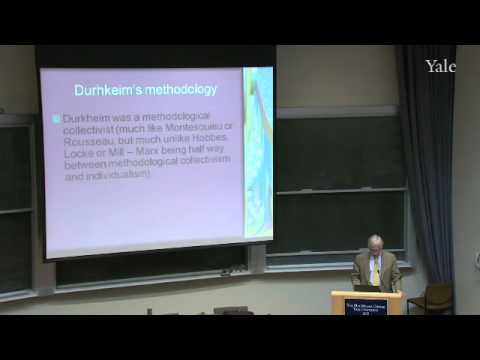
He was a methodological collectivist,
much like Montesquieu or Rousseau, and very much unlike
Hobbes, Locke or Mills; you know, Marx being kind of
halfway between methodological individualism and collectivism.
As a theorist of revolutionary consciousness,
he was a methodological collectivist.
We will see Durkheim's notion of collective conscience is not
all that different from Marx's idea of class consciousness,
which is not the sum total--right?--
of the individual consciousness of workers.
But Marx, in his theory of exploitation,
as you have read his text, reads almost like Adam Smith,
or John Stuart Mill.
Right?
It's self-interested, rational individuals,
from which he explains the nature of exploitation.
Well it's much more difficult to figure out how Weber fits
into these categories.
I think he's also vacillating between collectivism and
individualism.
Later in his life he's becoming more of a methodological
individualist.
But Durkheim, the consistency in Durkheim,
is that from day one he's a methodological collectivist,
and remains a methodological collectivist.
But at the same time he believed in the existence of
social facts, and that social facts,
on the other hand, can be observed with rigorous
empirical methodology; and this is what makes him,
in a way, a positivist.
So this is just a brief introduction to who the author
is.
And now let me move to the division of labor.
>
Well my computer is getting slower, as the semester is
progressing.
So it's probably time for the semester to end,
because my laptop, though it is new,
it still will become unbearably slow by the end of the semester.
Okay, so this is Émile Durkheim and the division of
labor in society.
So how does Durkheim proceed in the work?
And today's presentation will focus on the question why
Durkheim begins the analysis by taking the law as the point of
departure.
And then we will proceed how he makes the distinction between
organic and mechanical solidarity.
So the question actually is, for a methodological
collectivist, that you need to find some
collective expression, in order to study society--not
individuals.
And much like Montesquieu, he believes that the law is
such a collective phenomenon; law, which can be studied and
established without studying individual views or individual
opinions.
Right?
It's parts of what--Durkheim's terminology is the collective
conscience, and which is above individual consciousnesses.
Okay, so that's--what are the most important issues in the
work, as far as we'll discuss it today?
Well he's interested in solidarity.
As I pointed out, we are--his real question is
what holds society together?
We are so different, societies should fall apart.
Right?
He is writing in the late nineteenth, early twentieth
century.
This is the time of industrialization,
of urbanization.
People are dislodged from their traditional communities,
from the traditional villages, pushed away from peasant
agriculture, and move into urban industrial
employment.
And the question is will society break down,
will social order break down, if the traditional order does
not keep us together?
And this is what he tries to figure out;
what in a modern urban and industrial society can keep us
together?
And he tries to find solidarity.
And well what creates this solidarity is collective
consciousness.
And the fundamental idea in Durkheim about collective
consciousness-- as I said, it is analogous to
the notion of the general will in Rousseau,
or the notion of class consciousness in Marx.
So therefore it is not the sum total of individual
consciousnesses, but something of shared norms,
beliefs and values, which exist prior an individual
is being born, prior society actually existed,
which is passed on from one generation to the other.
Right?
And therefore he tries to show--right?--these collective
consciousnesses which persist over time.
And, of course, the most obvious,
most rigorous way to go about this, to look at law.
Because that's exactly what the law is.
Right?
The law is changing over time, but usually the change is very
slow and reaches over several generations.
So for somebody who is a French social scientist,
and one unique--we already talked about this.
Well the French are very methodological collectivists.
The Anglo-Saxons tend to be methodological individualists.
And the French, unlike the Germans,
are very scientifique; they are very much scientists.
The word scientifique in German does not exist.
The Germans say, "I'm
Wissenschaftler"; Wissenschaft
means--Wissen is knowledge.
Science in German is constituted by all sorts of
knowledge.
Right?
It's a much broader notion.
Right?
In French, or in English, with science we really mean
rigorous science of the natural science types.
Well Durkheim did not go as far as saying it is natural science.
But certainly he was very scientifique in
insistence of rigorous analysis of objective data.
Right?
That's what--why the Germans--Wiss
enschaftler, all those who study ideas are
Wissenschaftlers.
It's a much broader notion.
Natural scientists are also Wissenschaftlers.
But people who study humanities and history of ideas are also
Wissenschaftlers.
People who are an expert on Hobbes and spend their life
writing on Hobbes is a Wissenschaftler
--right?--in German.
We can hardly say somebody who does--right?--history of ideas
to be a scientist.
Right?
We are iffy.
We call it humanities.
We talk about social sciences with a lot of anxiety,
and real scientists ask us, "Social science,
what do you mean?
What is science about what you are doing?"
Well those of you who take economics, they make sure it
looks like science, because you have all the
equations on the blackboard.
So therefore a scientist can relax.
But if you are listening to my lectures, and not a single
equation on the blackboard, you probably have doubt that
this is really social science.
Anyway, he was scientifique,
in the sense of being very rigorous in his analysis.
Sort of what is collective consciousness--I give here a
citation for you.
Right?
It is a totality of beliefs and sentiments which are common to
the average member of society--right?--but which has a
life of its own.
Right?
That's what he calls collective consciousness.
So this is different from the consciousnesses of the
individuals; though he's a scientist. Right?
He's scientifique.
It has to be realized in individuals.
So therefore, I mean, Durkheim would not
necessarily be opposed to carry out even survey research,
and ask individuals about their customs or values,
and sort of aggregate this up and try to find those patterns,
especially over time and across nations.
That's not really what he did.
But I think he would be open for this kind of research,
which, of course, made him so influential in
early American sociology in the 1930s,
'40s and '50s, because American sociology has
been very positivist and very empirical.
Well but the most obvious example of collective conscience
is the law--probably also the language.
Well there are differences in law in pre-modern and modern
societies.
Now we are getting into--he's building the argument up to make
the distinction between mechanical and organic
solidarity.
And let me just go through of this.
So the argument is then in pre-modern societies the law
which existed is primarily a repressive or penal law.
Well there is--the purpose of punishment is to punish evil
behavior.
And we tend to agree what is evil behavior is,
and punishments therefore also tends to be harsh,
to prevent further aggressive behavior by individuals.
So this is the legal system of pre-modern societies.
Well I will give you a couple of citations,
and I won't read them.
I will put them on the internet and you can read it at your
leisure.
It kind of elaborates on the points what I made.
Okay, but in modern society the legal system is very different.
The legal system is based on contract;
the essence of modern legal system is contract.
It's not that we do not have a penal code--right?--the penal
code survives.
But what is novel is contractual law,
which is restitutive; which is not about punishing
evil, but simply restitute the damage somebody,
by breaking a contract, caused to the other contracting
partner.
Right?
And he said, well this is a new type of law
which emerges with modernity.
Marx would say it is a new legal system which emerges with
legal-- with capitalism,
and Weber would say this is the essence of legal-rational
authority.
Well why does he study law?
I don't want to elaborate on this too long.
That's obvious-- that the legal system is the single best
measure of what he tries to get at,
collective conscience, which can be studied the most
objectively.
Right?
There are law books and legal practices and minutes of
recordings how the courts operated,
and how law was made and implemented,
which can be studied with a great level of rigor.
For instance, it's very easy to study whether
indeed contractual law is a new form of law.
You can go back to legal history and to establish exactly
when contractual law emerged.
This was actually also very much on the mind of the young
Weber, when he was also looking at
basically the emergence of contractual law in late medieval
Italy, in his Ph.D.
for the law degree.
I think I already made this point, what is interesting,
that Durkheim and Weber sort of ignored each other.
I don't think they ever cited each other.
I don't recall ever seeing a citation to one another,
though they were working on the same area.
Of course, they both did speak both of the languages,
and they were, of course, aware that the other
giant exists.
They were probably, in many ways,
too close--too much in competition with each other--to
cite each other.
I mentioned already that Durkheim did review Marianne
Weber's book, but never any of Weber's books,
though Marianne was writing-- right?--about marriage law,
which was of marginal interest to Durkheim,
and Weber was writing on religion, which was so central
for Durkheim's interests.
Nevertheless they kind of ignored each other.
Now about the two types of solidarity.
Well mechanical solidarity--it's hard to
remember the distinction.
One would think organic solidarity must be
old--right?--and mechanical must be modern, the machines.
Now the opposite is true.
I kept making these mistakes for the first two or three years
when I was reading Durkheim, some forty-five years ago.
Well mechanical solidarity is which describes pre-modern
societies, and this is a solidarity which is based on the
similarities of the parts.
Well this is why you can have a penal law, because a penal law
does not make a distinction between contractual partners;
it assumes a sameness of the group as such.
And mechanical solidarity--right?--as I said,
is primarily based that we see ourselves similar in the group.
Organic solidarity, so will Durkheim argue,
is one which is based on differences in society.
A higher level of division of labor in society produces
organic solidarity.
Organic, he meant, it is a kind of
…