en English
Untitled English subtitles
Report a problem
Advertisement
English transcript
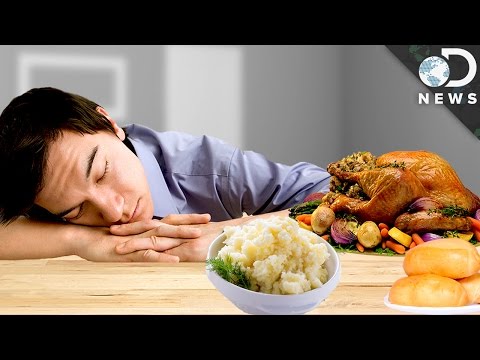
Oy, you guys, no, I can’t. Food coma…uhhhh….
Good day, everyone, Amy here on DNews.
It’s the holidays! Which means it’s time to visit family and eat a startling number
of ginormous meals, which will undoubtedly come with the all-too familiar food coma.
Though it sounds kinda funny and made up, a food coma is actually a real, medically
recognized condition. Properly called postprandial som-no-lence, it’s that sensation of being
so deliciously full that you can’t move until you eventually fall asleep.
Medically speaking, a food coma comes down to a shift in activity in the autonomic nervous
system. It’s the system that controls involuntary action of organs, heart, and glands, and incorporates
the sympathetic nervous system responsible for the “fight or flight” response and
parasympathetic nervous system that lets your body rest and digest. After ingesting a large
meal, the autonomic nervous system starts favouring the parasympathetic nervous system,
decreasing your awareness in your sympathetic nervous system, making you feel lethargic.
But more often, turkey is the common scapegoat. The myth always circulates around the holidays
is that tryptophan in turkey gives you that sleepy feeling. It’s partly true. Tryptophan
is an amino acid that produces serotonin in the brain for that sated feeling, and serotonin
produces the hormone melatonin that makes you sleepy.
But tryptophan is also found in other poultry and meats, cheese, yogurt, fish, and eggs
— basically things non-vegans eat throughout the year, so you can’t blame turkey, which
incidentally has less tryptophan than chicken.
Tryptophan binds to other proteins in the blood, but it’s too bulky to easily make
it through to blood-brain barrier. Other smaller proteins get through more easily, preventing
tryptophan from entering the brain. So it can’t trigger the production of serotonin
or melatonin. Tryptophan needs helps, and it gets it from carbohydrates. Yup, carbs
are the culprit behind food comas.
So here’s how it works. Ingesting carbs stimulate insulin production, the hormone
that helps your body turn sugar into energy. Insulin also helps drive protein out of the
bloodstream and into cells. But some proteins remain in the blood, like the protein albumin
that binds to tryptophan. So if levels of tryptophan are in the blood are lower than
other protein levels, the sudden loss of protein from the blood after a rise in insulin makes
it so the relative amount of tryptophan rises. It’s now a more dominant protein, and with
less competition, it has a much easier time getting through the blood-brain barrier, hitting
the brain to make serotonin and melatonin. And it gets better. Because tryptophan can
be stored in your body, you can get the carb-induced food coma long after you’ve finished dinner.
That slice of pumpkin pie might be the carb hit your body needs to start the process that
makes serotonin.
So go ahead and eat your massive holiday meal and enjoy knowing exactly why you’re going
to fall asleep at the table. Though how your body handles tryptophan-bound proteins can
change if you’re sick or on medications, so everyone’s food coma will be a little
different. And speaking of turkey, Anthony and Cristen talk about why turkey gets such
a bad rep for the food that makes you sleepy in this video right here.
We’ll put a link in the description if you’re on mobile.
So who out there is looking forward to their holiday food comas? Because let’s be real:
no one’s going to not eat a massive holiday meal. Let us know in the comments below and
don’t forget to subscribe for more DNews every day of the week.
So who out there is looking forward to their holiday food comas? Because let’s be real:
no one’s going to not eat a massive holiday meal. Let us know in the comments below and
keep coming back to Test Tube for more DNews every single day of the week.
So who out there is looking forward to their holiday food comas? Because let’s be real:
no one’s going to not eat a massive holiday meal. Let us know on the Discovery News Facebook
page or on Twitter @DNews. And you can find me; I’m @astvintagespace. Thanks for watching!