en English
Untitled English subtitles
Report a problem
Advertisement
English transcript
Hey, Vsauce. Michael here. How many people
are in space right now
dot com tells us that the answer
is 6. Ever since the first person reached
outer space 52 years ago, more than 500 humans
have left Earth and they've gone as far as the moon,
an impressive distance. I mean, space stations, which we use in outer space
today
are way cool, but to scale they only
orbit about this far away from Earth. Whereas
the Moon, where Apollo astronauts went,
is way out
here. For the last twelve years,
there has been a continuous and uninterrupted presence
of humans living in space. Different people at different times,
ever since November of 2001. But so far,
all of us, every human who has
ever existed was born right here on
Earth. Of course, Earth is a giant collection of matter that got together
in space,
held together by its own gravity, so technically,
we were all born in space. But I wanna talk about
outer space. What is our
relation to it and within it?
How suited is our biology for the larger universe we were born into?
More specifically, if you were born and raised
beyond earth, what would you look like?
First things first. Where
is outer space? Well, outer space happens to be
about one hundred thousand meters above your head.
At that point the atmosphere is so thin
that in order to achieve lift, an aircraft has to travel at a speed
so quickly that that speed is the same
as an orbital speed. An orbital speed
is a speed that is so fast, even with no lift,
even while falling you don't,
because the earth literally curves
away from you as fast as you fall
towards it. This is what astronauts in the International Space Station are
really doing.
They're falling. It's a common misconception that astronauts float around
weightless in space, because there is no gravity there.
But there's plenty of gravity. In fact, there's pretty much the same amount of
gravity
operating on them that there is operating on you
right now while you watch this video. Believe it or not,
if we build a tower all the way up to where the International Space Station
orbits, 370,000 meters high,
and you walked out onto the top of that tower, it would feel kind of like this.
You would just be walking around like I'm walking
right now. You wouldn't feel that much different,
but the International Space Station would be whizzing by
at 17,000 miles per hour. It has to,
because they are falling. So to say that astronauts float around in
orbit, because they are experiencing zero gravity
is very misleading. Really, what they are feeling
is Zero-G, where G is accelleration
felt as weight. G hurts
so good, because gravity's limiting influence
insures that we develop correctly and healthfully.
After all, it is what we were born to thrive in.
So asking what a human would look like, if conceived
gestated, delivered and raised in orbit
would look like, requires a discussion of weightlessness.
Realistically, people building colonies on planets beyond Earth
or traveling through space for long periods of time,
who expected new humans to be born, would utilize technology that helped mimic
conditions here on earth.
But until artificial gravity is perfected and can be easily implemented,
it's important to understand the effect weightlessness has on
our biology and other things. For instance,
in a zero-g environment hot air doesn't
rise. So a candle flame is not shaped like a stretched
ball of glowing gas that's drawn upward.
Instead, it's just a round
ball of hot gas.
We are not sure we can make babies
in space. The logistics of merely hugging are difficult enough.
A recent invention, called the '2suit', might make it easier.
The 2suit provides effortless intimacy in weightless environment, such as
outer space or on planets with low gravity.
But will it be enough to ensure that conception happens?
The enzyme responsible for stopping the movement of a sperm cell's
tale doesn't work very well when they're at zero-g.
In space, sperms
swim faster. One thing we know about babies
inside mothers in space involves the development
of the vestibular system. Canals in the inner ear that use the flow of fluid
to determine movement, up versus down and balance.
In a zero-g environment the fluid in the vestibular system just floats around.
It's confused. And this can lead to motion sickness,
visual illusions and disorientation. It's called
spaced adaptation syndrome and it affects about 50 percent
of astronauts. Confusion about motion can make you
vomit, carsick, seasick, zero-g sick,
because of survival. It's believed that
motion sickness, a confusion about acceleration,
is similar to the effects caused by the consumption of poisonous plants,
in which case vomiting can save your life.
Pregnant rats taken to space
give birth to babies back on earth that struggle with directions.
Unlike rat babies that gestated here on earth,
the ones that gestated in space have trouble writing themselves when thrown
into water.
They do tend to be better at processing orientations common during
weightlessness,
which is a good sign for humans gestated,
born and raised in space, but it's some of the only
good news. Vestibular fluid isn't the only fluid to be affected by a zero-G
environment. All of your body fluids are. On
earth, gravity pulls those fluids down, but in
orbit, the fluid is free to evenly distribute,
giving astronauts their characteristic bird legs and puffy faces.
Cosmetically it's kind of a bummer. And all of that new fluid pressure in your face
can compromise vision. Of 27 astronauts studied after long space
flights
nine had fluid expansion around the optic nerve,
6 had eyeballs flattened in the back by fluid pressure
and four had bulging optic nerves.
More fluid pressure in your head causes an errant message
that your body must have too much fluid. So the bodies of zero-G travelers
respond by
producing less blood. Astronauts can lose up to 22 percent of their total blood
volume
while in space, leading to weaker
atrophied hearts. Away from Earth's protection,
radiation from the Sun, and the rest of the universe,
is incredibly dangerous and we're still not exactly sure how to best guard
against it.
Mice exposed to levels of radiation expected during interplanetary journeys
showed signs of different brain blood flow and larger plaques of the type
found in patients
with Alzheimer's. Psychologically,
feelings of isolation in space, thinking about just how far away you are
from the rest of humanity
can affect you physically. Scientists working at the South Pole have developed
compromised immune systems
with fewer T-cells. As for the shape of your body,
fully grown astronauts in orbit, no longer pressed
down by earth typical g-force experience
spinal expansion, sometimes growing by as much as 3 percent
before they come back to Earth. A 6-foot-tall human
can go to space and come back as a 6-foot 2-inch tall
person. Without usual and necessary stress,
bones in space atrophy at a rate of about one percent
per month. Given enough time, total bone mass
lost can be as high as 40 to 60 percent.
And when weightless, you don't need as much muscle strength to
move around. This causes the muscles of people weightless in space to atrophy.
Those that you use to fight gravity can shrink 5 percent per month,
for total muscle mass loss of 20 percent.
It's all kind of scary and sad.
But don't bother crying over it, because without 1G to pull them down,
tears don't work the same way in space.
Astronaut Chris Hadfield makes excellent videos about how things happen
differently
in orbit. For instance, tears just pool upon your face due to surface tension.
In space you can cry, but as he says,
the tears don't fall. We know that these problems exist for
adults in space. Theoretically they would affect
developing children in space even more so.
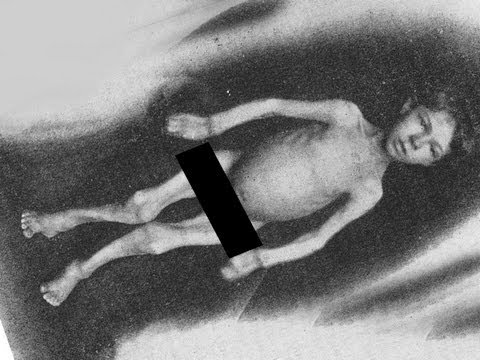
Parallels have been drawn between the way a child skeleton would likely
develop in
orbit and diseases that cause weak
and soft bones here on earth. Bones that break and heal
according to different forces than the typical downward ones,
like Rickets. It's tenable to say that without proper precautions,
exercise and care, like adult astronauts already take,
children developing in space could look like this.
Not because of Rickets or a lack of vitamin D,
but because the usual forces and active use required for healthy bone
development
just wouldn't be there. Added to the other threats,
imagine a body shaped like this but with
thinner legs, thin, weak muscles, a puffier
face, poor eyesight and a higher than usual proclivity to dementia later
in life.
Doesn't sound very good, does it? Remember though that a lot of this
is speculation. Few studies have been done on the topic
and few are planned for the future. We don't even know if a healthy fetus can
develop in the first place
or if conception can even occur in space.
When I think about how little we know about our bodies
and how our bodies might grow and develop in the larger
universe beyond earth, I like to think about
plankton. These little guys live in the ocean
and they exist in staggering numbers.
Many varieties are too small to even see individually,
but collectively they can be seen from space.
It's estimated that there are more plankton in the oceans of Earth
than there are stars in our galaxy. More plankton on
Earth than there are galaxies in the observable
universe. And these guys
wonder around at the whim of ocean currents.
They're wanderers. In fact, they get their name from the Greek word for
wanderer, a name that they share with objects
seen wondering in the sky. Planets.
Plankton on a planet. Wanderers
on a wanderer. Maybe,
like ocean plankton, we humans are destined to wander far and wide
eventually also becoming more numerous than the stars
in our galaxy. It's within the realm of what we can achieve.
But before we start feeling too excited, too proud,
keep in mind that we know very little
about how our bodies grow and develop
outside of this wanderer, this planet.
And even though we know a lot of older
words that sound like body,
fundamentally we don't even know why we call these things
bodies in the first place.
And as always, thanks for watching.