en English
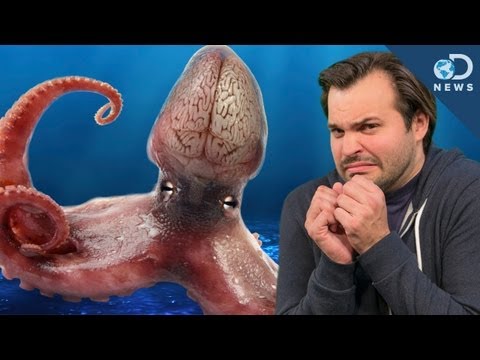
Octopi Have a Brain in Every Tentacle! English subtitles
Report a problem
Advertisement
English transcript
There is an animal out there they will steal your shoes,
can play catch with a ball, and can
look at you with intelligent eyes.
But you probably wouldn't want this one as a pet.
Hey, guys, Trace here for D News to open your mind a bit.
What's in a brain?
That which we call a mind by any other configuration
we'd think is sweet, or so it turns out.
In case you're not into paraphrasing Shakespeare,
it's come to light that many of our assumptions
about large brains have been off the mark.
The human brain is a centralized organ
inside the head that controls and manages
all the functions of the human body.
Everything happens in here.
Involuntary, voluntary, emotion or logic--
it's all made in one spot.
The human brain is a pretty large size
considering our body.
It's almost twice as large as it should be.
We're pretty smart with this centralized CPU.
But what if we networked a bunch of brains?
Would we be even smarter?
Right now, we can solve puzzles and mazes, we can open jars,
we use tools, we can steal things,
we can hide from predators, we can play with toys,
we can recognize faces, and a bunch of other stuff.
But an octopus?
It can do all that too.
Are you surprised?
Slowly, humans have been finding out that the animals around us
are a lot smarter than we thought.
And the lowly octopus is kind of like an animal genius.
The cephalopod and the human share a common ancestor
from 750 million years back, a worm with eye spots-- gross.
But while the human keeps the brain in one place,
the octopus doesn't.
They only have 500 million neurons, about 1/20
of what our brains have.
But the cephalopod brain works more
like an internet of brains.
While their main CPU is only the size of a walnut,
each of their eight arms contains packets of neurons
too.
These networked smaller brain somehow
enabler a cephalopod to approach the power of one central brain.
Researchers think each of the collections of neurons
in the cephalopod's arms can carry out instructions
independently and think for themselves.
The suckers can attach to things, exert forces,
and even smell stuff.
For example, octopi have learned how to open jars and even
those little child-proof drug bottles that
cause problems for some adult humans.
Plus, these octopi aren't taught to use tools.
They're solitary.
They don't have social groups and only live for five years.
If you left a four-year-old human along
with a prescription bottle full of candy, what would happen?
Cephalopod?
Have that thing right open.
Not long ago, we considered animals just dumb things
here for toys and entertainment.
But the closer we look, the more we
find that as they evolved alongside us,
they gained some skills that seem pretty intelligent.
Tool use, forethought, reasoning,
and puzzle-solving skills have been
observed in elephants, chimpanzees, dolphins, birds,
and octipi.
We may have made this awesome giant brain do a lot for us.
But some of these animals we share the planet with
are not so far behind.
So what do you think of the humble octopus?
Smarter than you thought?
Are you surprised?
Type out your feelings into that boxy thing down below,
and submit them, so we can all see.
And while you're at it, click the button that says Subscribe,
so you'll get all the D News that's fit to film.
Thanks a lot.