en English
The Economics of Sex English subtitles
Report a problem
Advertisement
English transcript
Marriage rates in the U.S. have hit an historic low.
Annual revenue of the online dating industry is at an all-time high. $1.049 Billion.
Ever wonder if romantic relationships are getting increasingly more difficult to navigate
these days? Why fewer couples are getting married and later than ever before? Time for
a crash course on the Economics of Sex.
Let’s think about sex as an exchange where each person gives the other person something
of themselves. It might appear at face value that they are giving the same thing - - intimate
access to each other’s bodies - - but there’s more going on here than meets the eye.
Men and Women both enjoy sex. We all know that. But what’s interesting is how the
data tells us that Men and Women experience sex differently.
On average, Men have a higher sex drive than women. Blame it on testosterone, call it whatever
you want--but on average, men initiate sex more than women, they're more sexually permissive
than women, and they connect sex to romance less often than women. Nobody’s saying this
is the way it ought to be. It’s just the way it is.
Women, on the other hand, are likely to have sex for reasons beyond just simple pleasure.
Her motivations for sex often include expressing and receiving love, strengthening commitment,
affirming desirability, and relationship security.
So in an exchange relationship where men want sex more often than women do, who decides
when it will happen?
She does, of course. Sex is her resource. Sex in consensual relationships will happen
when women want it to. So how do women decide to begin a sexual relationship?
Pricing. Women have something of value that men want…badly, something men are actually
willing to sacrifice for. So how much does sex cost for men? It might cost him nothing
but a few drinks and compliments, or a month of dates and respectful attention,
or all the way up to a lifetime promise to share all of his affections, wealth and earnings
with her exclusively.
The “price” varies widely. But if women are the gatekeepers, why don’t very many
women “charge more” so to speak? Because pricing is not entirely up to women. The “market
value” of sex is part of a social system of exchange, an “economy” if you will,
wherein men and women learn from each other – and from others – what they ought to
expect from each other sexually. So sex is not entirely a private matter between two
consenting adults. Think of it as basic… Supply and Demand. When supplies are high
- prices drop... since people won’t pay more for something that’s easy to find.
But if it’s hard to find ... people will pay a premium.
And the same rings true with sex. Men know that sex is cheap these days, if they know
where to look.
So how did we get here? How did the market value of sex decline so drastically?
Economists often speak of “technological shocks” that dramatically alter markets.
Take pesticides for example…
Pesticides revolutionized agriculture, enabling its mass production on a level unparalleled
in the history of human civilization. Lawns became greener. Produce became better, and
widely available with a marvelous variety. We eat like kings now. And the market has
changed ... forever.
Here’s another example: Artificial hormonal contraception or The Pill, allowed men and
women to have sex while avoiding pregnancy. This was a technological shock that forever
altered the mating market by profoundly lowering the cost of sex. It didn’t change overnight
but the effects have been … one might say… revolutionary.
Before contraception, sex before marriage took place during the search for a mate- someone
to marry. Sex didn’t necessarily mean marriage, but serious commitment was commonly a requirement
for sex. Sex was oriented towards marriage. Don’t believe people who say your great-grandparents
were secretly as casual about sex as your friends are. They weren’t, because to mess
around with sex eventually meant, well, becoming parents.
Now...remember the example of “pesticides?” It turns out that they had unforeseen effects
that are wreaking havoc on the environment and weakening the natural ecological systems
that we depend on. Scientists believe that because of pesticides, the bee population
is dropping at an alarming rate. One-third of all the food we eat depends on those bees
for pollination. And that’s just one example. It is now feared that the overuse of pesticides
is throwing ecology as we know it into disarray.
While the original purpose of the Pill was to prevent pregnancy, the data reveals an
unanticipated side-effect: the Pill threw the mating market into disarray. Having sex
and thinking about marriage have now become two quite different things. We now have a
split mating market:
One corner where people are largely interested in sex
and one corner where people are largely pursuing marriage
And there are more men looking for sex than women,
and more women looking to marry than men.
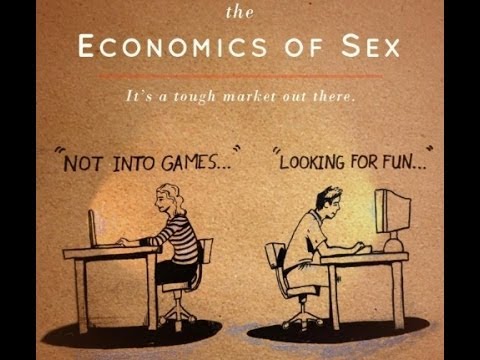
The language of online dating reinforces the reality of this split mating market. Men are
more apt to write that they’re “looking for fun,” while women tend to signal very
different things, saying things like “only serious inquiries, please” or “not into
games.”
So this split mating market poses a particular problem for women. They certainly call the
shots when it comes to short-term sexual relationships. This is because men outnumber them. This
enables women to be more selective in the short-term.
But the reverse is true when they decide they want to settle down.
We often hear about “men’s lack of commitment,” but the blunt reality is an economic one:
Women vastly outnumber men in the marriage market which means men can be picky and can
insist on extensive sexual experience before committing.
Men are in a position to maximize their rewards while investing fewer resources. Why do men
do this? Because they can. Here’s the thing: In the
past, it really wasn’t the patriarchy that policed women’s relational interests. It
was women. But, this agreement, this unspoken pact to set a high market value of sex … has
all but vanished.
But in a brave new world where having sex no longer means babies and marriage has become
optional, the solidarity women once felt toward each other in the mating market…has
dissolved. Women no longer have each other’s backs. On the contrary… they’re now each
other’s competition.
And when women compete for men, they tend to do so by appealing to what men want…
Here’s where women are wrong about men:
Men are not actually afraid of commitment at all. While women are the gatekeepers when
it comes to sex, the deal is that men are in the driver’s seat in the marriage market.
They can navigate it in exactly how they want to. And unlike women’s fertility, men’s
virility doesn’t expire by 40, or 45, or 50, or even 60. So what’s the rush? Talk
about having the upper hand! So... it should come as no surprise that
the average age of first marriage in the United States continues to rise, and that the share
of Americans between the ages of 25-34 years old who are married is continuing to drop.
While there are certainly factors that contribute to each of those trends, the gender imbalance
in a split mating market is a big one.
Talk about a profound irony. By nearly every measure, young men are failing to adapt to
contemporary life. When attractive women will still go to bed with you, life for young men—even
those who are floundering—just ain’t so bad.
In reality, men tend to behave as well or as poorly as the women in their lives permit.
Economists say that collusion—women working together—would be the most rational way
to elevate the “market value” of sex, But there is little evidence of this happening
among women today. At least, not yet…
If women were squarely in charge of how their relationships transpired and demanded a “higher
market price” for the exchange of sex so to speak, we’d be seeing—on average—
more impressive wooing efforts, greater male investment, longer relationships, fewer premarital
partners, shorter cohabitations, and more marrying going on.
For a woman to know what she wants in a relationship and to signal it clearly, especially if it’s
different than what most men want … This is her power in the economy. But none of
these things seem to be occurring … not now… at least…
Today, the economics of contemporary sexual relationships clearly favor men and what they
want, even while what they are offering in the exchange has diminished. And it’s all
thanks to supply, demand, and the long reach of a remarkable little pill.
Brought to you by the Austin Institute for the Study of Family and Culture.