en English
How Can Something Have Zero Calories English subtitles
Report a problem
Advertisement
English transcript
This episode of Dnews is brought to you by Domain.com.
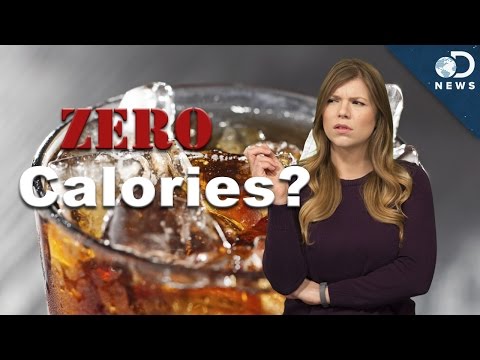
Zero-calorie foods are all the rage these days - but are they REALLY zero calories?
And is it even possible for a food to HAVE zero calories?
Hey guys, Tara here for Dnews - and I’m sure a lot of you out there drink diet soda
on occasion, and if so - perhaps you’ve found yourself wondering at times, “How
is it possible that this has zero calories?” Or for that matter, how can any food have
zero calories?
It’s an interesting question, and the truth is - they really can’t.
Aside from water, there is no truly zero calorie food or beverage. And here’s why you probably
didn’t know that.
First off, most foods labeled as having “zero calories” - actually DO contain a small
amount of calories. But as long as it’s less than 5, then the FDA legally allows manufacturers
to round down - meaning a food with 4.9 calories, can still be listed as having zero.
Splenda, the “zero calorie sweetener,”
actually has 3.4 calories per packet. But for an even better example, let’s look at
this product: I Can’t Believe It’s Not Butter spray. It’s advertised as a non-fat,
zero-calorie food with a serving size of 5 sprays. But it’s actually not zero-calorie,
it contains 4 calories for every 5 sprays. And when you consider the fact that its main
ingredient, soybean oil - contains about 120 calories per tbsp, then that means the entire
bottle - has almost 900 calories, even though it’s advertising suggests that it is a zero
calorie food.
So misleading labels are definitely part of the problem. Another problem is the myth perpetuated
around “negative calorie foods.” These are things like celery or cucumbers, that
contain very few calories - and it’s a common misconception that your body expends more
energy digesting them, than the amount of calories it takes in. Unfortunately, there’s
really no science to back that up.
Let’s go back to the example of celery. A single stalk of celery has 6 calories, and
the “thermic effect” of celery - which is the percentage of its calories you burn
by digesting it - is around 8%. 8% of 6 calories is about half of a calorie - which means that
even after you account for digestion, your net calorie consumption is still 5 ½. Obviously
that’s negligible in the long run, but it proves an important point.
Foods with the highest thermic effect, are proteins - which still only have a thermic
effect of around 20-35%. Meaning there are no truly negative-calorie foods or beverages.
Except… for ice water. Ice water technically has zero calories, but your body has to expend
extra energy to bring it back up to your normal body temperature - and for 8 oz of water,
that burns about 8 calories. So theoretically, if you were drinking 8 8oz glasses of ice
water a day, you’d be burning about 64 calories a day - for a year, that equates to 6 ½ pounds.
Now as far as weight loss is concerned, it’s minimal - but of course the other benefits
from drinking that much water definitely aren’t.
Now, what about foods that are heavy in mass, but claim to have zero or very low calories?
How do those work? Well, the idea is that those foods are made up of ingredients your
body simply can’t break down. If you were to think about it in very abstract terms,
you could almost liken it to eating a piece of plastic - your body can’t digest it,
so it simply passes through your system, meaning you don’t consume or burn calories from
eating it.
Now most of the time, foods that are like that, contain a lot of fiber, which is indigestible
by humans - although we still consume it, because it keeps our intestines flowing and
healthy. So if you were to eat a big, heavy hunk of food that was almost entirely fiber,
it would still have an extremely low calorie count, because your body can’t absorb any
of it.
So you see, the idea of a zero calorie food - is pretty much a misconception. Almost all
foods, even those labeled as “zero calorie” - do contain a small amount of calories. And
the only true “negative calorie” food - is water. Which isn’t even a food. EVERYTHING
WE KNOW IS WRONG!
Switching gears for a second, if you’ve been thinking about starting up your own blog
or website, then why not check out domain.com? When you buy a domain name from Domain.Com,
you’re also buying the power to influence and control what people find when they search
for you online.
Domain.com is affordable, reliable, and easy-to-use, and let’s face it - no domain extension
will help you tell your story like a .COM or .NET domain name.
Better yet, the guys over at Domain.Com have set us up with a special offer, just for you
lovely Dnews viewers. All you have to do is enter the coupon code DNEWS at checkout, and
you’ll get 15% off Domain.com’s already affordable domain names and web hosting.
So when you think domain names, think Domain.Com.
In the meantime, let us know in the comments what you think of this episode - and if there
are any other misconceptions about food you’d like cleared up. That’s it for me, but as
always - thank you guys for watching!