en English
Why Lightning Strikes Are About To Double English subtitles
Report a problem
Advertisement
English transcript
I don’t know about you, but thunderstorms scare the hell out of me. Lightning may never
strike in the same place twice, but based on the following video, I think we’re going
to run out of places to hide real real soon.
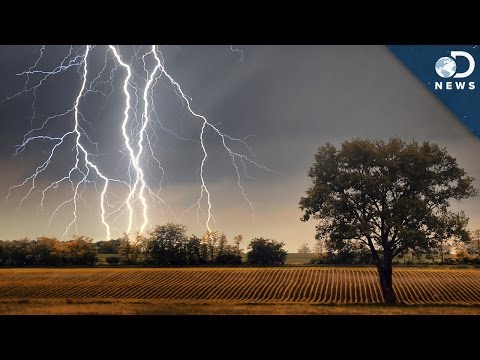
Hey folks, I’m Matt Lieberman filling in for DNews. According to Climate scientists
from the University of California, Berkeley, global warming will cause the amount of air
to ground lightning strikes to increase by 50% by the end of this century. Now, that
may feel far away right now, but the road to lightning palooza, as it will now be called,
is not going to be fun for anyone. So, how are global warming and lightning connected?
Well, lightning strikes are caused by charge separation in clouds, which are composed of
water and ice molecules. Atmospheric water molecules are essentially lightning fuel.
Now, increased global temperatures will cause more water to evaporate into the atmosphere.
Imagine a bomb dropped into a barrel of gunpowder in one of those oldschool rooms packed to
the gills with TNT. In a house that’s on fire. The opportunity for explosive deep convection
skyrockets under these conditions, sharply raising the risk of human injury and wildfires.
Jeez. Hold on, excuse me, science? How did we get to this conclusion, science?
I’ll tell you, me! You see, convection, the thermal transfer of energy through fluid
and gas, has long been measured by precipitation, namely, the amount of rain, snow, and hail
that hits the ground during a given period. However, that doesn’t account for the ascent
speeds of moisture into the atmosphere. This is a factor known as CAPE, or Convective Available
Potential Energy, which is measured via instruments released twice daily into the atmosphere via
weather balloons. Essentially, CAPE measures how fast and far a moist pocket of air could
travel into the upper atmosphere, releasing explosive charges. Armed with this information,
scientists can actually now predict 77 percent of lightning strikes.
Scientists then applied their new CAPE data to 11 climate models that predict precipitation
throughout the century and reached their conclusion. As it turns out, CAPE in the U.S. will rise
by 11 percent for every degree celsius that our global temperature rises. Combined with
small increases in precipitation levels and based on the projected four degree increase
worldwide by 2100, lightning strikes will rise by 50%. Just another reason to try to
curb global warming before it zaps us back.
So how do you feel about lightning? Are you concerned about the potential increase?
Let us know in the comments below. I’m Matt Lieberman filling in for DNews. You can find
more of my videos over at Sourcefed. Please like the video and subscribe to the channel.
Thanks for watching.