en English
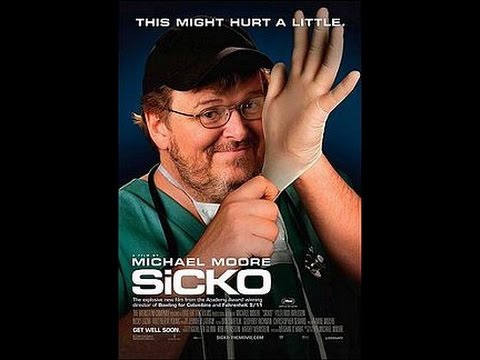
Sicko (French & English Subtitles) English subtitles
Report a problem
Advertisement
English transcript
We got issue in America.
Too many good docs are getting out of business.
Too many ob-gyns aren't able to practice their love with women across this country.
I don't have a job. I don't want to have any more debt out to anybody else.
I'm flushing the wound.
This is Adam.
He had an accident.
He's one of nearly 50 million Americans with no health insurance.
But this film isn't about Adam.
So this is the table saw. It was spinning that way...
This is Rick.
I was gripping a piece of wood and I grabbed it here and it hit a knot...
He sawed off the tops of to of his fingers.
...and it was that quick.
- His first thought? - I don't have insurance.
Am I gonna have to pay cash for this? $ 2,000, $3,000 or more?
Does that mean we're not gonna get a car?
Rick also doesn't have health coverage.
So the hospital gave him a choice.
Reattach the middle finger for $60.000.
Or do the ring finger for 12.000.
It's an awful feeling to just try to put a value on your body.
Being a hopeless romantic. Rick chose the ring finger.
For the bargain price of 12 grand.
The top of his middle finger now enjoys its new home in an Oregon landfill.
I can do that thing where, you know, the old man used to pull the finger off.
This movie isn't about Rick either.
Yes. There are nearly 50 million Americans with no health insurance.
They pray every day they don't get sick.
Because 18.000 of them will die this year.
Simply because they're uninsured.
But this movie isn't about them.
It's about the 250 million of you who have health insurance.
Those of you who are living the American Dream.
It's moving day for Larry and Donna Smith.
They've packed everything they own in these to cars.
And are driving to Denver. Colorado.
To their new home...
- Hi. - Hello.
...in their daughter's storage room.
This is home, sweet home.
- Look at all that stuff. - We'll get everything organized.
- We will. - What do we do with the computer?
- It stays. - It stays there.
So this is where Heather talked about we might have to put bunk beds.
I see what she's talking about.
It wasn't supposed to end up like this for Larry and Donna.
They both had good jobs.
She was a newspaper editor.
And he was a union machinist.
They raised six kids who all went to fine schools like the University of Chicago.
But Larry had a heart attack.
And then another one.
And then Donna got cancer.
And even though they had health insurance.
The copays and deductibles soon added up
to the point where they could no longer afford to keep their home.
If somebody told me ten years ago this was gonna happen to us because of healthcare,
I would have said, "It's not possible. "
"Not in the United States. We wouldn't let that happen to people. "
- Are we gonna quit? - No.
It's just hard.
They were bankrupt.
So they moved in with their daughter.
We'll get it all figured out.
We emptied the dresser so you have a spot.
Nice, very nice.
Even their son Danny popped in from across town
to welcome them to Denver.
- What do we do about people like you? - I don't know, that's a good question.
You're supposed to pay a deductible for $9,000, I understand. That's healthcare.
What about people like Kathy and I that have to come up there
and move you every five years, every two years, every year,
- 'cause you don't have enough money? - That's what Russell says too.
I'm sorry. It's not what we wanted to have happen in life.
And we're doing what we can to make the change.
You don't know what that feels like inside at 50-some years old,
to have to reach out to my 20-something-year-old for help.
It's gonna be hard for four, five, six, seven months, it's gonna be hard.
I have a feeling of you bring your problems with you no matter where you go.
Yeah.
But I don't know what to do about that.
By sheer coincidence. Their daughter's husband. Paul.
Was leaving on a job the very same day they arrived.
Paul was a contractor. But there weren't many jobs lately.
So he found work out of town.
I'm sure you'll keep a telephone conversation.
Email you.
You're gonna be just fine, lovies.
Weird situation, isn't it?
- Tell me where Daddy's going. - Iraq.
Why is Daddy going to Iraq?
To do some plumbing.
Oh, boy.
This I do early in the morning. The first thing I do is I clean here.
At age 79. Frank Cardile should be kicking back on a beach somewhere.
But even though he's insured by Medicare.
It doesn't cover all the cost of the drugs that he and his wife need.
Being that I'm an employee here, my medicine is for free.
So that's why I gotta keep working. Until I die.
There is nothing wrong with that.
OK.
I always gotta keep my ears open because there's always spillages.
Sometimes you get a gallon of milk.
Tomato sauce - oh, you're in trouble. It'll take a half-hour to clean that up.
And I look up on every aisle so as everything is clean.
If I see something I pick it up, whether it's paper or garbage.
One day I had the keys in my hand and they went in there.
And I had to climb in there to get the keys out.
It's a sad situation.
If there are golden years, I can't find 'em, I'll tell you that.
She had a painkiller for her hip.
The girl said, "Frank, this is $ 213." "What, for a painkiller?"
- I didn't take it. - I backed off. I said, "I gotta come back. "
What's in them? What's in these new drugs that they distribute?
I don't believe you need half of the things they tell you.
I have never taken medication now, as I'm getting older.
I don't even like to take an aspirin.
I do like a little brandy.
I don't really know how this happened, but the trunk came forward into the back seat.
Laura Burnham was in a head-on collision that knocked her out cold.
Paramedics got her out of the car and into an ambulance for a trip to the hospital.
I get a bill from my insurance company
telling me that the ambulance ride was not going to be paid for,
because it wasn't preapproved.
I don't know exactly when I was supposed to preapprove it, you know?
Like after I gain consciousness in the car, before I got in the ambulance?
I should have grabbed my cellphone off the street and called in the ambulance?
I mean, it's just crazy.
I applied for HealthNet insurance for Jason.
They rejected him because of his height and weight.
Jason is six feet tall and 130 pounds.
I applied for healthcare through BlueCross BlueShield
and they told me that my body mass index was too high.
I'm 5' 1 ", I weigh 175 pounds.
I always thought health insurance companies were there to help us.
So I posted a note on the internet.
Asking people if they had had any similar stories
about problems with their insurance company.
Within 24 hours. I had over 3700 responses.
And by the end of the week. Over 25.000 people
had sent me their healthcare horror stories.
Some of them decided not to wait for me to get back to them.
Like Doug Noe. Who took matters into his own hands. Without my permission.
His daughter was nine months old when they discovered she was going deaf.
His health insurance company. CIGNA.
Said they'd pay for an implant in only one of her ears.
According to the letter they sent.
It's experimental for her to hear in to ears.
If a cochlear implant is good for one ear,
it doesn't even make any sense that it wouldn't be good for the second ear.
Especially when a child is just starting to learn how to talk,
she has to learn from both sides of her head.
That's when he sat down to write CIGNA a letter.
This is to CIGNA. "Noted filmmaker Michael Moore
is in the process of gathering information for his next film. "
"I've sent information concerning CIGNA's lack of caring for its policy holders. "
"Has your CEO ever been in a film before?"
Before he knew it. He received a call on his voice mail from CIGNA.
Tuesday. 8.:54 am.
Obviously all this worked because Annette is going to get her second implant in July.
"Dear Mike. I work in the industry. "
"I work for an HMO."
I started to get hundreds of letters of a different sort
from people who work inside the healthcare industry.
They'd seen everything and they were fed up with it.
"Health insurance companies suck. Flat suck. "
Like Becky Malke. Who was in charge of keeping sick people away
from one of America's top insurance companies.
I work in a call center, so people call in and ask for insurance quotes.
There are certain preexisting conditions, basically industry-wide,
that will not be covered -
diabetes, heart disease, certain forms of cancer.
If you have these conditions, you are likely not going to get your health insurance.
How long is this list of conditions that make you ineligible?
It would be a really long list. It would be a long list.
It could wrap around this house.
Sometimes you know they're gonna be declined at the end of the application,
and they're like... God, like one time I had a couple,
and they were so happy to get... I'm gonna cry.
They were so happy that they were... I took them through this application.
And the husband was late for work.
And the wife said to him, "Don't worry, baby, it's gonna be OK."
"We have health insurance now. "
And when I looked, I could tell they were gonna get declined
because of their health conditions. And they were so happy.
I thought, "God, they're gonna get that call in a couple of weeks
telling them that they're not eligible for insurance. "
I just felt so bad 'cause I just really thought
and I knew and I couldn't say anything to them.
I just felt like crap.
That's why I'm such a bitch on the phone to people,
because I don't wanna get to know them,
I don't wanna know about their lives, I just wanna get in and out,
and get done with it 'cause I can't take the stress of it.
In spite of Becky being a bit of a pain on the phone.
A quarter billion Americans are still able to get health insurance.
Let's meet some of these happy insured customers.
Maria has BlueShield.
And Diane. Horizon BlueCross.
BCS insures Laurel.
And Caroline has CIGNA.
And it's a good thing that they're all fully covered.
I ended up being diagnosed with retroperitoneal cancer.
- Brain tumor. - Breast cancer.
Brain tumor on the right temporal lobe.
As they were insured. They got the red-carpet treatment at the doctor's office.
She requested for me to see a neurologist.
The way they would treat it was to remove it.
Surgery was scheduled for December 9.
There is a test that you can take
that will show whether or not you would benefit from chemo.
They got their treatment. But not before battling their insurance companies.
Investigated whether or not this was a preexisting condition.
"It's not medically necessary. "
They claim that it's experimental.
"We don't consider that life-threatening. "
Diane died from her non life-threatening tumor.
Laurel's cancer is now spread throughout her body.
Her "experimental test" proved that Caroline needed chemo.
While vacationing in Japan. Maria became ill
and got the MRI that BlueShield of California had refused to approve.
The doctors in Japan told her she had a brain tumor.
BlueShield had said repeatedly she didn't have a tumor.
That's when she said: "Well. I'm pretty sure I have a lawyer. "
March 13, 2003.
I'm gonna direct your attention to exhibit one.
Please describe for me what it is.
It is a denial for referral to an ophthalmologist.
- Is it your signature on this? - Yes.
I'd like to direct your attention to exhibit two.
This is a denial of a request for referral
for a magnetic resonance imaging test of the brain.
- It has your signature? - Yes.
Directing your attention to exhibit three. Please read this document.
This is a denial of a referral to a neurosurgeon.
Can you explain for me how you came to sign the denial letter?
This is a standard signature put on all denial letters.
- Is it your signature or a stamp? - That is a stamp.
Did you ever see a denial letter before your signature was stamped on it?
No, but the denial letters are fundamentally the same.
The denial letters that are sent out...
- The answer is no. - No. All right.
The definition of a good director was somebody who saves the company money.
Dr. Linda Peeno was a medical reviewer for Humana.
She left her job because she didn't like their way of doing business.
I was told when I started that I had to keep a 10% denial.
Then they were giving us reports weekly that would have all the cases we reviewed,
the percent approved and the percent denied.
And our actual percentage denial rate.
Then there would be another report that compared me to all the other reviewers.
The doctor with the highest percent of denials was gonna get a bonus.
Really? So you, as a doctor, working for the HMO,
if you denied more people healthcare, you got a bonus?
That was how they set it up.
Any payment for a claim is referred to as a medical loss.
That's the terminology the industry uses.
I mean, when you don't spend money on somebody, you deny their care,
or you make a decision that brings money in and you don't have to spend it,
it's a savings to the company.
This is Tarsha Harris.
BlueCross didn't deny her her treatment.
And actually approved her operation.
But then they discovered that in the distant past.
She had had a yeast infection.
Apparently it's common. Men, women can get a yeast infection.
So I was prescribed the yeast infection cream, general cream, and it went away.
She later applied for health insurance
and that's what you're supposed to be disclosing - serious ailments.
The yeast infection is not a serious ailment. There was nothing she could have done.
It wasn't until they were gonna have to spend money that they looked.
If they'd taken five minutes and wanted to clear up the yeast infection,
they could've looked at her records or talked to her doctor.
Because of the undisclosed yeast infection.
BlueCross dropped Tarsha Harris.
She thinks she's put this behind her. And then BlueCross changes their mind,
tells the doctors, "We're taking the money back, go get the money from Tarsha. "
The fact of the matter is it was a yeast infection, that's all it was.
I'm still a little bitter because I don't trust insurance companies now.
To me, it seems they're always gonna be looking for a way out.
What happened to helping the person that's sick?
Don't make their problems worse.
This is Lee Einer.
If they weren't able to weed you out in the application process.
Or deny you the care your doctor said you needed.
And somehow ended up paying for the operation.
They send in Lee. Their hitman.
His job is to get the company's money back any way he can.
All he has to do is find one slip-up on your application.
Or a preexisting condition you didn't know you had.
We're gonna go after this like it's a murder case.
And I mean the whole unit dedicated to
going through your health history for the last five years,
looking for anything that would indicate
that you concealed something, you misrepresented something,
so that they can cancel the policy
or jack the rates so high that you can't pay them.
And if we couldn't find anything you didn't disclose on the application,
you can still get hit with a preexisting denial,
because you don't even have to have sought medical treatment for it.
In some states, it's legal to have a prudent person preexisting condition.
And that's a mouthful, I know,
but what that says is if prior to your insurance kicking in,
you had any symptom which would incline a normally prudent person
to have sought medical care,
then the condition of which that symptom was a symptom is excluded.
I know!
It's labyrinthine, isn't it? But that's how it works.
They're supposed to be even-handed,
but with an insurance company, it's their frigging money!
So it's not unintentional, it's not a mistake,
it's not an oversight, you're not slipping through the cracks.
Somebody made that crack and swept you towards it.
And the intent is to maximize profits.
Looking back, I don't know that I killed anybody.
Did I do harm in people's lives?
Yeah. Hell, yeah.
I haven't worked for insurance companies for a long time,
and I don't think that really serves to atone
for my participation in that mess.
I am glad I'm out of it, though.
Julie Pierce was struggling to get care for her husband Tracy.
Who was suffering from kidney cancer.
Julie works in the intensive care unit at St. Joseph's Medical Center
in Kansas City. Missouri.
Which provided her family with health insurance.
Every month, there was a new drug that the doctor wanted to try.
My insurance denied it. One letter might say, "not a medical necessity,"
one letter might say, "it's not for this particular type of cancer,"
and they denied it.
Then we came up with the bone marrow. It has showed to stop it,
sometimes to completely get rid of it.
Tracy's doctors said this treatment had been successfully tried
on many other patients.
If one of Tracy's brothers turned out to be a suitable donor.
There were promising bone marrow treatments for beating Tracy's cancer.
Two weeks later, the bone marrow nurse at KU called me and she goes:
"We've got the results back. His youngest brother is a perfect donor match. "
We were ecstatic.
You know, I think that's the happiest I had seen him...
in a while.
So we submitted it and they denied it.
Said it was "experimental. "
So I found out that there is a board of trustees over our medical plan
that actually work at my hospital.
And they are the final decision-makers on what gets approved and what doesn't.
Julie and her husband and their son. Tracy Junior.
Demanded a meeting with the health plan's board of trustees.
The very people who had the power to approve their claim.
They told Julie that they were sympathetic to her situation.
I said, "Your sympathy does me no good when I'm burying him next year. "
And I told them, I said if I was... Bruce van Cleve was our CEO.
I said, "I bet if it was Bruce van Cleve's wife, it would get approved. "
"No, it's nothing like that. "
I said, "Or maybe if my husband was white. "
And I got up and walked out of the room.
When we got home, I found him up in the bathroom.
And I knocked on the door and said, "What are you doing in there?" "Nothing. "
I opened the door 'cause usually he'll say: "What do you think I'm doing in here?"
And he was sitting in there and he was crying.
And he said, "Why me? I'm a good person. "
And I said, "But we're not done fighting this. "
"We're strong, yeah. " And then he said...
You know, he goes, "I can see now that I'm gonna die. "
He said, "I can leave everything, but I don't want to leave you and Tracy. "
The doctor told me he would die in three weeks.
And...
On January 13th, which was my birthday,
he went to sleep.
And he died five days later, here at home.
He was my best friend.
He was my soul mate. He was my son's father.
I mean, we were to grow old together.
They took away everything that matters.
I wanna know why, why my husband?
Why wasn't he given the chance to live?
You preach these vision and values that we care for the sick, the dying, the poor.
That we're a healthcare that leaves no one behind.
You left him behind. You didn't even give him a start.
It was as if he was nothing.
And I want them to have a conscience about it.
And I don't think they do. I don't think it has fazed them one bit.
At all.
There was one person in the healthcare industry
who did have a conscience.
Dr. Linda Peeno. A former medical reviewer at Humana.
My name is Linda Peeno.
I am here today to make a public confession.
In the spring of 1987, as a physician,
I denied a man a necessary operation
that would have saved his life, and thus caused his death.
No person and no group has held me accountable for this,
because, in fact, what I did was I saved the company a half a million dollars for this.
And, furthermore, this particular act secured my reputation
as a good medical director,
and it insured my continued advancement in the healthcare field.
I went from making a few hundred dollars a week as a medical reviewer
to an escalating six-figure income as a physician executive.
In all my work, I had one primary duty, and that was to use my medical expertise
for the financial benefit of the organization for which I worked.
And I was told repeatedly that I
…