en English
Is The Moon A Star English subtitles
Report a problem
Advertisement
English transcript
Still confused as to whether the Moon is a star or a planet? I can fix that.
Hey guys, Amy here to talk space on DNews. There has been a lot of talk recently about
dwarf planets vs. “regular” planets, comets, asteroids… not to mention some questions
what what exactly a natural satellite is. Well, let’s break down what exactly is kicking
around in our Solar System.
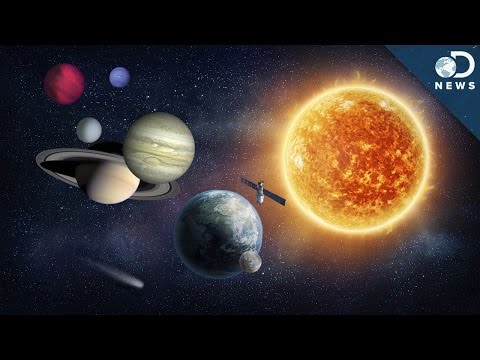
At the centre is our Sun, which is a star. A star is a luminous ball of gas, mostly hydrogen
and helium, that is held together by its own gravity. Nuclear fusion in its core produces
photons, the light particles we see, as well as heat and trace amounts of other heavy elements.
But not all stars are the same. Stars can be different colours depending on their temperature,
hotter stars looking slightly bluer while cooler stars look slightly more red. And stars
are typically different sizes, the cooler stars being smaller. As stars evolve and age,
depending on their mass, they expand and eventually puff up as red giants and rip themselves to
shreds (that’s what happens to stars about the mass of our Sun) and turn into a white
dwarf or, if they are really massive, they explode as supernovas before turning into
neutron stars or black holes. Then there are brown dwarfs, which are sometimes called failed
stars because they just aren’t big enough to start the fusion reaction that makes a
star bright. Brown dwarfs also have planet-like qualities, making them a kind of bridge between
stars and planets.
Orbiting all kinds of stars are the planets, but for a body to be classified as a planet
it has to meet three additional criteria laid out by the International Astronomical Union:
It has to be large enough to be round, it cannot be a satellite of another body, and
it must have cleared its orbit of all nearby debris. This all basically puts a minimum
size limit on planets, but as long and they’re big enough planets can come in different types
and sizes. Earth is a rocky, terrestrial planet, as are Mercury, Venus, and Mars. The outer
planets Jupiter, Saturn, Uranus, and Neptune, are called gas giants, though those last two
are sometimes called ice giants as well.
When we talk about planets around other stars, we have slightly different descriptors. There
are super Earths, which aren’t exactly what they sound like. These are planets more massive
than Earth but still far less massive than Uranus or Neptune, which are 15 and 17 times
as massive as the Earth respectively.
On the other end of the size spectrum are dwarf planets, planets that are too small
to have cleared their orbital path of debris, like Ceres, the dwarf planet we’ve talked
about before, in the asteroid belt. Pluto is a dwarf planet as well, though in recognition
of everyone’s favourite little body, the IAU recently designated all dwarf planets
that orbit beyond Neptune as plutoids.
But regardless of size, type, or distance from its host star, any planet can have a
moon. A moon is a natural satellite, a body that makes an orbit around a planet. Moons
can have water like Europa, can have thick atmospheres like Titan, or be, for all intents
and purposes, a dead world like our own Moon. As long as it’s orbiting a planet, it’s
a moon.
Of course, there are more subcategories and intricacies in individual bodies, but those
are sort of the basics. Does that clear things up?
If you have any more questions on celestial bodies, let us know in the comments below
or you can ask me on Twitter as @astVintageSpace. And don’t forget to subscribe for more DNews
every day of the week.