en English
The Large Hadron Collider Explained English subtitles
Report a problem
Advertisement
English transcript
Two and a half years ago scientists used the most complicated machine ever to solve one
of the greatest puzzles to vex the human race. And then they went, “Yeah but what if we
kicked it up a notch?”
Greetings atom smashers, Julian here for DNews. The Large Hardon Collider made headlines years
ago when it confirmed the existence of the Higgs Boson. This was huge news in the world
of particle physics because the discovery solved a few quarks.... I mean quirks.
As we understand it, there are subatomic particles that carry the fundamental forces (except
gravity, as far as we know) called bosons. In order for the math to work, these bosons
should be massless. And yet we actually observed some of them and found that certain kinds
of bosons did indeed have mass. To solve the problem it was proposed by Peter Higgs and
other researchers in the 60’s that a field existed everywhere all the time, and moving
through this field gave bosons and other particles their mass. The math predicted that if the
field was excited by high energy collisions, you could jiggle the field in just the right
way to briefly spring another particle together, and that particle is what we call the Higgs
Boson.
But scientists weren’t content to dust off their hands on their lab coats and call it
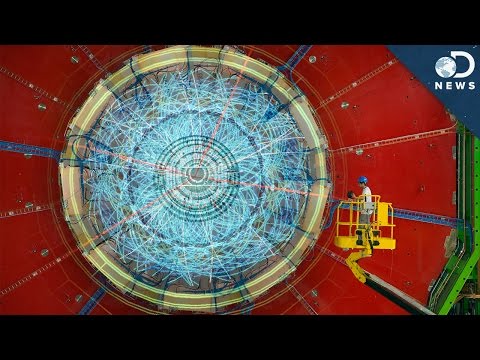
a day. No, they decided to build a 27 kilometer underground loop of supercooled magnets and
tubes and cameras 5 stories high so they could take pictures of protons smashing together
at nearly the speed of light, and they did it with no guarantee that the Higgs Boson
could be found or even existed at all. And you thought asking out your crush was risky.
But when they first flipped the switch in 2008, there was a problem. One measly connecting
wire in the over 10,000 used for the superconducting magnets failed and damaged the LHC. When it
was brought back online, it could only run at half of its intended power. And then they
found the Higgs Boson anyway. This machine answered one of the greatest questions ever
asked with one hand tied behind it’s back. But there’s more work to do.
You see the math doesn’t predict an exact value for the Higgs, and if the Higgs boson
has certain masses it implies vastly different things. One possible mass equation suggests
the Higgs is 115 gigaelectronvolts over the speed of light squared (GeV/c^2), which supports
the idea of supersymmetry, or more particles to add to the standard model that we haven’t
found yet. But the Higgs could also have a mass around 140 GeV, and that suggests a favorite
theory of sci fi, the multiverse. A mass that high could lend credibility to the idea that
there are many universes with Higgs bosons of different masses and ours just happens
to be a universe that has a higgs field just right to keep everything stable. So what is
the actual mass of the Higgs boson? About 125 GeV/c squaredSweet@. So supersymmetry
or multiverse? Both? We have no idea.
That’s why in March the LHC is coming back. It’s here to kick butt and chew bubblegum,
and it’s all out of bubblegum. It’s going to be twice as powerful with tougher wiring.
It’ll have better cooling to keep it’s superconducting magnets at 1.9 degrees above
absolute zero. And it’s been had its cameras upgraded for more precise measurement. And
when it spools up, no one knows what we’ll find. Supersymmetric particles? Candidates
for Dark Matter? Nothing at all? We’re just going to have to wait and see.
If bosons and fermions and quarks is all just a bunch of gibberish to you, we have a video
on what all those mean - check this out: