en English
What Did Prehistoric Humans Actually Eat English subtitles
Report a problem
Advertisement
English transcript
There’s a lot of people out there claiming to know the best diet, based on what our ancestors
ate. But how do we separate the hogwash from the history?
Hey guys, Julia here for DNews.
There are some people who like to make inferences on how we should live based on some “ideal”
past. Take a recent trendy diet. The basic tenets of the paleo diet come from a few current
hunter-gather societies, suggesting we should eat more like we did before the invention
of agriculture. We want an easy answer for how we should live, or more specifically eat,
but the real story is so much more complex.
So what does evidence say ancient humans ate?
From looking at teeth, skull fragments, environmental conditions, and even computer models, our
ancestors lived in a wide range of habitats, leading to a variety in diets. Optimal Foraging
theory suggests that diet is influenced by a food’s value and distribution within the
habitat.
For most of human-ish history we were hunter gatherers. Well, mostly gatherers. Before
4 million years ago, our ancestors ate a surprising amount of fruits and leaves, similar to how
chimps eat now. Researchers found isotopic evidence in teeth enamel of a transition around
3.5 million years ago, early hominid species starting expanding their diets. They added
other plants, like tubers, roots, and succulents. The researchers had to add that perhaps these
isotopes are from animals they ate, that ate the plants.
Speaking of meat, it’s not certain when meat entered early human’s diet. Whether
hunted or scavenged, researchers find evidence of marks on animal bones dating back 2.6 million
years. A skull found in Tanzania dating back 1.5 million years ago showed that meat had
become crucial for brain development in early humans. It’s thought that eating meat regularly
triggered changes in our brains, making us the kind of smart apes we are today.
Then there’s teeth. You can tell a lot by the teeth. Teeth size and shape and even how
our jaws fit together tell a story. We have bunodont - back teeth that are low with rounded
cusps that lend themselves well to eating below ground food, roots, tubers, the like.
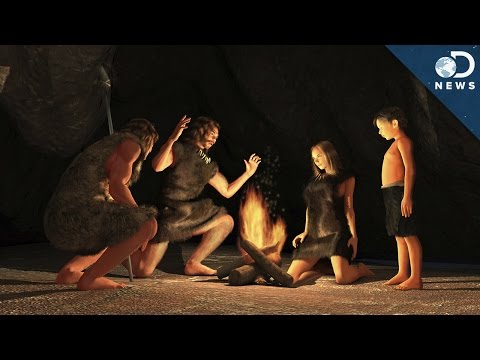
Our crooked teeth are probably the result of cooking food. Cooking opened up a new way
of getting nutrients. But our teeth changed with the invention of fire. As we started
softening our food by cooking, our jaws got smaller, but our teeth haven’t caught up
yet. hence all the crowding and crooked teeth.
Then about 12,000 years ago we settled down in communities and started growing our own
food rather than foraging for it. This is commonly called the Neolithic Revolution or
Neolithic Demographic Transition. During this time, humans introduced cereals into their
diet - the Neolithic Founder Crops, including, wheat, barley, lentils and peas. Although,
there’s evidence that of charred barley and wheat from Israel dating to about 23,000
years ago. There also some evidence that might move back the introduction of grain into the
human diet to about 100,000 years ago. Researchers from the University of Calgary found starch
granules on stone tools.
Evidence found in pottery shards suggest that humans also added dairy products to their
diets, around 7,000 years ago. While these advances are more recent, our guts evolved
to keep up. A genetic mutation in central Europe just over 7 thousand years ago for
humans to make drinking milk a thing.