en English
How Does Circumcision Affect Your Penis English subtitles
Report a problem
Advertisement
English transcript
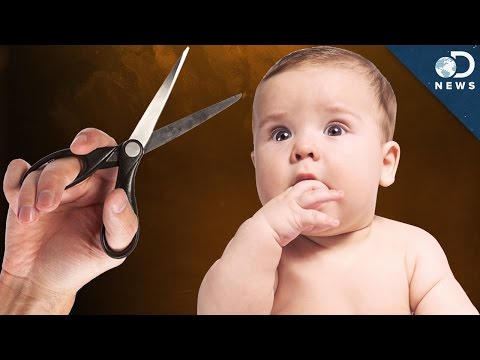
We ALL know the penis is a sensitive organ, and yet there are many who choose cut off
a chunk of their kids' manhood -- but what does this DO to the penis?
The practice of circumcision dates back thousands of years, popping up in ancient cultures in
Asia, Africa, Australia and the Americas independently, before any knew the other existed. It's practiced
in Muslim, Christian and Jewish populations. Worldwide rates vary, but in the U.S. from
1980 to 1999, 65 percent of babies were cut, and today, it's closer to 56 percent; rates
have been falling since 1960. Nationally, three out of four babies getting the procedure
in the Midwest, two thirds in the Northeast, a little over half in the south, and only
a fifth in the West!
Circumcision is the act of slicing the foreskin off the penis. A natural penis has skin covering
its head, but a circumcised one does not. A DiscoveryNews.com article describes the
foreskin as an "eyelid for the penis," which is a weird analogy but they are similar in
that there’s a mucous membrane on the inside.
The adult foreskin is about 12 square inches, of skin containing specialized nerve endings.
From a sexual standpoint, circumcision removes one third of the erogenous tissue of the male
genetalia -- as the penis and clitoris come from the same fetal tissue, the analogous
organ to the foreskin is the clitoral hood!
Obviously, there is a TON of debate as to the real benefit of circumcision; and it doesn't
help that the policies keep shifting. In 1999, the American Academy of Pediatrics issued
a statement calling the practice into question, saying the risks didn't outweigh the benefits,
but now a new compilation study done by the Mayo Clinic claims the benefits outweigh the
risks 100 to 1! According to their findings, over their lifetime half of all men will require
some kind of foreskin-related medical attention; circumcision reduces risks of "urinary tract
infection, prostate cancer, sexually transmitted diseases" and the risk of cervical cancer
is reduced for the female partners of cut men. In fact, the World Health Organization
recommend the procedure for any country attempting to battle HIV infection.
Now you might be thinking, wait, the United Nation's World Health Organization has a pruned
penis policy? Yeah, it does. And a 2010 study from Plos ONE explains why… See, the foreskin
isn't just an extra bit on the bits. Because the foreskin is a protective, mucous-membrane
layer, it also attracts bacteria -- actually, according to the study, the foreskin has it's
own microbiome! For the study, researchers from Johns Hopkins Bloomberg School of Public
Health looked under the hood of uncircumcised penises, and found anaerobic bacteria, those
are bacteria which live without oxygen.
Studying Ugandan men before and after circumcision, they discovered, that this previously unknown
anaerobic bacteria disappeared in the year they were cut; forever altering the individual
microbiome of the male penis. It is known from other studies that Langerhans cells normally
live under the foreskin as well, and are commonly attacked by HIV, so perhaps that's why HIV
transmission is so much lower with circumcised men? They're still figuring this out.
In the end, the practice is ancient and fascinating, but is it necessary? Not at all, and there's
still a roaring debate about removing a third of the penile erogenous tissue, issues of
cleanliness, not to mention possible side-effects the major trauma!