en English
Your Spine Does More Than You Think English subtitles
Report a problem
Advertisement
English transcript
This episode of DNews is brought to you by Squarespace.
Are you off balance? The answer could be in your feet!
Hey Everyone, Crystal here, back for DNews. Usually when it comes to controlling our balance
the brain and our vestibular system gets the credit and the glory. Our eyes, inner ear
canal, and cerebellum all work together to help us orient ourselves in space.
But our spinal cords are really the unsung heros when it comes to sensory-motor control
and reflexive muscle corrections that keep us upright.
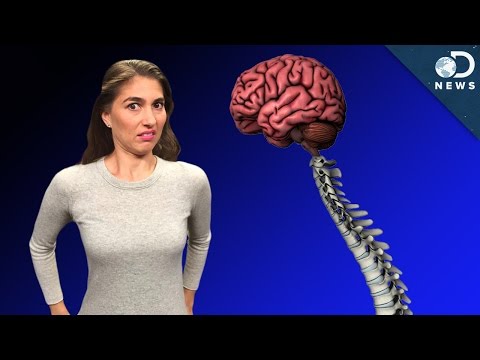
The spinal cord is an oft forgotten but important part of our central nervous system and is
frequently described as a collection of nerve fibers and cells that conduct information
from our bodies to our brain. But the thing is, it’s not just an information superhighway,
it is also responsible for processing some of that information before our brains get
the message.
Dont believe me? Ever rub your elbow after you bump it? It takes a little of the pain
away right? Thats because adding additional sensory information like “my elbow is being
rubbed” to the information about pain being processed by the spinal cord confuses the
“my elbow hurts” signal at a processing node. Because of this, less of the pain signal
gets through the gate to your brain, resulting in you experiencing less pain!
The cells in our spinal cord are also responsible for some of the reflexive corrections we make
unconsciously that keep us from falling over, and scientists at The Salk Institute think
that the set of neurons they recently discovered are part of that circuit.
One of the cool things about this newly identified set of neurons is that they are specific for
light touch, not touch in general and they connect both to the spinal cord *and* respond
to innervation from brain pathways descending from the cortex and the cerebellum. The scientists
propose that this set of cells may serve as an integrative node to generate posture adjustments
and corrective movements that counteract foot slippage.
They called this special set of neurons “ROR alpha” because scientists mostly suck at
naming things, and because those neurons express a specific identifying receptor called, coincidentally,
ROR alpha.
They compared mice deficient in RORa neurons to “normal” or “wild type” mice and
they found that deficient mice were were still able to walk and stand normally on flat ground
but were less sensitive to stimulations across their skin or to other sensations like sticky
tape on their feet.
Researchers saw the biggest difference when the mice were challenged to tasks requiring
fine motor control and skills like walking across an elevated beam. In head to head competition
on these types of tasks the RORa deficient mice struggled, and the wild type mice did
not. Researchers attributed this to the animals' reduced ability to sense when a foot was slipping
off the edge and respond accordingly with small adjustments in foot position and balance.
I think it would be so interesting to see if this newly discovered neurocircuitry is
stronger in dancers, athletes, or people in other professions where using your feet and
staying upright is harder than it sounds. But to answer that question, we’d need to
see some of these experiments repeated with humans, not mice, as the model organism.
For now, the next time you’re walking across a high-wire, balancing on a ledge, or trying
to look cool in your yoga class, take a second to appreciate all of the many subtle and reflexive
corrections your body is making to keep you upright, and give a little credit to your
spinal cord for all its hard work
We'd like to thank Squarespace for this episode of DNews.
Squarespace recently launched the latest version of their platform, Squarespace Seven, which
has a completely redesigned interface, integrations with Getty Images and Google Apps, new templates,
and an incredible feature called Cover Pages. Try the new Squarespace, at Squarespace.com/dnews,
and enter offer code DNews at checkout to get 10% off.
Squarespace. Start Here. Go Anywhere.
What do you think? How important is light touch to your sense of balance? Subscribe
to DNews and let us know in the comments down below. You can also come find me on Twitter:
@PolycrystalhD