en English
What Can We Learn By Drilling Into The Earth's Mantle English subtitles
Report a problem
Advertisement
English transcript
So, guys, I just learned that drilling into the earth can tell us about outer space. What
is going on here?!
Hi guys, Lissette here for DNews. Scientists are drilling into the earth. We all know the
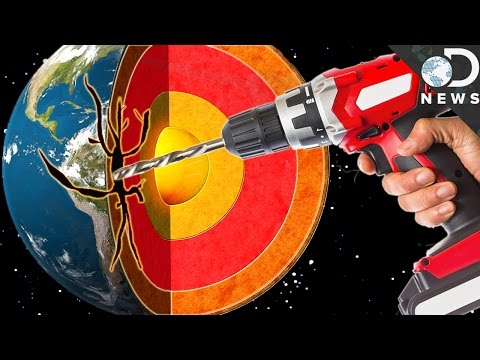
Earth is made of three major layers - the core, mantle, and crust, which is where we
all live. The crust floats on the mantle, a super-thick layer of mostly slowly moving
rock. We've been trying to reach the mantle since the 1960s, but despite numerous expeditions,
have still not dug past the crust. By all accounts, attempting to reach the mantle is
dangerous and expensive, so why are we trying so hard to get down there?
Because the mantle can tell us a lot about the history and formation of our planet in
the universe. The mantle makes up 84% of the Earth's volume and is incredibly hot with
temperatures that range from around 1000 degrees celsius close to the crust and about 4000
degrees celsius near the core. The weight of everything above it creates pressure that
builds up tremendously the closer we get to the core. The crust varies from 5 to 60 km
thick, with the thinnest layers found under the ocean. The farthest we’ve gotten was
in the 1980s in Russia's Kola peninsula, where they dug for 20 years and managed a 12 kilometer-deep
hole, which was probably not even halfway to the mantle. This and many expeditions have
failed because of technical difficulties like improper equipment and just plain bad luck
in choosing spots to drill. But this doesn’t mean scientists have given up.
More recently, a team of scientists from the International Ocean Discovery Program (IODP)
drilled into the ocean crust and were able to retrieve rocks that showed signs of life
. We're not talking about mole people or green big eyed kind of life, but microbial life.
The rocks contained methane and hydrogen, which as one of the researchers stated “microbes
can ‘eat’ to grow and form new cells”. This is huge! Similar rocks, gases, and conditions
are found in other planets. So, according to the researchers, these rock specimens can
aid our search and understanding of how extraterrestrial life may exist in similar inhospitable conditions
in the depths of the universe.
But reaching the mantle doesn't just teach us about space, it also teaches us about earth.
The mantle's activity is largely responsible for the movement of tectonic plates, which
scientists theorize influences volcanic activity, earthquakes, mountain ranges, and movement
in the oceans. So understanding the mantle more can help us better understand the earth’s
current topography and it’s history - Including how our continents shifted throughout the
ages and are shifting today. If we can drill down to the mantle, researchers could have
this type of information straight from the source, increasing the accuracy.
Right now we can only make inferences about the structure of the earth based on how fast
an earthquake's’ seismic waves, travel through the planet and the routes they take, what
we can see on the crust, and the composition of rock samples. It wasn’t too long ago
that by chance a volcano ejected a diamond from the mantle that confirmed that there
is an ocean’s worth of water in the mantle’s transition zone! Scientists learned this because
it contained ringwoodite, with a certain amount of water in it. This tiny rock made a huge
difference. And look, these rocks are great, but they are inconsistent - we don’t know
when the next mantle rock will be spewed out of which volcano or if it will be intact enough
for scientists to derive meaningful conclusions. We got lucky with this diamond, but often
these rocks are too damaged. Most have been belched out from volcanoes, ejected by tectonic
plate crashes, or carried upward to the ocean floor. These treacherous and often erratic
journeys leave scars on them, and leave scientists with messy data. It’s hard to know what
characteristics were a result of the journey vs reflective of the mantle itself.
So drilling down to the mantle could mean that we would finally be able to get pristine
samples of the mantle, and even an entryway for further exploration. It could give us
a clear look at the mantle’s composition, how it’s moving, and more accurate readings
of its velocity, pressure, and temperature. In essence, what the earth and possibly the
universe is made of.
But the drilling we most often hear of is tied to oil. To learn where oil comes from,
check out this video over on TestTube News.